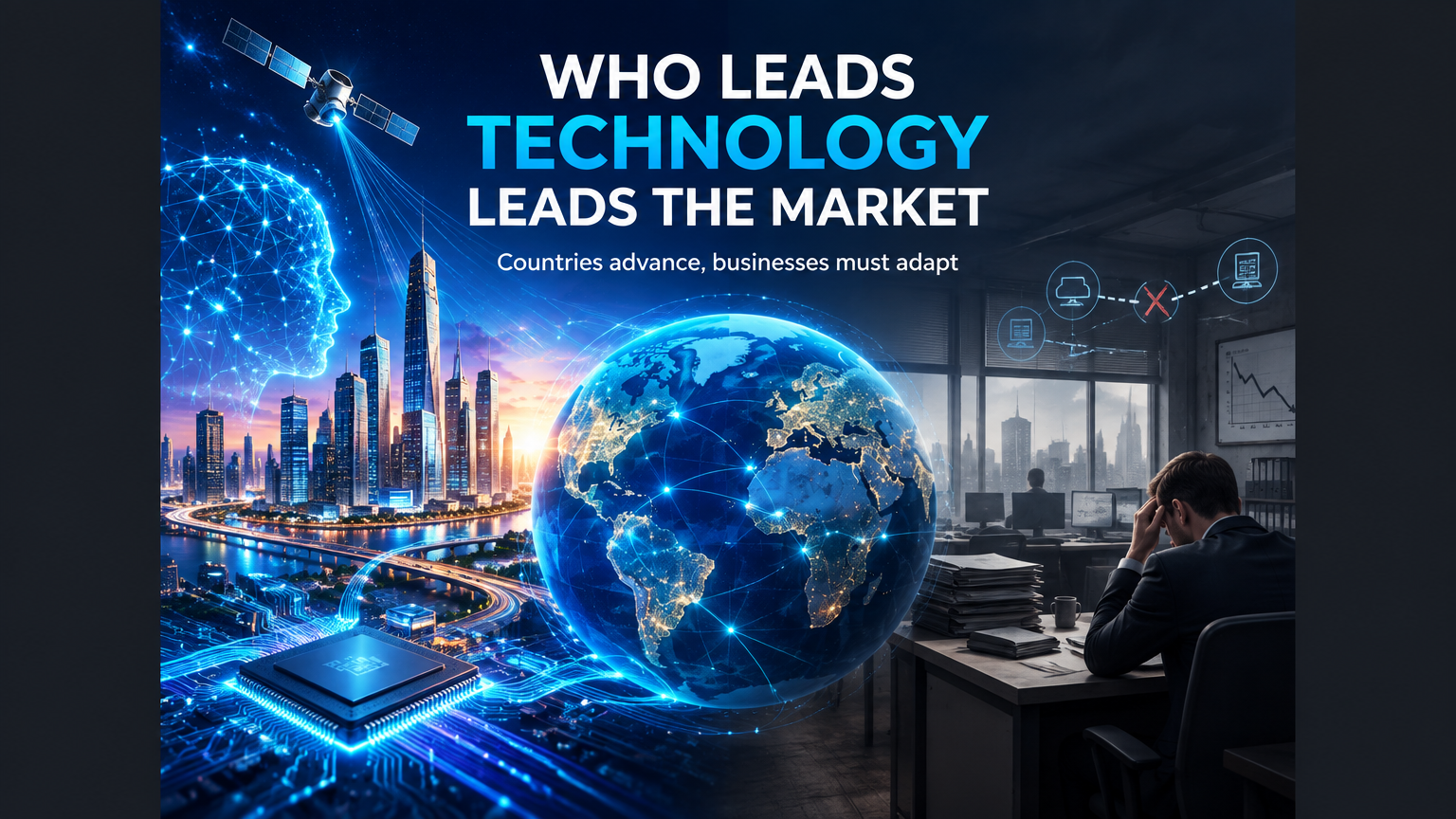
/While some companies are still discussing whether they should create a website, automate tasks or start using artificial intelligence, entire countries are investing billions in innovation, semiconductors, robotics, quantum computing, energy and digital systems.
This difference may seem distant from the reality of a small or medium-sized business.
It is not.
When a country advances technologically, its companies gain better tools, faster processes, more prepared professionals and access to more competitive markets.
When a business remains stagnant, it begins to lose ground even if it still sells good products.
Technology is not only changing the most advanced countries. It is changing the rules of competition in every market.
Which countries are the most technologically advanced?
There is no single definitive list of the most technologically advanced countries.
One country may lead in artificial intelligence but lag in digital infrastructure. Another may be a research powerhouse but have a smaller market. Others may stand out in semiconductors, robotics, quantum computing or business digitalization.
That is why it is more useful to compare several indicators.
The 2025 Global Innovation Index, published by the World Intellectual Property Organization, placed the following countries among the global leaders:
- Switzerland;
- Sweden;
- the United States;
- South Korea;
- Singapore;
- the United Kingdom;
- Finland;
- the Netherlands;
- Denmark;
- China.
The 2025 IMD World Digital Competitiveness Ranking placed Switzerland, the United States and Singapore among the economies best prepared to adopt and explore digital technologies.
These rankings reveal an important point:
technology leadership does not depend on one company or one product. It depends on an entire ecosystem.
Switzerland leads through more than famous products
Switzerland appears at the top of innovation and digital competitiveness rankings because it combines several strengths:
- strong universities;
- research investment;
- a stable business environment;
- intellectual property protection;
- reliable infrastructure;
- skilled professionals;
- the ability to transform knowledge into businesses.
This is an important lesson for any company.
Innovation does not only mean creating something entirely new. It also means improving processes, testing new models, understanding data and turning knowledge into results.
A small company may not have the budget of a multinational, but it can apply the same principle at a smaller scale.
It can use data to make decisions, automate tasks and create a better customer experience.
The United States leads in artificial intelligence and frontier technology
The United States remains one of the world’s leading technology powers.
The country concentrates major artificial intelligence companies, cloud providers, chip developers, robotics companies, biotechnology firms and cybersecurity organizations.
Beyond the companies themselves, there is a powerful combination of:
- universities;
- venture capital;
- research centers;
- startups;
- major laboratories;
- consumer markets;
- computing infrastructure;
- the ability to attract professionals from around the world.
This ecosystem allows new technologies to be developed, financed and commercialized quickly.
For businesses, this means that American companies can test new solutions at scale, reach global customers and turn innovation into competitive advantage.
South Korea combines semiconductors, connectivity and advanced industry
South Korea is a global force in areas such as:
- semiconductors;
- displays;
- telecommunications;
- electronics;
- robotics;
- automobiles;
- artificial intelligence;
- advanced manufacturing.
The country built an economy highly connected to technology and invested heavily in education, infrastructure and research.
South Korea demonstrates that technology is not only about software.
The ability to manufacture components, sensors, batteries, chips and equipment also determines who will hold power in the digital economy.
Companies in other countries may build excellent applications, but they may still depend on foreign suppliers for essential components.
Singapore shows that size does not determine digital power
Singapore is an interesting example because it does not have the same territory or population as the United States, China or India.
Even so, it has become a reference in:
- digital infrastructure;
- public services;
- cybersecurity;
- innovation;
- logistics;
- education;
- international business attraction;
- data use.
The country shows that size alone does not determine technological capacity.
A clear strategy, efficient institutions and continuous investment can turn a small territory into a global business and innovation hub.
For companies, the lesson is direct:
you do not need to be large to be technologically competitive. You need to build an intelligent structure.
China is advancing through scale and speed
China entered the top ten of the 2025 Global Innovation Index for the first time.
The country also has enormous industrial capacity and major investments in artificial intelligence, energy, robotics, electric vehicles, telecommunications and digital commerce.
China’s main advantage is the combination of:
- production scale;
- a large domestic market;
- public investment;
- private companies;
- infrastructure;
- implementation speed;
- the ability to reduce costs.
China has also advanced in strategic technologies such as electric vehicles, batteries, drones and artificial intelligence models.
For companies in other countries, this speed increases competitive pressure.
A product that seems innovative today can be copied, improved and manufactured at scale very quickly.
Japan and Germany remain highly relevant
Japan and Germany continue to hold important positions in strategic industries.
Japan has a strong tradition in:
- robotics;
- industrial automation;
- electronics;
- engineering;
- vehicles;
- scientific research;
- precision manufacturing.
Germany remains a major power in:
- industry;
- engineering;
- automobiles;
- machinery;
- chemicals;
- automation;
- advanced manufacturing.
These countries demonstrate that technology is not limited to apps, social networks or generative AI.
Traditional industries can also be highly technological when they use data, sensors, robotics, control systems and automated processes.
India is advancing quickly
India does not rank first in every technology indicator, but it has demonstrated significant growth in:
- information technology;
- software development;
- digital services;
- electronic payments;
- startups;
- artificial intelligence;
- professional training.
The country also has a large young population and a significant domestic market.
Indian companies have gained global space by providing software, technical support, digital services and enterprise solutions.
This progress shows that countries that invest in education and professional training can move quickly in the technology economy.
What happens to countries that fall behind?
When a country does not keep pace with technological transformation, the consequences appear across different areas.
Lower productivity
Companies using manual processes produce less, take longer and make more mistakes.
Foreign dependence
The country has to import essential technology, equipment, services and systems.
Loss of skilled workers
Talented professionals may seek opportunities in more advanced markets.
Lower competitiveness
Local companies face competitors that are more efficient, faster and better prepared.
Difficulty attracting investment
Investors look for infrastructure, professionals and environments capable of supporting technology businesses.
Greater inequality
The best-prepared companies advance while less-prepared companies lose ground.
The World Bank estimates that more than 2 billion people were still offline in 2025. Internet usage also remains highly unequal between high-income and low-income countries.
This shows that the technology gap is not only a difference between companies. It is also a difference between societies.
A country does not need to lead to start improving
There is a common mistake in this debate.
Some people think that in order to compete technologically, a country must create the next major artificial intelligence system or manufacture the world’s most advanced chips.
That is not necessary.
A country can start by using existing technologies more effectively.
It can digitize public services, improve education, support small businesses, build startups, expand connectivity and train professionals.
The same is true for a business.
It does not need to invent a revolutionary technology to begin improving.
It can organize customer data, improve support, create a professional website, automate repetitive tasks and use artificial intelligence tools.
Businesses are falling behind because of a lack of preparation
Competition between countries reveals a reality that also appears inside individual markets.
Many companies do not lose customers because their products are poor.
They lose because they:
- respond too slowly;
- do not track data;
- rely on manual processes;
- do not appear on Google;
- lack a professional digital presence;
- do not automate routine work;
- do not understand their customers;
- fail to update their digital channels;
- ignore new technologies;
- depend only on referrals.
Meanwhile, better-prepared competitors can:
- respond more quickly;
- create better campaigns;
- identify opportunities;
- reduce costs;
- personalize offers;
- automate routines;
- analyze results;
- make better decisions.
The difference may begin small, but it grows over time.
The compounding effect of technology
Imagine two companies that begin with similar revenue.
The first automates customer service, tracks key indicators and improves its digital presence.
The second continues using disorganized spreadsheets, responds to customers manually and makes decisions based on assumptions.
During the first month, the difference may be barely noticeable.
After one year, the first company may have:
- more information;
- greater efficiency;
- more customers;
- greater investment capacity;
- better processes;
- stronger market knowledge.
The second may have accumulated delays, errors and lost opportunities.
This is the compounding effect of technology.
Small improvements repeated every day can create a major advantage over time.
Technology does not replace strategy
Buying tools does not automatically transform a business.
A company can purchase expensive systems and remain disorganized.
It can have artificial intelligence but not know which problems need to be solved.
It can invest in advertising without measuring results.
It can own management software without using data to make decisions.
Technology works best when connected to a clear strategy.
Before choosing a tool, a company should ask:
- What problem needs to be solved?
- How much time is currently being lost?
- Which process generates the most errors?
- Where are the growth opportunities?
- What data is already available?
- What result will be measured?
- Who will be responsible for implementation?
Technology should serve the business, not the other way around.
Artificial intelligence will widen the gap between prepared and unprepared companies
AI can lower the cost of entering certain markets, but it can also increase the distance between prepared and unprepared businesses.
A company using AI to analyze data, create content, answer customers and automate operations can produce much more with the same team.
A company that ignores these tools may become slower and more expensive.
This does not mean artificial intelligence will replace everyone.
It means professionals who know how to use it may work more effectively than those who have not developed that ability.
The difference will be visible in areas such as:
- marketing;
- customer service;
- sales;
- programming;
- management;
- financial analysis;
- logistics;
- human resources;
- content production.
How can a business start catching up?
The first step is a simple diagnosis.
Look at the activities that repeat every day.
Ask:
- Which tasks consume the most time?
- Where do customers wait too long?
- Which information is scattered?
- Which reports are produced manually?
- Where do the most errors occur?
- Which channel generates the most opportunities?
- What could work without constant human intervention?
Then choose one small process to improve.
It could be:
- lead capture;
- initial response;
- contact organization;
- report generation;
- proposal follow-up;
- data updates;
- content publishing;
- campaign analysis.
Rapid Genius provides website development, digital marketing, data science and AI-powered automation, solutions that can help businesses turn operational problems into more efficient processes.
The advantage belongs to those who learn faster
The most technologically advanced countries did not reach the top because of one invention alone.
They built systems capable of:
- learning;
- investing;
- testing;
- correcting;
- training professionals;
- supporting companies;
- transforming research into products;
- adapting to change.
Businesses need to do the same.
A competitor that learns faster can overtake a larger, older company with more resources.
The speed of learning has become a competitive advantage.
Conclusion: those who stop will fall further behind
Countries that lead in technology combine research, education, infrastructure, capital, prepared companies and the ability to adapt.
Switzerland, Sweden, the United States, South Korea and Singapore rank among the global leaders in innovation and digital competitiveness. China, India and other countries are also advancing and narrowing the gap.
The result is an economy increasingly divided between those that master technology and those that depend on it.
The same thing happens to businesses.
Companies that invest in data, automation, digital presence and artificial intelligence can work with greater speed and precision.
Companies that ignore the transformation may lose customers even when they offer good products.
The most important question is not:
“Is technology advancing too quickly?”
It is:
“Are my country, my company and my team learning quickly enough?”
Competition does not wait for everyone to be ready.
It moves forward.
The most technological countries are already building the next market. The best-prepared companies are already taking their position.
Those that start now can still recover ground.
Those that keep postponing may discover, too late, that they did not lose only an opportunity.
They lost the market.