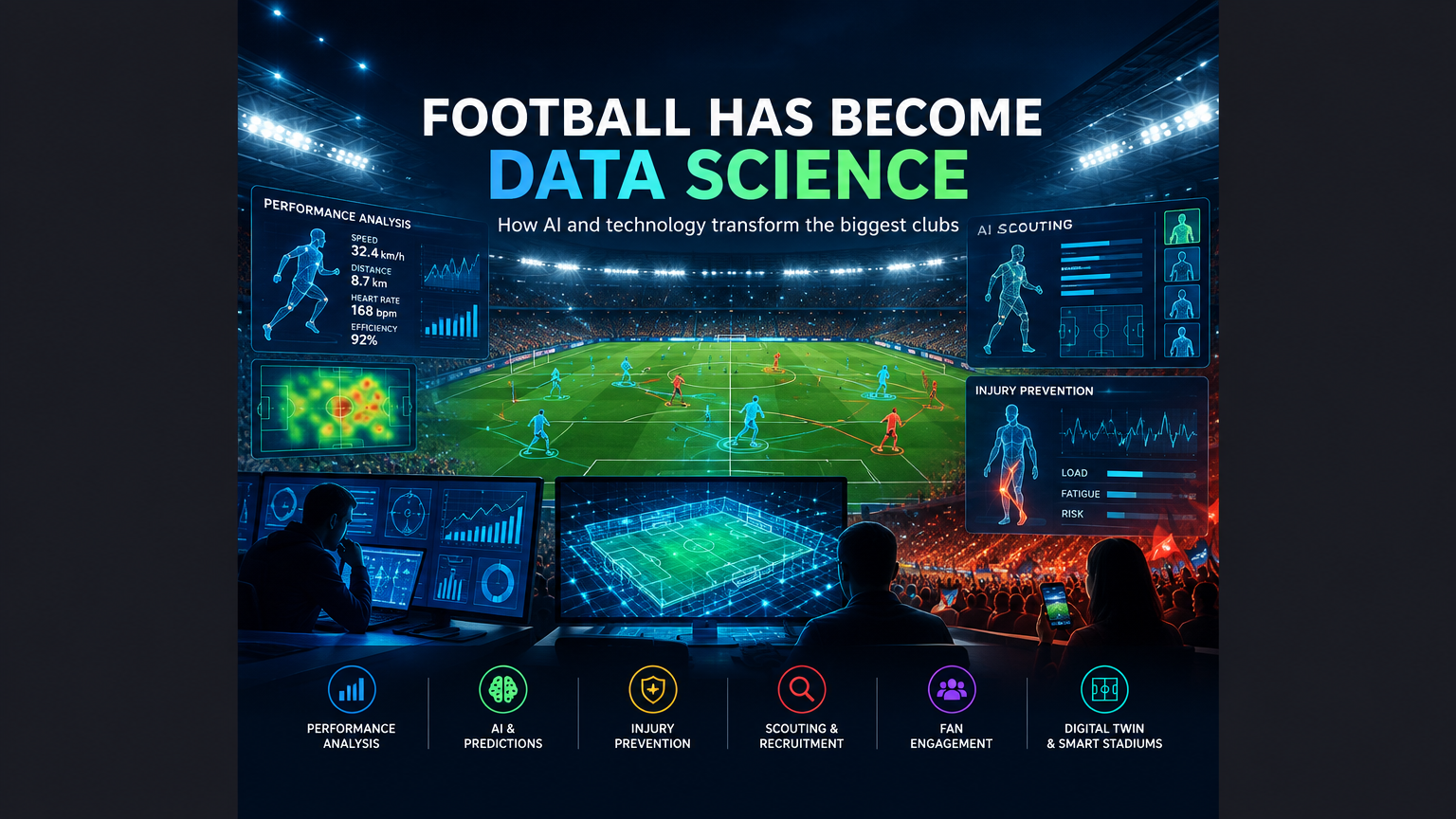
Modern football is no longer decided only on the pitch.
Every pass, run, tackle and shot generates data. Every training session produces information about physical load, injury risk and performance. Every connected fan generates records about engagement, consumption and preferences.
The biggest clubs understood this before almost every other industry.
Real Madrid, Barcelona, Manchester United and Flamengo invest in data science, artificial intelligence, video analysis, sensors and digital platforms to turn information into competitive advantage.
The result is a quiet but profound transformation:
professional football has become a data industry.
And what is happening on the pitch today anticipates what will happen in companies across every sector tomorrow.
The scale of data in modern football
The revolution began with the volume of information.
According to the Barça Innovation Hub, each match at the 2026 World Cup generates more than 150 million data points, and the official ball transmits information 500 times per second.
These numbers show the size of the transformation.
The infrastructure behind it combines three layers:
Optical tracking
Cameras track dozens of points on each player’s body dozens of times per second, recording position, speed and movement.
Sensors and devices
Wearable equipment and the ball itself capture physical data during training and matches.
Artificial intelligence
AI models interpret millions of events and turn raw data into patterns, classifications and recommendations.
No human analyst could process this volume manually.
That is why clubs had to hire data scientists, software engineers and performance analysts.
Real Madrid: technology for a global audience
Real Madrid is one of the most valuable clubs in the world, and its technology strategy goes beyond the field.
The club works with technology partners to personalize content and scale its communication with an audience estimated at more than 660 million people.
This operation involves:
- large-scale content production;
- personalization for different audiences;
- global digital platforms;
- engagement analysis;
- digital fan experience.
The lesson is clear: a football club is also a media and technology company.
The larger the fan base, the greater the need for systems capable of organizing, analyzing and distributing content efficiently.
Barcelona: innovation as part of the identity
Barcelona created the Barça Innovation Hub, a space dedicated to research, innovation and technology applied to sport.
The initiative publishes analyses about data science in football, follows artificial intelligence trends and connects the club to startups, researchers and technology companies.
The club also invests in performance analysis, data-driven scouting and metrics-based physical preparation.
Barcelona’s strategy shows that innovation can become part of a sports brand’s identity.
It is not only about winning matches. It is about building an ecosystem that attracts talent, commercial partners and new revenue streams.
Manchester United: AI applied to performance
Manchester United announced an expanded use of artificial intelligence to improve team performance, in collaboration with technology partners connected to the University of Manchester.
The approach involves analyzing large volumes of data to support technical, physical and medical decisions.
Applications include:
- player performance analysis;
- physical load monitoring;
- injury prevention;
- recovery assessment;
- tactical preparation support.
Manchester United’s case is interesting because it shows a traditional club seeking to regain competitiveness through data.
History and brand remain powerful assets. But on the pitch, the difference between winning and losing may lie in the quality of analysis.
Flamengo: technology in Brazilian football
Flamengo is one of the most relevant examples in Latin America.
The club invests in data analysis infrastructure, physical monitoring, player evaluation and digital platforms to connect with supporters.
Brazilian football has unique characteristics:
- an intense calendar;
- a high volume of matches;
- logistical challenges;
- a dynamic transfer market;
- an enormous fan base.
In this context, data and technology help answer practical questions:
- Which player is close to their physical limit?
- Which athlete has a higher injury risk?
- Which young talents deserve an opportunity?
- How can squad rotation be optimized?
- How can millions of fans be engaged efficiently?
Flamengo demonstrates that clubs outside Europe can also compete technologically when they invest in structure and qualified professionals.
LaLiga created an AI observatory for football
The transformation is not happening only inside clubs.
LaLiga launched Tech Powerhouse 2026, an annual observatory dedicated to technology and artificial intelligence applied to football.
The report identifies trends such as:
- agentic AI;
- technological sovereignty;
- digital twins;
- smart stadiums;
- hyper-personalization.
These trends show where the sector is heading.
Agentic AI involves systems capable of performing tasks autonomously. Digital twins create virtual representations of players, training sessions or physical structures. Smart stadiums use sensors and data to improve the fan experience.
When an entire league creates an observatory on the subject, it becomes clear that technology is no longer optional.
How AI is changing the work of clubs
Artificial intelligence is present in almost every area of a modern club.
Performance analysis
AI models process match events and identify tactical patterns, strengths and weaknesses.
Injury prevention
Systems analyze training load, medical history, movement patterns and physical indicators to estimate injury risk before problems occur.
Scouting and recruitment
Data platforms evaluate thousands of players, comparing performance, age, appreciation potential and tactical fit.
Tactical preparation
Analysts use data to study opponents, simulate scenarios and prepare strategies for each match.
Fan experience
AI personalizes content, recommends products, answers questions and creates individualized digital experiences.
Commercial management
Data helps price tickets, products, image rights and sponsorships based on real fan behavior.
The transfer market has become a data equation
European football moved more than 8 billion euros in transfers during the 2024-25 season.
In that environment, evaluating a player correctly can be worth tens of millions.
Analysis platforms use statistical and machine learning models to estimate:
- expected performance;
- development potential;
- injury risk;
- tactical fit;
- market value;
- probability of adapting to new leagues.
Clubs that use data consistently tend to make fewer expensive mistakes.
This does not eliminate the role of traditional scouts. Human observation remains essential for evaluating personality, leadership and adaptation.
The difference is that the final decision now combines human perception and quantitative evidence.
An avoided injury is worth millions
A serious injury can keep an important player off the pitch for months.
The losses involve:
- salary paid without sporting return;
- reduced team performance;
- depreciation of the athlete;
- medical and rehabilitation costs;
- impact on results and revenue.
That is why injury prevention has become one of the most valuable applications of data science in football.
Modern systems cross-reference GPS data, sensors, medical exams, training history and weekly loads to identify warning signs.
When the system indicates high risk, the technical staff can adjust training load, change the lineup or schedule preventive recovery.
This type of data-driven decision can protect assets worth tens of millions.
The fan experience is technological too
Clubs do not use technology only to improve the team.
They also use it to transform the relationship with fans.
Recent examples include:
- multilingual AI assistants in digital stores;
- kit designs created with AI tools;
- personalized content for each fan;
- apps with real-time statistics;
- connected stadiums;
- immersive and augmented reality experiences.
The modern fan expects more than watching a match.
They want to interact, consume content, buy products and participate in a digital community.
Clubs that understand this change turn fans into recurring customers.
What can businesses learn from football?
Here is the most interesting point for readers of this blog.
Football clubs face exactly the same challenges as any company:
- deciding with limited information;
- managing expensive resources;
- predicting risk;
- understanding their audience;
- optimizing processes;
- competing with better-structured rivals.
The solutions they adopt can be adapted to businesses of any size.
Data-driven decisions
The club does not pick a lineup based only on intuition. It combines performance, physical condition and history.
A business can do the same when analyzing sales, campaigns, customers and processes.
Prevention instead of correction
Preventing an injury costs less than losing a player for months.
In business, preventing a system failure or a process error is also cheaper than fixing it afterward.
Deep audience knowledge
The club studies its fans to personalize content and offers.
A business can study its customers to improve products, communication and experience.
Intelligent use of automation
Repetitive tasks are delegated to systems, freeing specialists for strategic decisions.
In business, automation can free the team to focus on what truly generates value.
Continuous investment
No elite club buys a technology and abandons the project. They iterate, measure and improve.
A business needs the same commitment.
Rapid Genius works with data science, AI-powered automation and digital solutions, areas that follow the same logic applied by major clubs: turning information into decisions.
Where do ordinary companies still go wrong?
Many organizations look at football and think:
“That is possible because they have so much money.”
The observation is partly correct, but it hides a common mistake.
The problem for most companies is not the lack of expensive tools.
It is the lack of organization of the data they already have.
A company may have:
- scattered spreadsheets;
- information buried in emails;
- records in notebooks;
- outdated customer data;
- manual reports;
- decisions based on memory.
No advanced tool solves that scenario alone.
The first step is organizing information.
Then comes automation.
Then comes analysis.
Then comes artificial intelligence.
It is the same sequence used by elite clubs.
The difference between collecting data and using data
Owning information does not create advantage.
Generating value requires turning data into decisions.
A club can have millions of data points and keep losing matches if nobody knows how to interpret them.
A company can have complete reports and keep making wrong decisions if the data is not connected to the business.
The right question is not:
“How much data do we have?”
It is:
“Which decisions can we improve with the data we already have?”
That shift in perspective separates organizations that merely accumulate information from those that truly learn from it.
The future of football will be increasingly digital
The trends identified by LaLiga indicate that the transformation is just beginning.
In the coming years, we are likely to see:
- more AI agents supporting technical staff;
- digital twins of players and training sessions;
- fully connected stadium experiences;
- extreme personalization for fans;
- more accurate predictive models;
- integration between health, performance and data;
- new ways to monetize fan passion.
Football will remain emotion, talent and improvisation.
But behind that emotion there will be an increasingly sophisticated technological structure.
Conclusion: talent remains decisive, but data amplifies talent
Real Madrid, Barcelona, Manchester United and Flamengo show that modern major clubs are technology organizations.
They combine history, passion and brand with data science, artificial intelligence and digital platforms.
The pitch is still decided by players. But the decisions that build a winning team increasingly pass through analysis, prevention and data-driven strategy.
For businesses, the lesson is direct:
technology does not replace talent. It expands its reach.
A team with good players and good data competes better than a team with only good players.
A company with good professionals and good technology grows faster than a company with only good professionals.
The question that remains is:
How many important decisions in your company still depend on guesswork when they could depend on data?
The biggest clubs have already answered that question.
And the companies that learn the same lesson will compete at another level.