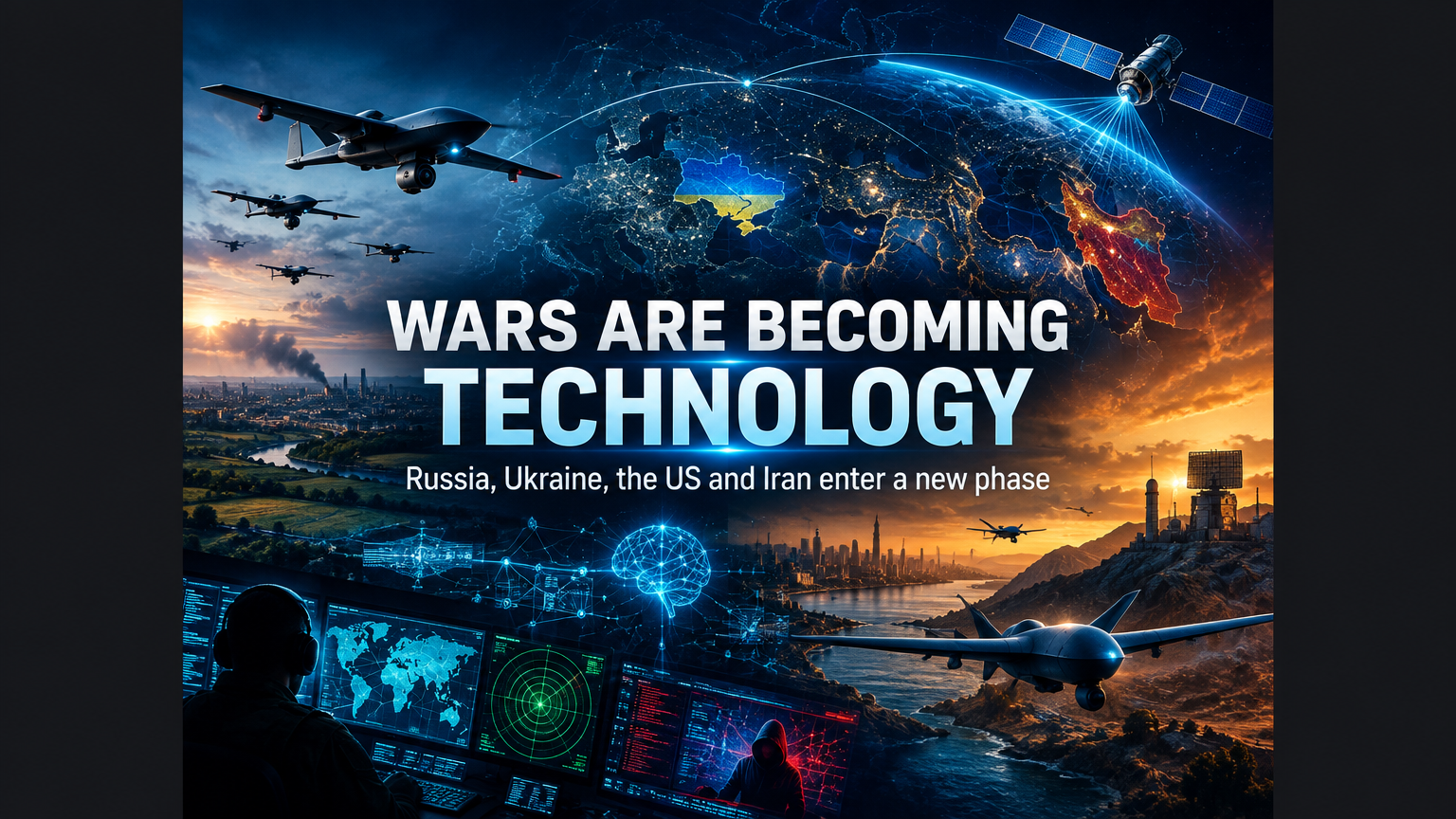
Modern wars are no longer fought only with soldiers, tanks, missiles and aircraft.
Increasingly, conflicts depend on autonomous drones, artificial intelligence, cyberattacks, satellites, surveillance systems, electronic warfare and algorithms capable of making decisions within seconds.
As the world follows the Russia-Ukraine war and the escalating conflict between the United States and Iran, a silent transformation is taking place:
technology is no longer just a support tool. It is becoming the center of modern warfare.
As of September 23, 2026, the Russia-Ukraine war remains marked by attacks against energy, logistics and transport infrastructure, while diplomatic efforts continue to focus on reducing damage to energy systems.
In the Middle East, the United States and Iran remain involved in a conflict with military, economic, cyber and strategic consequences. Discussions involving the Strait of Hormuz show how a maritime route can become a global issue involving energy and security.
The unavoidable question is:
Are we entering the age of automated warfare?
The answer is still uncertain, but the signs are becoming increasingly clear.
Artificial intelligence is already being used to:
- analyze satellite images;
- identify movements;
- locate targets;
- predict routes;
- coordinate drones;
- detect threats;
- disrupt communications;
- protect networks;
- produce disinformation;
- automate logistical decisions.
In some cases, the machine does not merely present information to a human operator. It can also suggest or execute actions faster than any human team could.
This changes the nature of conflict.
When an operation depends on decisions made within minutes or seconds, the advantage may belong to the side with better sensors, processing systems and reaction capabilities.
Russia and Ukraine: a war increasingly shaped by technology
The Russia-Ukraine war remains one of the world’s most important laboratories for military innovation.
Both sides use drones for reconnaissance, attacks, surveillance and damage assessment.
These systems can be relatively inexpensive, quickly adapted and produced in large quantities. This allows new versions to be tested on the battlefield much faster than traditional military equipment.
The war also involves:
- fiber-optic drones;
- electronic warfare systems;
- attacks on substations;
- satellite image analysis;
- communication networks;
- air-defense systems;
- long-range strikes;
- artificial intelligence for navigation.
International reports indicate that Russia has used small drones connected through fiber-optic cables to reduce the impact of Ukrainian electronic warfare systems.
This strategy shows how electronic warfare directly influences equipment development.
When a defense system can block radio signals, attackers search for technical alternatives.
The result is a continuous competition between attack, defense and adaptation.
Autonomous drones could change the battlefield
A traditional drone requires a remote operator to control its movements.
A more advanced drone can follow a programmed route, detect obstacles and return automatically.
The next stage involves systems capable of interpreting the environment and making decisions during a mission.
This evolution creates important concerns.
An autonomous drone may:
- identify an object;
- classify a threat;
- choose a route;
- avoid obstacles;
- change its trajectory;
- operate despite communication loss;
- continue a mission without constant human intervention.
Technology may increase military efficiency, but it also creates a difficult question:
Who is responsible when a machine decides to act on its own?
There is still no universal answer.
Ukraine is discussing a possible energy truce
Recent reports indicate that the Ukrainian government is willing to discuss a truce related to attacks against energy infrastructure.
The proposal comes at a time of concern about the winter and the consequences of attacks on essential systems.
Power plants, substations, fuel depots and distribution networks have strategic value because they directly affect the ability of cities and industries to function.
A prolonged disruption can affect:
- heating;
- transportation;
- hospitals;
- water supply;
- communications;
- industrial production;
- business operations.
Even when there is no broad peace agreement, a pause in attacks against energy infrastructure could reduce the impact on civilians.
However, any agreement depends on trust, verification and the ability to monitor violations.
This is where satellites, sensors and data analysis can play an important role.
The United States and Iran: a conflict with global consequences
The conflict between the United States and Iran has an even broader dimension because it involves one of the world’s most important maritime routes.
The Strait of Hormuz is a strategic passage for oil and gas transportation. Any disruption could raise energy prices, affect supply chains and create consequences in countries not directly involved in the conflict.
Recent reports indicate that Iranian officials have signaled the possibility of reopening the strait within days if certain conditions are met, including reduced U.S. military pressure and an end to the blockade.
At the same time, officials from both countries have participated in diplomatic discussions during the United Nations General Assembly.
These talks do not represent a final agreement. They also do not eliminate the risk of further attacks.
The situation remains unstable.
The Strait of Hormuz has become a technology issue
Managing and monitoring a maritime passage such as the Strait of Hormuz requires much more than warships.
The region also depends on:
- tracking systems;
- satellites;
- maritime sensors;
- radar;
- drones;
- signals intelligence;
- communications networks;
- infrastructure protection;
- traffic analysis;
- cybersecurity.
Commercial ships may be monitored through digital systems, but those systems can also be disrupted, manipulated or attacked.
Technology makes it possible to track routes and identify suspicious behavior, but it also creates new vulnerabilities.
A cyberattack against a shipping company could disrupt operations even if no ship is physically hit.
Physical and cyberattacks can happen together
Officials from the United Arab Emirates said that missile and drone attacks connected to the conflict with Iran were accompanied by cyberattacks against the same targets.
This combination is one of the most concerning features of modern warfare.
Imagine an operation against a strategic facility:
- A drone conducts reconnaissance.
- A cyberattack attempts to disrupt monitoring systems.
- Communications are impaired.
- A missile or another weapon strikes the facility.
- A second digital attack delays recovery.
This type of coordinated operation can amplify the impact of a conventional attack.
That is why cybersecurity is no longer an issue limited to technology companies. It is now part of the defense of hospitals, airports, ports, power networks and supply chains.
Companies that work with automation, data science and digital solutions need to consider this new risk environment when designing connected systems.
Technology is also changing wartime propaganda
The battle for information is another central element.
Videos, images and messages can be created and distributed within minutes.
Artificial intelligence can:
- generate fake images;
- edit videos;
- create synthetic voices;
- imitate people;
- translate messages;
- distribute narratives;
- produce content in multiple languages;
- identify vulnerable audiences.
During a conflict, the public must distinguish between:
- official information;
- propaganda;
- manipulated content;
- old images;
- out-of-context videos;
- false reports;
- AI-generated material.
That task is becoming more difficult because artificial systems can produce a convincing appearance of authenticity.
The technology that helps journalists and analysts verify content can also be used to create new forms of manipulation.
The role of satellites and data
Commercial satellites have transformed the ability to monitor wars.
Images can show:
- troop movements;
- construction of facilities;
- runway changes;
- building damage;
- vehicle movements;
- fires;
- port activity;
- infrastructure disruptions.
This data can be analyzed by specialists, governments, companies and independent organizations.
Artificial intelligence can accelerate this work by identifying changes across large volumes of imagery.
Instead of relying only on human analysts, an organization can use systems that compare images from different days and highlight relevant changes.
This increases analytical speed, but it also requires caution.
An algorithm may misinterpret shadows, vehicles or construction work. Important decisions therefore still require human validation.
The future of war will depend on data
Modern military technology runs on data.
Data about:
- location;
- weather;
- routes;
- communications;
- energy;
- supplies;
- movement;
- industrial capacity;
- system behavior;
- equipment availability.
The side that can collect, process and use this data faster may gain a significant advantage.
This logic is similar to what companies use to understand customers, forecast demand and optimize operations.
The difference is the impact.
In a company, a wrong decision may cause a financial loss.
In a conflict, a wrong decision can cause destruction, deaths and international escalation.
Technology warfare also creates risks for ordinary companies
Many organizations believe they will not be affected because they do not work directly with defense or geopolitics.
That assumption can be dangerous.
Companies can be affected by:
- attacks on suppliers;
- cloud service disruptions;
- failures in financial systems;
- attacks against transport companies;
- blocked routes;
- higher energy costs;
- data theft;
- disinformation campaigns;
- system shutdowns;
- attacks against shared infrastructure.
A small company may be connected to customers, banks, transport providers and international suppliers.
If one of those links is attacked, the impact may reach the company as well.
That is why investing in secure websites, reliable apps and properly structured digital processes is no longer only a technical decision. It is a way to protect business continuity.
What do these wars teach us about technology?
The main lesson is that technology is not neutral.
The same tool can be used to:
- protect civilians;
- deliver medicine;
- locate people;
- reduce risk;
- automate rescue operations;
- monitor disasters;
- attack infrastructure;
- spread fear;
- manipulate information.
The result depends on objectives, rules and the people controlling the system.
This discussion also applies to business.
Automation can reduce errors, save time and increase productivity. However, if it is deployed without security, it can create failures at scale.
Artificial intelligence can improve decisions, but it can also amplify bias or errors when trained on unsuitable data.
Connected systems can simplify operations, but they also create potential entry points for attacks.
We are entering an era of hybrid conflicts
Modern wars combine several dimensions:
- military;
- digital;
- economic;
- energy;
- information;
- logistics;
- space;
- technology.
A country may try to pressure an adversary without launching a ground offensive.
It may attack energy systems, disrupt communications, manipulate markets, damage logistics or influence the population.
This model is known as hybrid conflict.
It makes it harder to determine when a war truly began and when it has ended.
It also complicates international responses because not every digital attack is immediately recognized as a military action.
Can artificial intelligence reduce or increase risk?
This is one of the major contradictions of technology.
Artificial intelligence can help:
- detect attacks before they occur;
- protect networks;
- identify threats;
- predict damage;
- coordinate evacuations;
- locate survivors;
- reduce human error;
- optimize resources.
At the same time, it can be used to:
- create faster attacks;
- automate drones;
- produce disinformation;
- find vulnerabilities;
- manipulate systems;
- expand espionage operations;
- coordinate digital campaigns.
The same technology can strengthen defense or increase offensive capabilities.
That is why rules, supervision and accountability will be essential.
Conclusion: the future of war is already being programmed
The latest developments involving Russia and Ukraine and the United States and Iran show that modern conflicts are increasingly connected to technology.
Drones, satellites, artificial intelligence, cyberattacks, electronic warfare and autonomous systems are changing how countries fight, protect themselves and negotiate.
In Ukraine, the war continues to involve attacks against energy, logistics and infrastructure, while increasingly sophisticated drones enter the battlefield.
In the conflict between the United States and Iran, the Strait of Hormuz, cyberattacks and energy infrastructure turn a regional dispute into a global issue.
The most important question is not simply:
“Who has more weapons?”
It is:
“Who can transform data, technology and information into faster decisions?”
That will be one of the defining competitions of the coming decades.
Technology will not remain limited to governments.
Companies will also need to protect networks, data, suppliers and internal processes in a world where military and digital conflicts can occur at the same time.
The future of war is already being developed in laboratories, data centers, satellites and lines of code.
The central question is whether humanity will control this technology before it begins to control the pace of conflict.