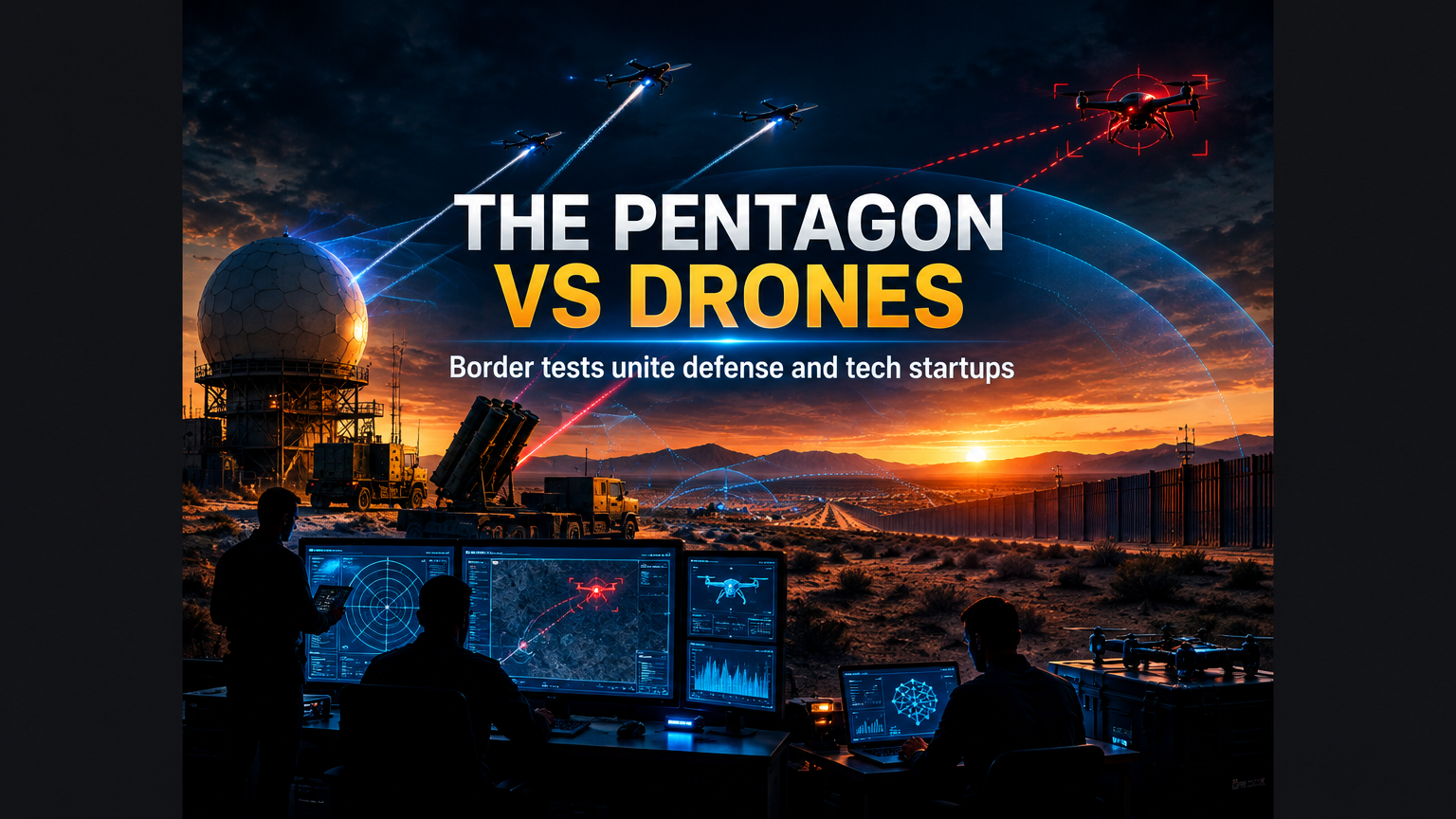
A new threat is forcing the US military to change how it defends itself.
It is not tanks, missiles or aircraft. It is cheap drones, bought at electronics stores, used by cartels for surveillance, smuggling and human trafficking along the US-Mexico border.
According to Reuters, the US Army has intensified counter-drone technology testing in the Mexican border region, with field evaluations of defense systems including interceptor drones and advanced radars. The number that explains the urgency: 378 drone incursions detected in just 30 days, with 11 cartel drones downed by lasers since August.
The exercise, named Falcon Peak 26.2, ran from August 31 to September 25 at the Army’s Yuma Proving Ground in Arizona. About a dozen companies brought their systems to test under real desert conditions, with sand, wind and heat.
The most revealing detail is not what is being tested. It is who is being invited to test it.
Venture-backed technology startups are at the same table as traditional defense contractors.
And that shift says a lot about how technology advances in every sector, including yours.
Why cheap drones became a serious military problem
The logic of the problem is disarmingly simple.
A commercial drone costs a few hundred dollars. An air defense missile costs hundreds of thousands, or millions.
When an adversary uses a $500 drone to force the response of a $1 million defense system, the math of war inverts. Even winning every engagement, the defender loses the economic war.
It is the same principle we analyzed in previous articles on modern conflicts: the advantage does not belong to whoever has more weapons, but to whoever turns technology into faster and cheaper decisions.
The cartels understood this before many governments. Commercial drones offer border surveillance, smuggling route mapping and operation coordination at negligible cost.
The military response must therefore be cheaper than the threat. And that is where startups come in.
What is being tested at the border
Falcon Peak 26.2 evaluated a layered defense, combining different technologies to detect, track and neutralize hostile drones.
Systems under evaluation include:
Advanced radars
They detect small, low-flying drones that traditionally escape conventional radars designed for aircraft.
Interceptor drones
Drones that chase and neutralize other drones. The most notable case is the Bumblebee, from startup Perennial Autonomy, founded by Eric Schmidt, former Google CEO. The system has already accumulated more than 4,000 verified intercepts in Ukraine before being tested on American soil.
Directed-energy weapons
On October 6, the Pentagon announced four directed-energy systems for a counter-drone program at US bases, including compact lasers and high-power microwaves. Boeing was selected for a pilot with its Compact Laser Weapon System, alongside AeroVironment, Epirus and Kord.
Automated guns
Systems such as the Bullfrog, tested in the exercise, combine automated weapons with computerized tracking.
The logic of layered defense is recognizing that no single technology solves the problem. Each layer covers the others’ weaknesses.
The quiet shift: the Pentagon opening the door to startups
The most interesting element of this story is not technological. It is structural.
The US Department of Defense launched the Drone Dominance program in December 2025, with plans to invest $1 billion directly into domestic drones. The competition has already produced concrete results:
- Neros received an order of more than
$100 millionfor 14,000 drones after winning program evaluations. - Swarm Defense, a Michigan startup, secured an order for 4,000 drones with a minimum value of
$25 millionafter placing fifth in the Deep Strike evaluation. - Perennial Autonomy holds a
$500 millionPentagon contract.
On September 29, a Pentagon task force and the Army announced counter-drone contract awards with a collective ceiling of $4.15 billion, within a contracting vehicle that could reach $7 billion.
And the venture capital market followed the movement. Industry estimates indicate the US federal government will spend at least $1.8 billion on counter-drone technology in 2026 alone. In Europe, defense startups are forecast to raise a record $10.5 billion in 2026, according to Dealroom.
The biggest example of this new era is Anduril, which has raised more than $11 billion and reached a multibillion-dollar valuation with autonomous defense systems.
Why the Pentagon is betting on startups
The answer lies in speed.
The traditional military procurement system was designed for decade-long projects: aircraft, ships, submarines. It works, but takes years between requirement and delivery.
The drone problem evolves in months. The adversary adapts, the countermeasure needs to be developed, tested and deployed before the threat changes again.
Startups operate at a different pace:
- they iterate in weeks, not years;
- they use commercially available components;
- they update software continuously;
- they accept failing fast and correcting;
- they compete on real-test performance, not institutional relationships.
The Falcon Peak exercise materializes this philosophy: instead of buying on paper, the Pentagon takes a dozen vendors to the desert and buys from whoever performs.
It is performance-based evaluation applied to national defense.
What this teaches about the technology economy
Here is the connection to the central theme of this blog.
The Pentagon is doing, at military scale, what companies in every sector need to do: replacing slow, centralized processes with fast innovation ecosystems.
Three lessons stand out.
1. Cheap threats require cheap responses
The drone problem will not be solved with expensive missiles. It will be solved with interceptors proportionate in cost.
In the business world, the equivalent is clear: operational problems that cost little per occurrence, but repeat thousands of times, should be solved with proportionate solutions. Automating a process that consumes 15 daily minutes per employee yields more than hiring more staff.
2. Test in the real world, not on paper
The Pentagon stopped evaluating vendors by presentations. It takes them all to the desert and measures performance.
Companies that evaluate vendors and tools by sales pitch repeat the mistake the defense sector is correcting. Real testing, with real data, is the only reliable criterion.
3. Iteration speed beats budget size
The winning startups are not the biggest. They are the ones that iterate fastest.
The same rule applies to business competition. The competitor that learns and adapts fastest overtakes the larger one, as we saw in the analysis of countries and businesses left behind in the technology race.
Where your business technology fits into this story
Counter-drone defense is, at its core, a real-time data and automation problem: detect, classify, decide and act in seconds.
It is exactly the same architecture modern companies build to operate:
- detect: monitor what happens in the business in real time;
- classify: separate signal from noise;
- decide: apply rules and intelligence to define the response;
- act: execute automatically, with human oversight in critical cases.
Rapid Genius builds exactly this kind of structure: intelligent automation that connects tools, eliminates manual work and puts operations on autopilot, with data science turning information into decisions and websites and apps serving as the interface between the business and its customers.
The Pentagon spends billions to detect threats in seconds. Your business can start detecting opportunities and bottlenecks in minutes, at a fraction of the investment.
The limits and risks of this race
The enthusiasm for defense startups does not eliminate open questions.
Integration between different vendors’ systems is a real technical challenge. A layered defense only works if the layers talk to each other.
Dependence on venture capital creates return pressure that can conflict with national security priorities.
And offensive drone technology itself keeps advancing, meaning today’s defense may be surpassed tomorrow. It is a race without a finish line.
None of this invalidates the strategy. But it separates mature adoption from hype.
Conclusion: the frontier where innovation becomes defense
The Pentagon is testing at the Mexican border a combination that defines the next era of technology: advanced radars, interceptor drones, directed-energy weapons and venture-backed startups, all evaluated in real conditions.
The trigger was an unexpected threat: 378 commercial drone incursions in a month, operated by cartels that understood the economic asymmetry before governments.
The response reveals a larger structural shift: national defense adopting the Silicon Valley innovation model, with performance-based testing, rapid iteration and billion-dollar contracts for whoever delivers results.
For businesses, the lesson is direct:
the future belongs to those who detect fast, decide with data and act with automation.
The question that remains:
If the Pentagon is overhauling its entire defense to respond to a threat that evolves in months, how long can your company wait to respond to changes in your market?
The answer to that question separates those who lead from those who get caught by surprise.