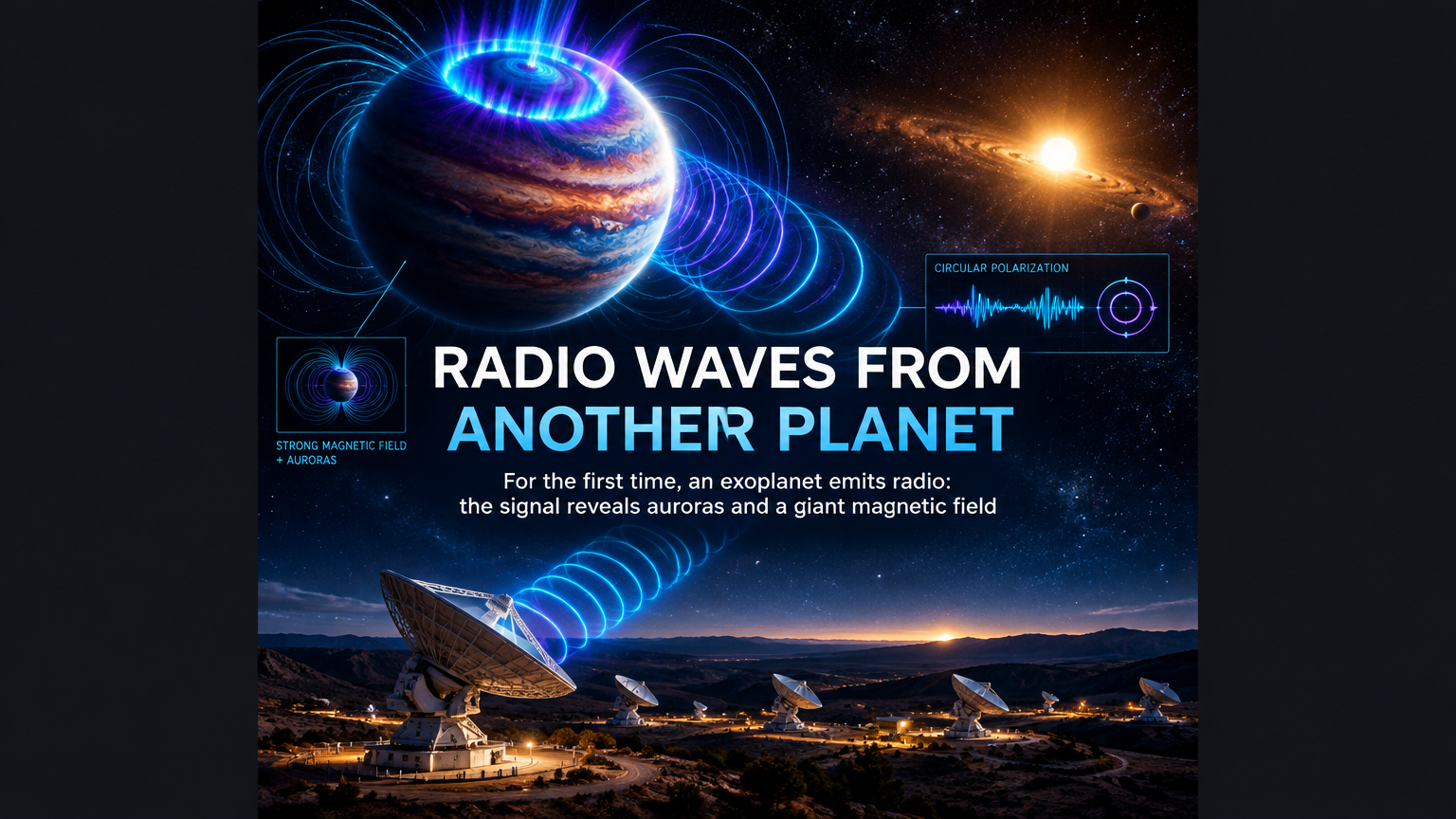
For the first time in history, scientists have captured radio waves coming directly from a planet outside the Solar System.
The planet is Beta Pictoris b, a gas giant about 63 light-years from Earth. The detection was made by the MeerKAT radio telescope in South Africa, by a team led by Kevin Ortiz Ceballos at the Center for Astrophysics | Harvard & Smithsonian.
Before any speculation, the warning the scientists themselves made a point of giving: it is not aliens trying to communicate.
The waves come from auroras, the same light shows we see at Earth’s poles, generated by charged particles interacting with the planet’s magnetic field.
But if it is not life, why is the discovery being treated as a landmark?
Because it opens a completely new window for studying worlds that lie light-years away. And that window is what this article is about.
What exactly was detected
The team observed the Beta Pictoris system in four separate sessions and two frequency bands, capturing faint but repeating bursts of radio signals.
The central challenge was knowing where the waves came from.
In previous detections of planet-hosting systems, astronomers could not tell whether the signal came from the star or the planet. The two objects appear at virtually the same point in the sky, separated by a tiny angle.
The solution was elegant: the researchers compared their radio images with the precise positions of extremely distant background quasars, which act as fixed markers in the sky. Layering the maps, the radio signal lined up with the position of Beta Pictoris b, not its parent star.
It is the first time a radio emission has been attributed directly to an exoplanet.
The signal reveals auroras and a giant magnetic field
Auroras occur when charged particles travel along the lines of a magnetic field and excite molecules in the atmosphere. As they circle, those particles emit radio waves.
Auroras have a characteristic signature: they emit circularly polarized radio, meaning the orientation of the wave rotates in a circle. That is exactly the signature the researchers identified from Beta Pictoris b.
From the signal, the team calculated the strength of the planet’s magnetic field: at least 1,250 gauss in the region where the waves are produced.
For scale, Earth’s magnetic field is about half a gauss. Beta Pictoris b’s is thousands of times stronger.
That makes the detection also the first direct measurement of an exoplanet’s magnetic field, data that simply did not exist for any planet beyond the Solar System.
The result makes sense for the object in question. Beta Pictoris b has between 10 and 12 times the mass of Jupiter, approaching the size of brown dwarfs, objects that have already shown auroras with fields of thousands of gauss.
Why this matters for the search for life
Here is the point that turns an astronomical curiosity into a central piece of the search for habitable worlds.
Magnetic fields work as shields. They deflect charged particles launched by the star, the so-called stellar wind, which would otherwise erode the planet’s atmosphere over billions of years.
Earth has life in part because it has a magnetic field protecting its atmosphere.
Mars, without that shield, lost most of its own.
Until now, there was no way to measure that protection on any exoplanet. The technique demonstrated with Beta Pictoris b creates a path: detect auroral radio and, from it, infer the magnetic field.
For gas giants, the data is interesting. For rocky planets, it may be decisive. Earlier work, such as observations of the YZ Ceti system with the LOFAR radio telescope, already pointed in that direction, and the Beta Pictoris b detection shows the method works.
The caveats science itself imposes
A responsible article must mark the limits of the result.
The study was submitted to the arXiv preprint server on September 15, 2026 and has not yet gone through peer review, the process in which other scientists evaluate the work before final publication.
In addition, researchers interviewed by specialized press point out that fully confirming the auroral origin would require seeing the signal pulsate over time, following the planet’s rotation, which lasts about eight hours on Beta Pictoris b. Expert assessment is that the case is compelling, but still pending that verification.
Context also matters: Beta Pictoris b is a favorable case, a huge planet orbiting a young, magnetically quiet star, which made it easier to isolate the signal. Detecting radio from smaller planets, in noisier systems, will be far harder.
None of this diminishes the achievement. It defines what it is: a proven first step, not a mature technique.
The system that became astronomy’s laboratory
Beta Pictoris has a history of starring.
Planet b was discovered in 2008 through direct imaging, a technical feat that consists of blocking the star’s light to see the faint dot of the planet beside it.
Planet c was confirmed in 2019.
And, in July 2026, astronomers photographed planet d, the faintest exoplanet ever directly imaged from Earth.
The system is also young, less than 1% the age of the Solar System, making it a natural laboratory for studying how planets form and evolve.
More than 6,300 exoplanets have been confirmed. Most were detected indirectly, through dimming light or stellar wobble. Observing directly, whether in visible light or now in radio, represents another category of knowledge.
What this teaches about technology and data
Here is the connection to the ground of this blog.
The detection was not born from a new telescope. It was born from a data analysis technique.
MeerKAT is an array of 64 antennas generating enormous volumes of raw signals. What turned that noise into a discovery was the ability to process, cross-reference and calibrate information: comparing radio images with reference quasar positions, filtering the circular polarization signature, repeating observations across sessions and frequencies to confirm the pattern.
That is the same pattern found anywhere data creates value:
- raw data, alone, says nothing;
- value lies in processing and comparison with trusted references;
- confirmation comes from repetition and cross-checking sources;
- interpretation requires method, not enthusiasm.
Businesses face the same challenge at smaller scale. They accumulate records of sales, customers and operations, but data only becomes decision after treatment, comparison and validation. That is exactly the work of data science applied to business, which Rapid Genius develops to turn scattered information into safer decisions.
And there is a second lesson: new tools create new questions. Auroral radio was not observable before because nobody had the right instrument and method combined. Every time a new technology layer appears, it reveals problems that already existed but were invisible. Whoever builds that capability sees the market before competitors.
The future: listening to planets one by one
The demonstrated technique points toward a new astronomy.
If auroral radio can be detected across increasingly diverse systems, astronomers will gain a variable missing from the catalogs: the magnetic field.
With it, it will be possible to assess rocky worlds in the habitable zone not only by temperature and water, but by the protection their fields offer against stellar wind.
Next-generation telescopes, such as the Square Kilometre Array, whose sensitivity surpasses current instruments by orders of magnitude, should expand this kind of observation.
The search for life beyond the Solar System has gained, with Beta Pictoris b, a new method. It begins with a gas giant, but points to the question that sustains the entire field:
Conclusion: the signal is not life, but it is method
The radio waves detected from Beta Pictoris b are not a message from distant civilizations. They are auroras, generated by a magnetic field of at least 1,250 gauss, thousands of times stronger than Earth’s.
The achievement marks three firsts in a single result: the first radio emission attributed directly to an exoplanet, the first direct measurement of a planet’s magnetic field beyond the Solar System, and the first strong evidence of an aurora in another planetary system.
The study still needs peer review, and full confirmation of the auroral origin depends on observing the signal pulse with the planet’s rotation.
But the door is open.
The question that remains:
When humanity can measure the magnetic shield of a rocky planet in another star’s habitable zone, what will that reading say about the life that exists there, or about the life that never began?
The answer started being built now, in a South African desert, with 64 antennas pointed at a young star 63 light-years away.