There is a huge difference between having a business that works and having a business that grows.
The first depends on product and effort. The second depends on structure, and today, much of that structure is digital.
The numbers show this is not an opinion. Industry research indicates that 98% of consumers search online before visiting a local business, and 97% read reviews before deciding. At the same time, surveys of small businesses show that most already use at least one digital channel, but few use them in an integrated way.
That gap is exactly where the opportunity lies.
The good news: you do not need a giant budget to compete digitally. You need the right sequence and consistent execution.
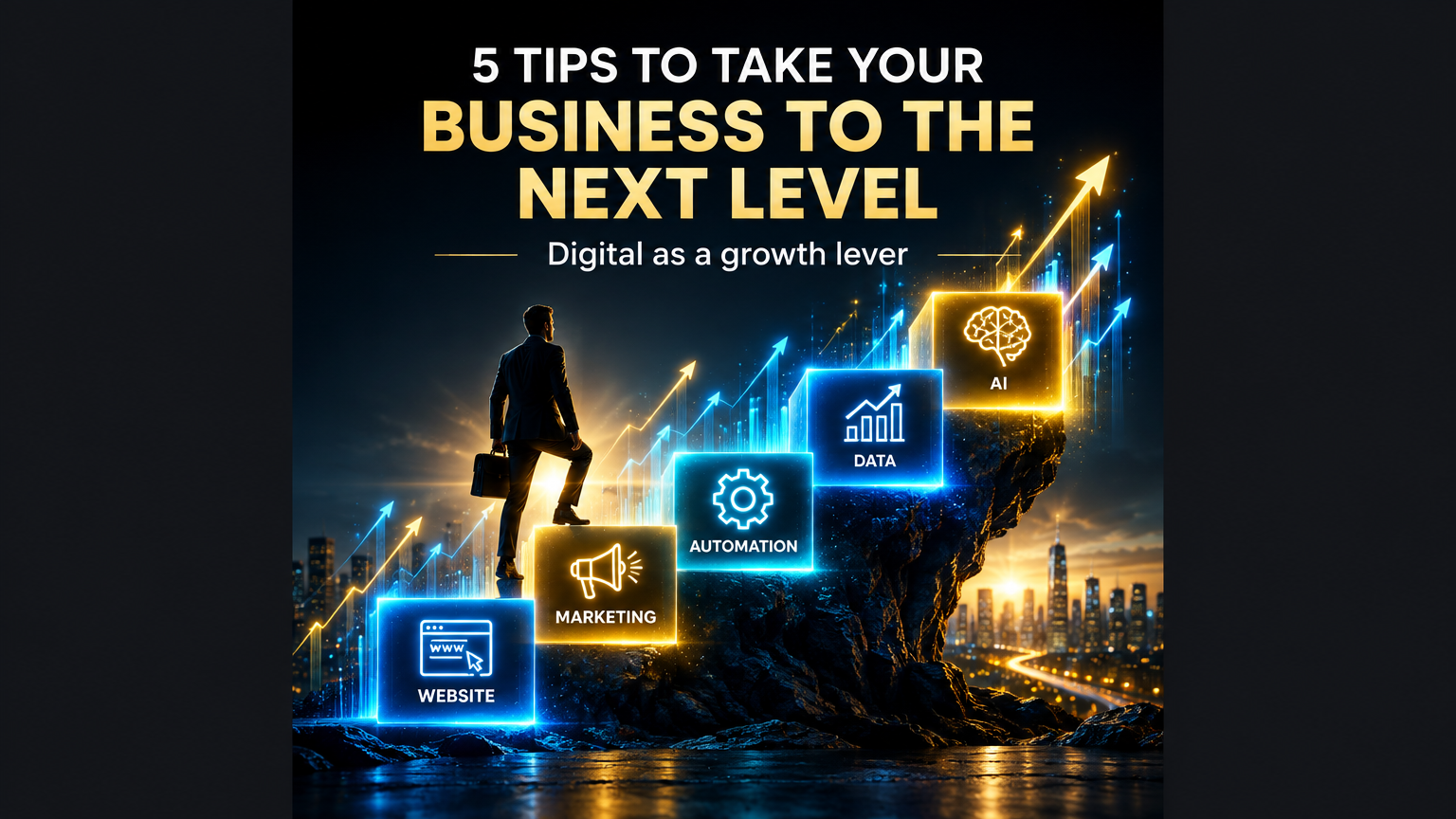
Here are the five tips that move the needle most, in the order they should be applied.
1. Have a professional website that converts
Social media is not yours. The profile can be suspended, the algorithm changes, reach drops. The website is the only digital asset you truly control.
And it needs to do three things well:
- appear on Google when someone searches for what you sell;
- load fast and work perfectly on mobile;
- turn visitors into contacts, with clear calls to action.
An amateur website costs money in an invisible way: it pushes away customers who were already interested. Industry studies indicate that most first impressions of a business are tied to website design.
If your site looks improvised, the customer assumes the service is too.
The starting point is a professional, fast, Google-optimized website, designed to convert, not just to exist.
2. Master Google before spending on ads
Before investing in paid traffic, make sure free traffic is working.
That means:
- a complete Google Business Profile, with photos, hours and services;
- reviews being collected and answered consistently;
- correct information across all channels;
- website content that answers real customer questions.
Reviews have become trust currency. With 97% of consumers reading reviews before deciding, a well-maintained profile is worth more than many paid campaigns.
Google Ads comes later, to accelerate what already works, not to patch holes in a weak foundation. Ads without a good website is money thrown away: the click arrives and finds no reason to stay.
3. Automate what repeats
Every business has processes that repeat: answering the same question, sending the same message, recording the same data, chasing the same invoice.
Each repetition consumes time nobody bills for.
Automation solves this quietly. Practical examples:
- automatic lead capture from ads straight into the CRM;
- initial WhatsApp response, 24 hours a day;
- automatic follow-up on sent quotes;
- recurring billing without manual tracking;
- reports that build themselves.
The gain is not only time. It is consistency. An automated process does not forget, does not delay and does not vary with mood.
Companies that organize this layer grow without inflating fixed costs, because they scale operations without scaling the team at the same rate. That is exactly the kind of solution Rapid Genius builds with intelligent automation, connecting WhatsApp, CRM, spreadsheets and finance into one flow.
4. Decide with data, not guesswork
Most companies make important decisions based on memory and impression.
“I think Instagram sells more.” “I think the customer wants price.” “I think the campaign worked.”
Digital allows you to replace each of those “I thinks” with a number.
With the right data, you discover:
- which channel actually generates customers, not just likes;
- which product has the best margin, not just the highest volume;
- where customers drop off in the buying process;
- how much it costs to acquire each new customer;
- which time, region or audience responds best.
This does not require a data department. It requires organization: capturing the information that already exists, centralizing it and looking at it with method.
That is the work of data science applied to business: turning scattered records into safer, more predictable decisions.
5. Use artificial intelligence as a lever, not decoration
AI has reached the point where any business can use it, and adoption has exploded. Surveys of small businesses in the United States show that the use of AI tools in marketing jumped from 26% in 2023 to 87% in 2026.
But there is a huge difference between using AI as decoration and using it as a lever.
AI as decoration: generating generic content, posting for the sake of posting, adopting the tool because it is trendy.
AI as a lever:
- intelligent support that qualifies leads before they reach the team;
- data analysis that anticipates demand and spots opportunities;
- content production at scale, in the brand’s voice;
- automations that learn from customer behavior;
- predictability in sales, inventory and cash flow.
The practical rule: AI should enter where a defined process exists. An intelligent tool on top of a messy process only accelerates the mess.
Order matters more than speed
Notice that the five tips form a staircase, not a menu of options.
The website sustains presence. Google brings the people searching. Automation organizes what arrives. Data shows what works. AI amplifies all of it.
Skipping steps is the most common mistake. Companies that start at tip 5, buying AI tools before having a website, presence and process, accumulate expensive licenses and shallow results.
Those who climb the staircase in the right order build a structure that compounds: each layer increases the return of the previous one.
Conclusion: digital is no longer a differentiator. It is a requirement
The 2026 consumer researches before buying, reads reviews, compares and decides on a phone. A business that does not show up in that process simply never enters consideration.
The right question is not “do I really need to invest in digital?”. It is:
“Which of the five steps of the staircase has my business not climbed yet?”
Identifying that step and acting on it in the next 30 days is worth more than any perfect plan for next year.
Digital rewards those who execute, not those who plan forever.