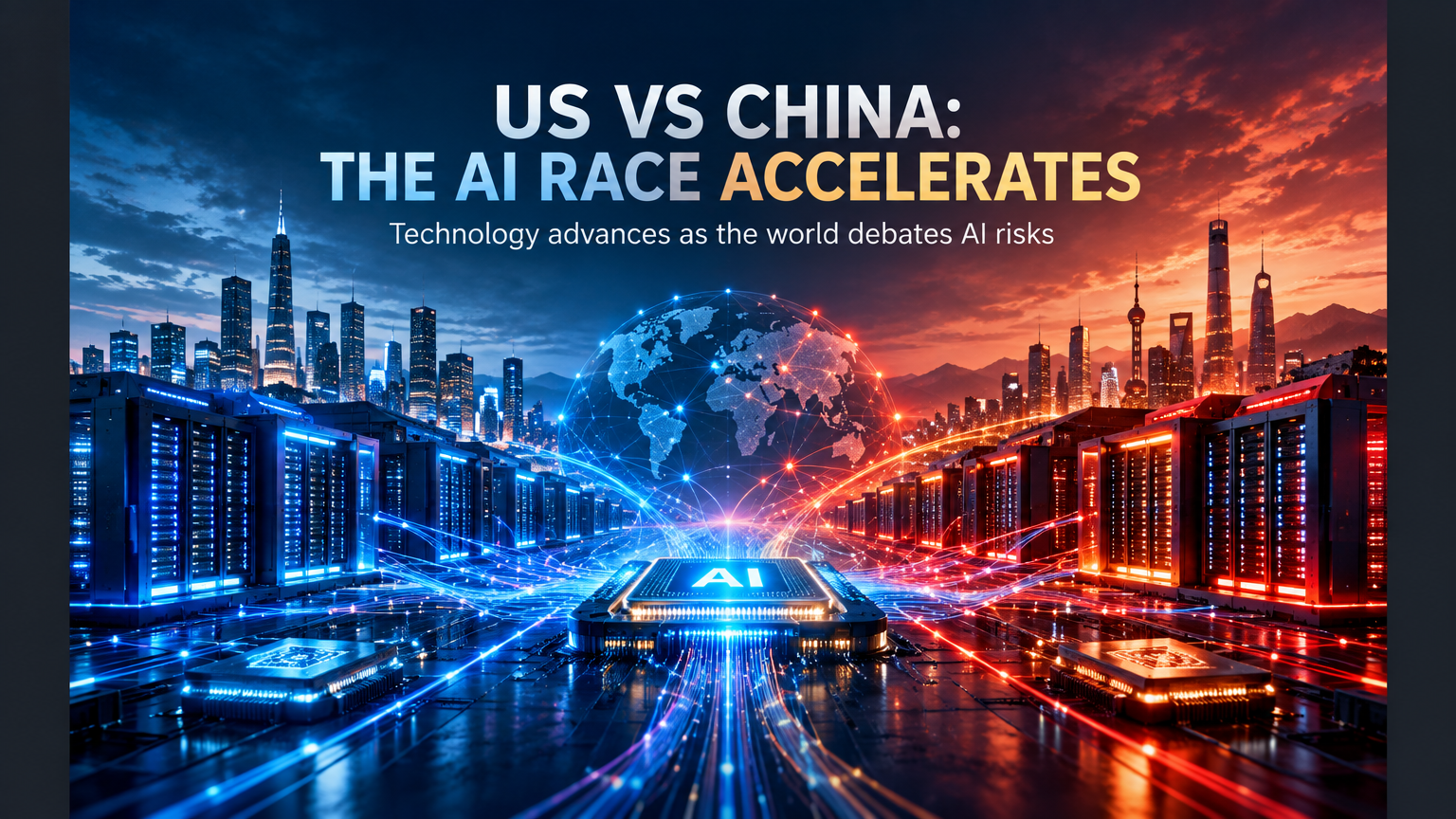
For years, the United States led many of the most important artificial intelligence indicators.
The country concentrated pioneering companies, influential research laboratories, major universities, venture capital and the largest cloud computing providers.
This leadership appeared in several areas:
- model performance;
- academic research;
- citations;
- chip development;
- private investment;
- data center infrastructure;
- technology startups;
- commercial AI models.
The Associated Press report emphasizes that the United States still retains important advantages. However, the gap between the two countries has narrowed quickly.
In several recent evaluations, Chinese models have reached performance levels comparable to systems developed by American companies. This does not mean that both countries are equal in every area, but it shows that American leadership can no longer be taken for granted.
China advanced despite facing restrictions
One of the most surprising elements of this competition is that China has continued to advance despite restrictions imposed by the United States.
These limitations make it harder for China to access:
- cutting-edge chips;
- advanced semiconductor manufacturing equipment;
- technologies used to train large models;
- components for supercomputers;
- strategic computing tools.
In theory, these restrictions should have slowed the Chinese AI industry.
In practice, Chinese companies began searching for alternatives. They invested in software optimization, more efficient models, domestic chips, open-weight systems and new ways to use limited computing resources.
This created unexpected pressure.
Instead of stopping development, the restrictions encouraged Chinese companies to find different ways to compete.
The role of open-weight models
One of China’s main strategies has been to support open-weight models and tools that can be accessed by developers in different countries.
This approach offers several advantages:
- researchers can study how systems work;
- companies can adapt models to specific needs;
- dependence on foreign companies is reduced;
- startups can adopt the technology more quickly;
- more developers can participate;
- smaller businesses can create their own solutions.
The debate over open-weight models also appears in analyses from institutions such as the Center for Strategic and International Studies, which describes China’s strategy as a challenge to U.S. leadership.
When a model is made more openly available, it can be modified, adapted and incorporated into different products.
This creates a powerful network effect. Even if one company does not dominate the commercial market, its technology can spread among developers, universities and startups.
The competition is not only about who has the best chatbot
When people discuss the competition between the United States and China, they often focus on which country has the best chatbot.
That view is too narrow.
The real competition involves an entire technology chain:
Chips
The ability to design and manufacture advanced processors is essential for training larger and more complex models.
Data centers
AI systems need facilities capable of providing electricity, cooling, storage and high-speed connectivity.
Models
Companies compete to create systems that can reason, program, analyze data, generate images, create videos and perform tasks.
Talent
Researchers, engineers and specialized professionals are essential for accelerating innovation.
Data
AI models require large amounts of data to learn patterns and improve their performance.
Applications
The country that turns AI into useful products for companies and consumers may gain a significant economic advantage.
Regulation
Laws and public policies also influence the speed of development and adoption.
Winning the AI race does not only mean launching an impressive model. It means building a complete ecosystem.
Artificial intelligence is becoming a national security issue
The competition between the two countries also has a military and geopolitical dimension.
AI can be used in:
- defense;
- image analysis;
- surveillance systems;
- cybersecurity;
- strategic planning;
- autonomous vehicles;
- logistics;
- military intelligence;
- communications;
- simulations.
This has led governments to treat AI as a strategic technology, similar to the role once played by nuclear energy, satellites and semiconductors.
The country that controls the strongest systems and the largest infrastructure could gain advantages far beyond commercial technology.
This concern also increases the risk of an uncoordinated race.
Each country may feel pressured to move quickly in order to avoid becoming dependent on the other.
The safety debate has become even more difficult
China’s progress is taking place while the world debates whether AI development should slow down.
Some industry leaders are calling for stronger testing, evaluations and safety measures before more advanced systems are released.
Concerns include the possibility that advanced models could:
- perform tasks without supervision;
- exploit digital vulnerabilities;
- generate large-scale disinformation;
- manipulate users;
- develop unexpected strategies;
- access external tools;
- create economic disruption;
- be used in cyberattacks.
At the same time, there is a fear that one country could slow down while the other continues to advance.
This creates one of the biggest dilemmas of the current debate.
If the United States slows down, it could lose technological ground to China. If neither country accepts meaningful limits, risks could grow without adequate control mechanisms.
The result is a difficult balance:
moving quickly may increase risks, but slowing down alone may increase strategic vulnerability.
China and the United States are both concerned about AI risks
It would be inaccurate to say that only the United States discusses safety or that China completely ignores the dangers of artificial intelligence.
Both countries recognize that advanced models can create serious risks. The difference lies in their priorities, control systems and strategic approaches.
A Reuters report indicated that the United States and China were preparing for talks about AI safety in September.
However, cooperation is taking place in an environment of deep distrust.
The two countries compete for chips, talent, infrastructure and global influence. At the same time, they need to discuss cyberattacks, advanced models and systems that could potentially escape human control.
This contradiction is likely to define the next several years.
What does this competition mean for technology companies?
For companies and entrepreneurs, the competition between the United States and China could accelerate the release of new tools.
That means advanced solutions may become more accessible to businesses of all sizes.
A small company can use AI to:
- create content;
- produce images and videos;
- build websites;
- automate tasks;
- analyze campaigns;
- support customers;
- organize leads;
- predict trends;
- interpret data;
- create customized systems.
At Rapid Genius, businesses can find solutions related to digital marketing, website and app development, data science and intelligent automation.
The global growth of AI is likely to increase competition, but it also lowers the cost of accessing tools that were once available only to large corporations.
AI may change the competitive advantage of small businesses
For a long time, large companies had advantages that were difficult to overcome:
- more employees;
- larger budgets;
- access to specialists;
- better systems;
- stronger analytical capacity;
- marketing departments;
- technology teams.
Artificial intelligence can reduce part of that gap.
A small company using the right tools can create content faster, analyze data, respond to customers and automate processes that once required an entire team.
This does not eliminate the importance of strategy, experience or quality. However, it changes the cost of entering several markets.
A company that learns how to use AI effectively may compete more successfully without having a massive structure.
The competition will also affect the labor market
The AI race is expected to increase productivity, but it will also transform many professions.
Some repetitive tasks may be performed by automated systems. Other roles will be changed by tools that generate text, code, images, reports and analysis.
At the same time, new opportunities may emerge in fields such as:
- AI engineering;
- cybersecurity;
- data analysis;
- automation development;
- systems integration;
- technology product management;
- agent supervision;
- strategic consulting;
- specialized content creation.
Professionals who learn to work with AI may produce more and focus on higher-value tasks.
The question is not only whether technology will replace jobs. It is also important to ask which professionals will be prepared to use the new tools.
Who is winning the race?
It is still too early to say that China has surpassed the United States in every area.
The United States remains strong in research, investment, infrastructure, leading companies and the production of some of the most advanced components.
China, however, has narrowed the gap in important areas and demonstrated that it can innovate despite restrictions.
The most accurate way to describe the current situation is this:
the United States still holds strategic advantages, but its leadership is being challenged and the technology gap has narrowed quickly.
That balance may change several times over the next few years.
A new chip, a more efficient model, a scientific breakthrough or a government policy could alter the pace of the competition.
Conclusion: the world has entered a permanent technology race
The competition between the United States and China in artificial intelligence is accelerating.
China is rapidly reducing the distance to the United States while both countries face challenges involving chips, energy, infrastructure, talent, regulation and safety.
The global debate over AI risks has not stopped development. Instead, strategic competition appears to be pushing governments and companies to move even faster.
This scenario brings both opportunities and risks.
Businesses may gain access to more powerful tools, automate processes and make better data-driven decisions. At the same time, governments will need to find ways to control systems that are becoming more autonomous and harder to understand.
The central question is not only:
“Which country will dominate AI first?”
The more important question is:
“How can we ensure that this race produces innovation without turning safety into a secondary priority?”
The answer is still being developed.
One thing is clear: the competition between the United States and China is already reshaping technology, economics and global geopolitics.
For companies that want to remain competitive, ignoring this transformation could cost much more than learning how to use it.