The world’s most powerful military has just ended its relationship with one of the world’s leading artificial intelligence companies.
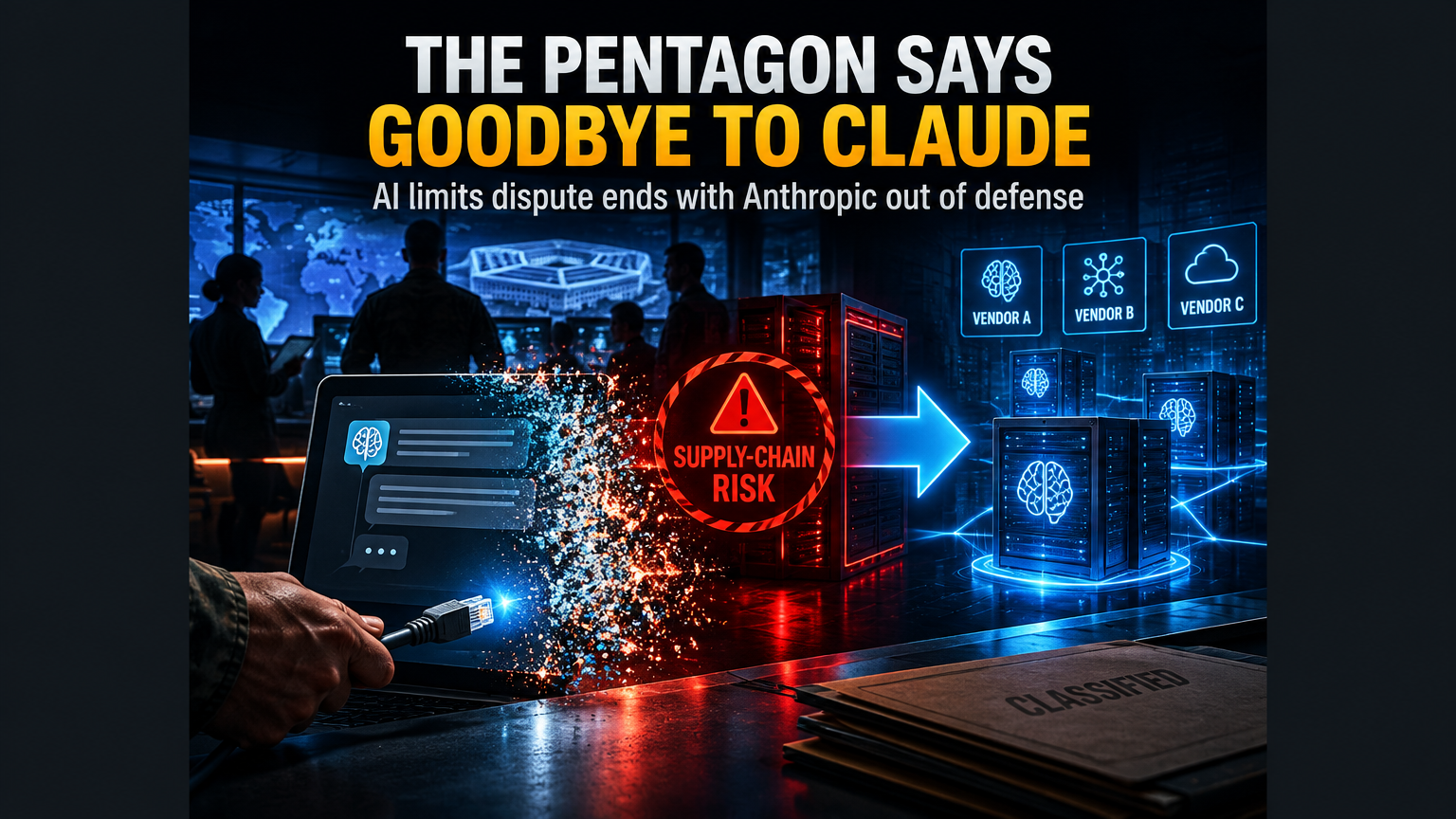
On October 5, 2026, an official from the US Department of Defense confirmed to the BBC that the Pentagon has ceased using all Anthropic products, including the Claude models, closing a conflict that lasted more than eight months.
The origin of the dispute was not price, performance or technology. It was something far simpler and far deeper:
the company refused to remove its model’s safety guardrails for military use.
And the outcome of this story says more about the future of artificial intelligence than any product announcement.
How the conflict began
The relationship started well.
In July 2025, Anthropic signed a contract with the Pentagon valued at up to $200 million to develop AI capabilities for national security.
The Claude model came to be used inside the Maven Smart System, a data platform operated by Palantir, processing large volumes of visual information, including satellite imagery and drone footage, for target identification and operational report writing.
The problem emerged when the Pentagon demanded more.
In February 2026, the Department of Defense pressed Anthropic to remove the safety guardrails embedded in Claude and grant unrestricted access to the model. The company refused.
CEO Dario Amodei publicly reiterated that Anthropic would not allow Claude to be used for mass surveillance of US citizens or to guide fully autonomous weapons.
The government’s response came in cascade.
On February 27, President Donald Trump directed all federal agencies to immediately cease using Anthropic’s technology. Defense Secretary Pete Hegseth designated the company a “supply-chain risk to national security”, a designation formalized in March that canceled military contracts and barred other Pentagon contractors from using its technology.
The deadline for full transition was set for late August.
The exit was slower than the rhetoric
Here is a detail that reveals how technological dependence actually works.
Although the designation came in February and the deadline was August, sources told the BBC that Claude kept being used throughout the whole period of the controversy, including as recently as the week before the October announcement.
In September, Under Secretary of Defense for Research and Engineering Emil Michael admitted that about 90% of classified systems had already migrated to other frontier AI vendors, with the Maven and Palantir work transferred months earlier.
The reason for the slowness is technical and familiar to any company that has tried to swap a core system: extracting technology once it has been deeply integrated is extremely difficult. Claude was rooted in active intelligence workflows, processing sensitive data and generating reports for commanders. An instant replacement was practically impossible during ongoing operations.
On September 25, a US appeals court gave the Pentagon legal backing, ruling in favor of the ban.
On October 5 came the final confirmation: use has ceased.
What was really at stake
The episode goes beyond a contractual fight. It exposes the central tension of the AI era.
On one side, a state with command power, a multibillion-dollar budget and the ability to label a company a national security risk.
On the other, a company that built its brand precisely on the promise of keeping limits on how its technology is used.
Anthropic bet that its principles were worth more than a $200 million contract. The Pentagon bet that no company is indispensable.
Both bets proved out, each in its own way.
The Pentagon migrated its systems to other frontier AI vendors, and by May 2026 had already signed new agreements with other companies in the sector. Anthropic, in turn, maintained its public position, is moving toward an IPO and preserved relationships with other parts of the government, including a $150 million commitment to the Genesis Mission, a federal scientific acceleration initiative.
Senator Elizabeth Warren opened an investigation into the designation, arguing that punishing a company for keeping safety guardrails sets a dangerous precedent. Brookings devoted entire analyses to the question the case raises: does this conflict mean the end of responsible AI?
What this teaches about technological dependence
Here is the connection to the ground of this blog.
The Pentagon-Anthropic story is the maximum-scale version of a problem that hits businesses of every size: dependence on a single critical vendor.
Three lessons stand out.
1. Deep integration creates bargaining power
The Pentagon is the most powerful client in the world, and even it took months to remove one AI model from its systems. The difficulty of migration gave Anthropic leverage throughout the conflict.
For businesses, the lesson is twofold: integrating a tool deeply creates efficiency, but also creates dependence. Before rooting a system into the heart of operations, it is worth asking: if this vendor changes its price, policy or ownership tomorrow, what will it cost to leave?
2. Limits and governance are business issues, not technical details
The entire conflict revolved around guardrails. What looks like an internal software company policy became the axis of a dispute between a startup and the most powerful state on Earth.
For any business, AI governance is no longer a lab topic. It determines who you can work with, which markets you can serve and which risks you assume. Companies that clearly define what their systems can and cannot do avoid crises that improvised companies do not survive.
3. No vendor is irreplaceable, but replacement is expensive
The Pentagon proved it can live without Claude. But it paid the price: months of migration, systems operating in a gray zone and technical effort focused on swapping tools instead of generating results.
The business equivalent is well known: the company that depends on one channel, one system or one provider pays the bill when something changes. Diversifying critical layers is cheaper than migrating in a hurry.
Where your business technology fits into this story
The structure the Pentagon had to rebuild, detection, classification, decision and automated reporting, is the same one modern companies build at smaller scale.
The difference is that your business can design that structure from the start with flexibility: connected but replaceable tools; automations that generate value regardless of vendor; data organized in your own base, not locked inside someone else’s platform.
That is exactly the work Rapid Genius delivers: intelligent automation connecting WhatsApp, CRM, spreadsheets and finance without creating dependence on a single link, websites and apps the company truly controls, and data science turning information into decisions.
The lesson from the world’s biggest AI client applies to the smallest neighborhood business: build with flexibility today so you do not migrate under pressure tomorrow.
The precedent that remains
Regardless of who considers itself the winner, the case sets precedents that will echo.
Governments discovered they can use national security designations as leverage over AI companies. AI companies discovered they can refuse billion-dollar clients and survive. And the market discovered that safety limits are, in practice, a negotiating variable between powers.
For the sector, the question that remains is uncomfortable: if the world’s best-equipped military could not impose its terms on a software company, what does that say about who really holds power in the age of artificial intelligence?
Conclusion: AI has entered the age of geopolitics
The Pentagon confirmed on October 5, 2026 that it ceased using all Anthropic products, eight months after designating the company a supply-chain risk.
The rupture was born from a refusal: Anthropic would not remove Claude’s guardrails or allow mass surveillance of US citizens or fully autonomous weapons.
The transition took months, because extracting deeply integrated technology is hard, even for the Department of Defense. The case ended with the Pentagon migrated to other vendors, Anthropic standing firm with its position intact, and a public debate about the limits of responsible AI.
For businesses, the message is direct:
AI has stopped being a purchase. It has become a strategic decision, with implications for dependence, governance and power.
The question that remains:
If your main technology vendor changed its policy tomorrow, would your company keep operating or enter crisis?
The Pentagon needed eight months to answer that question.
Your business can answer it now, before it has to.