There is a phrase Giorgia Meloni has repeated for years, since a 2019 rally, that became the signature of her political career: “Io sono Giorgia Meloni”, “I am Giorgia Meloni”.
On October 5, 2026, that phrase took on an unprecedented role.
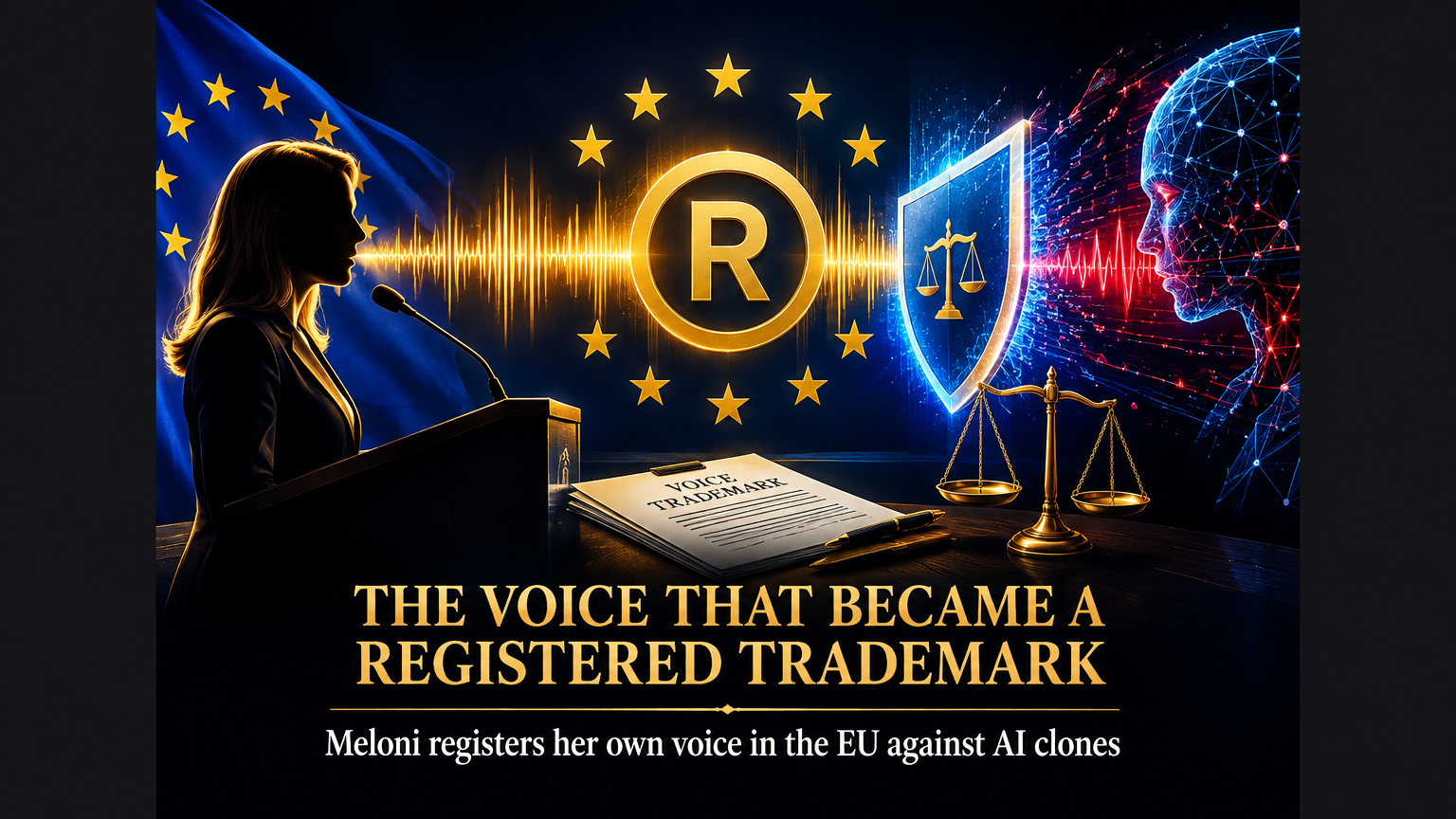
The Italian Prime Minister filed with the EUIPO, the European Union’s intellectual property office, an application to register her own voice as a trademark. The application includes a four-second audio recording of her saying exactly that phrase.
According to Reuters and the Financial Times, Meloni is the first major politician known to trademark her voice, in an explicit move to protect herself against AI-generated clones and deepfakes.
The news may sound curious at first. Can a voice become a trademark?
The answer reveals something important not only about law, but about the value of intangible assets in today’s market. And, like almost everything analyzed in this blog, it ends in a practical lesson for business.
What exactly was registered
The application was filed on Monday, October 5, and can be consulted in the EU’s public trademark database.
The object is a sound mark: a four-second audio recording of Meloni repeating the phrase that has accompanied her since the start of her political career.
Sound trademarks have existed for decades. Intel’s three-note jingle, the MGM lion’s roar and Netflix’s opening sound are classic examples of registered sounds.
What is unprecedented here is the owner: an individual, using her own voice, not as an authored work, but as a distinctive sign of origin, the core legal function of a trademark.
The logic is the same as any trademark: when the public hears that sound, it should immediately know where it comes from. A political leader’s voice, in this framing, works like a company’s jingle.
Why she did it now
Context explains the urgency.
Meloni has faced, for years, a continuous stream of AI abuse: manipulated images and videos circulating on social media, including sexual deepfakes that have already led to legal action in Italy.
Voice cloning is the next frontier of this problem. Current voice synthesis tools need only a few seconds of audio to generate a convincing imitation. For a public figure whose voice appears in hundreds of speeches available online, the training material is abundant and free.
Registering the voice as a trademark adds an extra layer of legal protection. According to Italian press, even if approved, the registration would not automatically prevent the use of her voice in deepfakes, but it would create additional legal obstacles for anyone attempting to replicate it, especially in commercial contexts or where confusion about the content’s origin arises.
It is one more tool in an arsenal that includes personality rights laws, criminal actions and, now, intellectual property.
The legal board this move fits into
Meloni’s registration does not happen in a vacuum. It fits into a regulatory framework that matured quickly.
The European AI Act
The EU’s AI regulation, in force since February 2025, has required, since August 2, 2026, that AI-generated or manipulated content be identified in legible and machine-readable form. Deepfakes must be labeled. Those producing or distributing synthetic content without marking face transparency rules.
Personality rights
In Europe, protection of image, voice and identity is not harmonized at supranational level. It depends on each country’s law, and Italy, Spain and Germany have strong personality protection traditions. The trademark registration adds a supranational layer to that national base.
The movement in the United States
The phenomenon is not European. Taylor Swift and Matthew McConaughey have already filed trademarks to protect their likenesses from AI misuse, according to the Washington Post. The Scarlett Johansson case against OpenAI, Tennessee’s ELVIS Act, which protects artists’ voices from cloning, and the federal TAKE IT DOWN Act show that vocal identity protection has become a legislative and judicial agenda item globally.
Between 2024 and 2026, courts in several countries began building precedents on voice cloning, and the framework still diverges across jurisdictions, as legal analyses of the sector point out.
Meloni’s move is symptomatic of this era: when technology makes identity replicable, the law responds by turning identity into property.
What a voice trademark can and cannot do
A responsible article must separate symbolism from practical effect.
What the registration can offer:
- Presumption of ownership: the registered voice now has an officially identified owner in the EU;
- Basis for infringement actions: unauthorized commercial use of the voice can be fought as trademark violation, in addition to personality violation;
- Leverage on platforms and marketplaces: IP registrations facilitate takedowns and administrative blocks;
- Deterrent value: the legal cost of cloning the voice increases.
What the registration does not solve:
- Deepfakes of political or opinion content may fall outside the trademark’s scope, which protects against commercial use and origin confusion, not every form of imitation;
- Detection remains the bottleneck: a registered trademark does not stop a clone from being created and published in minutes;
- Enforcement is territorial: the trademark is valid in the EU; clones published in other jurisdictions require other tools.
The honest assessment is the one Italian press itself made: the registration creates obstacles, not walls. It is one more piece on the board, and a symbolically weighty one, coming from a head of government.
The business lesson: your identity is an asset, and assets get protected
Here is the connection to the ground of this blog.
The Meloni case is an extreme version of a principle that applies to any business: the more valuable your identity is in the market, the more it attracts copies, and the more structured your protection needs to be.
Three practical lessons stand out.
1. Intangible assets are worth more than they seem
A politician’s voice, an artist’s face, a company’s reputation: none of that appears on the balance sheet as a physical asset, but all of it generates real revenue.
For your business, the equivalent is the set of name, brand, content, digital presence and customer relationships. That set is what the market recognizes, trusts and pays for.
2. Protection is built before the crisis
Meloni did not register her voice because one specific clone harmed her yesterday. She registered because the risk is structural and growing.
Businesses do the opposite: they only think about protection when someone copies the website, uses the name, impersonates the brand in ads or steals content. At that moment, without registration and without monitoring, every defensive action costs more and yields less.
Registering the trademark, keeping rights updated and documenting content authorship is cheap when done early and expensive when done late.
3. Monitoring is half of protection
A registration without surveillance is a safe without an alarm. Clones, fake ads and impersonator profiles appear every day on platforms that do not notify the owner.
Monitoring mentions, brand-name searches and ads using your terms is a routine, not a project. And it is exactly the kind of routine that gets automated.
Where your business technology fits into this story
Protecting and strengthening a brand in the digital environment involves three layers that Rapid Genius works on daily.
The first is owned presence: a professional, well-structured website is the anchor of your digital identity, the official place where the market verifies who you are. Without that anchor, clones and impostors compete on equal footing with the original.
The second is automated vigilance: mention alerts, brand-search monitoring and competitor ad tracking can run without manual effort, integrated into the company’s flow. That is the kind of routine intelligent automation sustains, ensuring nothing important goes unnoticed for lack of team time.
The third is analysis: understanding how the brand is perceived, where it appears, which channels generate recognition and which generate risk. That is the field of data science applied to business, turning reputation into numbers that guide decisions.
The Italian Prime Minister needed the European Union’s IP office to protect her voice. Your business needs less: registration, routine and structure. But it needs it.
Conclusion: when identity becomes property, protection becomes strategy
The registration of Giorgia Meloni’s voice at the EUIPO, with a four-second recording of “Io sono Giorgia Meloni”, marks an inflection point: for the first time, a major political leader turns her own voice into a registered trademark, explicitly to defend herself from AI clones.
The gesture does not solve the deepfake problem. It creates additional legal obstacles, adds to the AI Act and personality laws, and sends a message to the market: identity is property, and property gets defended.
For businesses, the translation is direct. Your brand, your content, your digital presence are assets that someone, at some point, will try to copy, imitate or hijack. The question is not whether. It is when, and whether you will be prepared.
The question that remains:
If tomorrow someone launched fake ads using your business’s name and face, how long would it take you to find out, and how much would it cost to reverse?
Whoever answers that question with structure, not luck, protects the asset that sustains all the others.