For years, Facebook and Instagram have helped define how billions of people communicate, consume content and do business online.
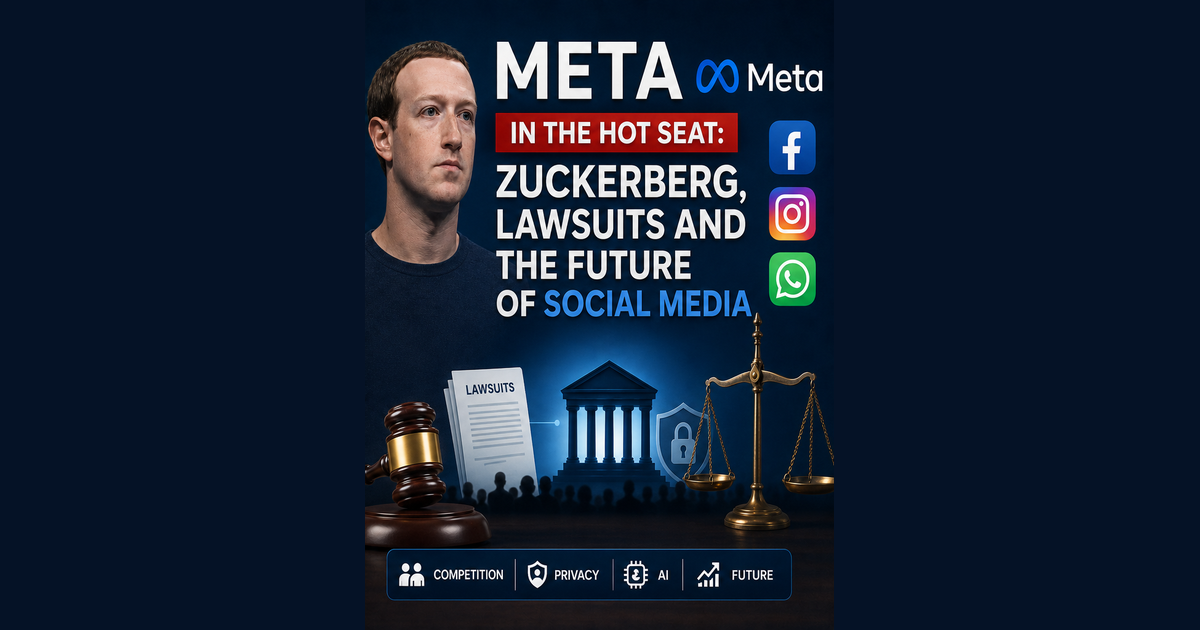
Now, however, the company behind these platforms is facing one of the most challenging legal periods in its history.
And the most interesting part is that these legal battles are not only about money or possible fines. They could influence how social networks operate, how algorithms are developed, how minors are protected and even how much space competitors have to challenge the biggest platforms.
But what exactly is happening to Mark Zuckerberg and Meta?
⚖️ Meta is facing several legal battles — and they are not all about the same thing
First, an important distinction needs to be made.
Mark Zuckerberg is Meta’s CEO and is at the center of discussions and testimony involving the company, but many of the major cases are against Meta, rather than necessarily against Zuckerberg personally.
One of the biggest battles is the antitrust case brought by the U.S. Federal Trade Commission, or FTC. The agency accuses the company of illegally maintaining a dominant position in personal social networking through a strategy that included the acquisition of Instagram in 2012 and WhatsApp in 2014. The case remains pending.
The central idea behind the accusation is simple:
Being big is not illegal. Using a dominant position to eliminate or weaken competition can be.
And that discussion could have consequences far beyond Meta.
If courts require structural changes, the decision could affect Meta’s growth strategy and influence how major technology companies acquire, develop or compete with emerging services.
🚨 The other major problem: children, teenagers and social media safety
While competition concerns the business world, another legal battle raises an even more sensitive question:
How far should a social network go to keep users engaged?
Meta is currently facing a major U.S. trial involving allegations that Facebook and Instagram were designed in ways that encouraged excessive use among children and teenagers.
A coalition of U.S. states accuses the company of creating mechanisms that could increase addictive use of its platforms, while also alleging problems involving the collection of minors’ data. Meta denies the allegations and says it continues to improve user safety.
The trial has attracted even more attention because former Meta employees are giving testimony.
Former engineering director Arturo Béjar testified that Zuckerberg prioritized growth and results while youth safety did not receive the same priority. Meta disputes that characterization and points to its investments in safety tools.
And here is an important point:
These are still allegations.
The final decision belongs to the courts. Therefore, claims still being litigated should not be presented as proven facts.
But regardless of the final outcome, something is already happening:
the entire industry is being forced to rethink the limits of social media.
🌎 What if Meta is forced to change?
This is where things become really interesting.
Imagine courts ordering certain features to be changed.
Infinite scrolling, algorithmic recommendations, engagement mechanisms, targeted advertising and age-verification systems could all face changes.
Some of these measures are already among the reforms sought by the states in the current case.
That could create a domino effect.
Because when a company the size of Meta changes its rules, thousands of businesses that depend on Facebook and Instagram to promote products, attract customers and generate sales must adapt as well.
And this brings us to one crucial word:
Competition.
🥊 Would more competition be good for users?
In most cases, yes.
Imagine a market where only two or three major social networks control most users, advertisers and creators.
Now imagine new companies being able to enter that market more easily.
Competition can encourage:
- better tools;
- more transparent algorithms;
- stronger data protection;
- new monetization models;
- better conditions for creators;
- more competitive advertising costs;
- greater freedom for users to choose where they spend their time.
That is one reason antitrust cases matter.
The FTC says its work in technology markets is intended to protect and promote competition.
But there is another side.
⚠️ Too much competition can also create problems
Excessive fragmentation can make the internet more complicated.
Imagine having to use five different apps to reach audiences that can currently be found on one platform.
For large companies, this may be manageable.
For small businesses, independent creators and freelancers, it could mean more work, higher costs and more time spent managing platforms.
And when new platforms appear, not all of them survive.
Some disappear quickly.
Others may promise freedom and privacy at first, only to adopt strategies similar to those of the major platforms once they gain enough users.
In other words:
more competition does not automatically mean a better internet.
What matters is healthy competition.
🤖 The next chapter may be written by Artificial Intelligence
There is another factor that could completely change this competition: AI.
The social networks of the future will probably look very different from the ones we know today.
Instead of simply showing a sequence of posts from people we follow, algorithms may create increasingly personalized experiences.
Two users could receive completely different feeds.
AI agents could help businesses create content, answer customers, analyze trends and manage campaigns.
Creators could produce videos, images and text at a much faster pace.
Small businesses could compete with much larger organizations by using automation and artificial intelligence.
This could lower some barriers to entry.
But it also creates new risks.
The smarter the algorithm becomes, the greater its ability to understand what keeps our attention.
And that is likely to remain at the center of social media debates for years to come.
🔮 What could social media look like in 5 or 10 years?
Nobody can know for sure.
But several trends seem likely.
1. More regulation
Governments will probably continue increasing pressure on major platforms regarding privacy, competition, advertising, child safety and artificial intelligence.
2. More competition
New platforms will continue trying to attract users who are dissatisfied with today’s giants.
3. More AI
Artificial intelligence will probably play an increasingly important role in content creation and distribution.
4. More personalization
Each user may receive an increasingly individualized experience.
5. Greater focus on safety
After years of lawsuits and public debate, digital safety and child protection may become fundamental requirements rather than optional features.
💡 What does this mean for businesses?
Perhaps the biggest lesson for digital marketers is this:
Do not build your entire business inside one social network.
Facebook, Instagram, TikTok, YouTube and other platforms can be excellent customer-acquisition tools.
But they do not belong to your company.
Rules can change.
Algorithms can change.
Reach can fall.
Advertising can become more expensive.
An account can be restricted.
And a court decision can completely change how a platform operates.
That is why smart businesses are building something larger than followers.
They are building owned assets.
Websites.
Email lists.
Customer databases.
CRMs.
Automation.
Content.
Communities.
First-party data.
Social networks can remain excellent entry points. But whenever possible, the customer relationship should go beyond them.
🚪 In the end, the Meta lawsuits could be bigger than Meta itself
It is easy to look at these headlines and think:
“Zuckerberg is having legal problems.”
But the real question is much bigger.
We are discussing who controls the internet, how large technology companies are allowed to grow, how algorithms should operate, how much privacy is worth and how far a platform can go to keep our attention.
If Meta wins these battles, it may preserve much of its current strategy, although regulatory pressure will likely remain.
If it loses, the company could be forced to make significant changes.
And its competitors will be watching very closely.
Because every major change at Meta could open a door.
And in technology, an open door today can create tomorrow’s next giant.
The real battle may not be about Facebook or Instagram.
It may be about the next generation of the internet.
And that battle is only beginning.