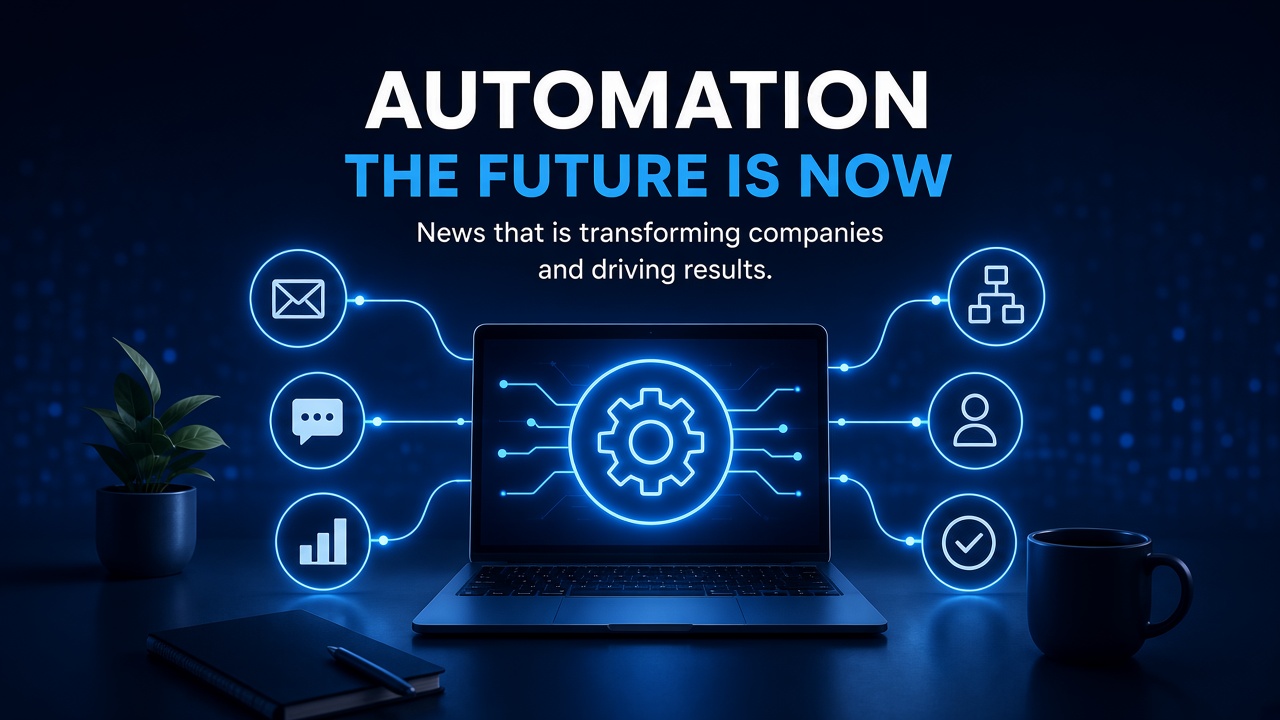
Imagine arriving at work in the morning and discovering that a significant part of your repetitive tasks has already been completed.
New leads have been organized.
Customer information has been updated.
Customers who need a response have been identified.
Some emails have been prepared.
A report has been created.
And certain tasks have already been sent to the right people.
Now imagine that this did not happen because someone manually created dozens of rules.
Artificial intelligence analyzed the context, decided which steps needed to happen, and used different tools to perform the work.
Does that sound like something from the future?
In 2026, it is becoming increasingly real.
Business automation is going through an important transformation. For years, automation meant creating a relatively predictable sequence:
If X happens → do Y.
Now, a new generation of automation is beginning to work differently:
Receive a goal → understand the context → decide the next steps → use the necessary tools → execute → check the result.
This change is being driven mainly by artificial intelligence and what are known as AI agents.
In this article, we will explain what is happening, what the main developments are, and, most importantly, how small and medium-sized businesses can take advantage of this transformation.
What has changed in automation?
Traditional automation is still extremely useful.
Imagine that someone fills out a form on your website.
You can create an automation that:
- receives the form;
- adds the contact to your CRM;
- sends a message;
- alerts the sales team;
- creates a follow-up task.
Everything works according to predefined rules.
It is simple, predictable, and efficient.
The problem appears when the situation is more complex.
Imagine receiving 100 different leads.
Some are excellent opportunities.
Others do not match your target profile.
Some write detailed messages.
Others leave only a phone number.
Some require immediate attention.
A rules-only automation can struggle to understand these differences.
This is where artificial intelligence starts changing the game.
Instead of simply following a rule, AI can interpret information, classify situations, generate responses, and help determine which path should be followed.
This is one of the most important movements in automation in 2026.
The era of intelligent automation has arrived
One expression appearing frequently today is AI workflow automation.
The idea is simple.
Instead of putting AI everywhere, you place artificial intelligence in the parts of a process where interpretation or decision-making is actually needed.
For example:
A system receives an email.
Traditional automation might simply forward it.
AI-powered automation can:
- understand the content;
- identify whether it is a complaint;
- recognize whether it is a potential customer;
- assess urgency;
- summarize the message;
- classify the contact;
- suggest a response;
- route it to the correct department.
After that, the predictable parts of the process can continue to be handled by traditional automation.
This combination is extremely important.
AI does not need to replace the entire automation.
It can simply make specific parts of the process smarter.
AI agents are the big new development
You may already have heard about AI agents.
But what exactly do they do?
A simple way to understand them is to think about the difference between an assistant and a digital employee.
A traditional chatbot usually waits for a question and provides an answer.
An AI agent can receive a goal and perform a sequence of tasks to try to achieve it.
For example:
Goal: find new potential customers for a business.
Depending on the tools and permissions available, an agent could:
- research information;
- organize data;
- identify companies that match the target profile;
- analyze relevant information;
- classify prospects;
- record the data;
- prepare a task for the sales team.
The technology still has limitations and requires controls, but the direction is clear.
Automation is moving beyond simple sequences of instructions and beginning to work with goals, context, and decision-making.
Google Cloud describes this evolution as a shift from individual tasks toward systems capable of orchestrating complete workflows.
Microsoft is turning agents into automation tools
Microsoft is one of the major examples of this transformation.
In Copilot Studio, agent flows allow businesses to combine agents, automations, connectors, and actions.
These flows can be triggered manually, by events, by other agents, or according to a schedule. They can also include steps that require human intervention.
One particularly interesting development is Microsoft’s ability to create certain flows using natural language.
In other words, a person can describe what they want to automate and the system can help build the workflow.
This reduces a barrier that has limited automation for many years:
the need to know how to program.
Automation is becoming increasingly accessible to people who understand the business, even if they are not developers.
n8n is also bringing AI into workflow creation
Another interesting example is n8n.
In July 2026, the platform introduced the n8n AI Assistant, an agent that can help create, edit, test, and troubleshoot workflows using natural language.
This represents a significant shift.
Previously, someone needed to understand the platform to build a workflow.
Now, AI itself can help build that workflow.
You could describe something like:
“When a new lead arrives through the website form, analyze the information, qualify the prospect, record the data, and notify the sales team.”
AI can help turn that description into an automation structure.
This does not remove the need to review and test it.
But it significantly reduces the distance between:
“I have an automation idea”
and
“I have a working automation.”
Zapier is betting on agentic workflows
Zapier is also moving in this direction.
The company distinguishes traditional automation from what it calls agentic workflows.
In traditional automation, the steps are defined in advance.
In an agentic workflow, an agent can analyze the goal, determine what needs to happen, use tools, and adjust its path when necessary.
This matters because the real world rarely behaves in a perfectly predictable way.
A customer may write an unusual message.
A document may be incomplete.
Information may be stored somewhere else.
A system may return an unexpected result.
An extremely rigid automation may simply stop.
A system with reasoning capabilities may be able to interpret the problem and find another path.
That flexibility is precisely what makes agent-based automation so interesting.
But there is something many people are getting wrong
Here is one of the most important points in this article:
Not everything should be handled by artificial intelligence.
That may sound contradictory.
If we are talking about intelligent automation, why not put AI into every step?
Because many tasks do not require artificial intelligence.
Imagine an automation that needs to check:
If the amount is greater than €1,000, send it for approval.
You do not need AI for that.
A simple rule is:
If amount > €1,000 → request approval.
It is faster, predictable, and cheaper.
Zapier itself emphasizes that deterministic tasks are still better suited to traditional automation and that using AI where reasoning is unnecessary can increase costs without adding value.
The best automation in 2026 is not necessarily the one that uses the most AI.
It is the one that knows where AI actually adds value.
The future is the combination of traditional automation and AI
Think about a business that receives leads through its website.
An intelligent workflow could work like this:
Step 1 — Capture
The form receives the information.
Step 2 — Automation
The data is automatically sent to the CRM.
Step 3 — Artificial intelligence
AI analyzes the potential customer’s message.
Step 4 — Classification
The lead receives a classification based on the company’s criteria.
Step 5 — Automation
The system routes the lead to the right salesperson.
Step 6 — AI
Artificial intelligence prepares a personalized response suggestion.
Step 7 — Human
The salesperson reviews it and decides whether to send it.
Step 8 — Automation
After the interaction, the CRM is updated automatically.
Notice that there is no real competition between AI and automation.
They work together.
Automation executes.
AI interprets.
Humans supervise.
This combination will likely become one of the most important structures in modern business systems.
Automation is reaching customer service
Another area receiving huge investment is customer service.
Companies are using AI agents to answer questions, find information, route requests, and solve certain problems.
Salesforce, for example, launched agent-based service solutions in 2026 designed to operate more autonomously while integrating with business data and channels.
This can be especially interesting for small businesses.
Imagine a company receiving messages throughout the day.
Instead of a person manually answering repetitive questions such as:
- What is the price?
- Do you serve this area?
- What are your opening hours?
- How does the service work?
- How can I book?
- What payment methods do you accept?
An automated system can answer immediately.
And when a more complex situation appears, the conversation can be handed over to a human.
This creates a much more efficient model:
AI for repetitive work + humans for relationships and judgment.
Sales is also becoming automated
Automation is moving rapidly into sales.
A traditional salesperson can spend a significant part of the day:
- researching companies;
- looking for information;
- organizing leads;
- preparing meetings;
- sending follow-ups;
- updating the CRM;
- creating reports.
Much of this work is not actually selling.
It is operational work.
That is why agent-based solutions are beginning to handle tasks such as account research, lead qualification, meeting scheduling, and preparing information for salespeople.
The goal should not be to replace the salesperson.
The goal should be to allow them to spend more time doing what truly requires a human:
understanding the customer, building trust, negotiating, and closing deals.
Marketing is also entering the era of intelligent automation
Imagine a marketing campaign.
Today, many stages can already be automated:
- lead capture;
- email delivery;
- segmentation;
- CRM updates;
- reporting;
- notifications;
- content distribution.
With AI, new capabilities can be added.
For example:
The automation receives a new lead.
AI analyzes the message and identifies the person’s interest.
The system can then:
- classify the lead;
- personalize communication;
- record information;
- suggest the next action;
- send a task to sales;
- update the history.
In 2026, Salesforce announced an approach involving an “AI marketing team,” with agents focused on content creation, pipeline generation, and campaign execution.
This shows that automation is no longer limited to administrative tasks.
It is moving directly into strategic areas.
What about small businesses? They can benefit too
You may be thinking:
“This sounds interesting, but it is probably only for large companies.”
Not necessarily.
One of the biggest changes happening today is the democratization of automation.
No-code and low-code platforms now make it possible to connect different services without requiring a business owner to build everything from scratch.
This means a small business can create automations for tasks such as:
Lead generation
Form → CRM → qualification → notification → follow-up.
Customer service
Message → analysis → automatic response → human handoff.
Finance
Document → data extraction → record → approval.
Marketing
New content → review → distribution → report.
Human resources
Application → organization → classification → routing.
Management
Data → analysis → report → alert.
The question is no longer:
“Can this be automated?”
In many cases, the answer is already yes.
The better question is:
“Which process in my business should be automated first?”
How do you find what to automate first?
Do not start with the tool.
Start with the problem.
Write down the tasks your business performs repeatedly.
Then look for tasks with three characteristics:
1. They are repetitive
The same activity happens frequently.
2. They consume time
Employees spend significant amounts of time doing them.
3. They follow a relatively clear process
There is a sequence that can be organized.
These tasks are excellent candidates for automation.
Then look for activities that also require interpretation.
Those may be good candidates for AI-powered automation.
A simple example for a service business
Imagine an agency receiving quote requests through its website.
Without automation:
Customer → form → employee checks → copies data → sends message → records information → schedules follow-up.
Now imagine:
Customer → form → automation records → AI analyzes → qualifies → generates summary → sends to salesperson → creates follow-up → updates CRM.
The difference is not only speed.
It is consistency.
The process becomes less dependent on someone remembering to perform every step.
The big challenge: security and supervision
There is, however, one issue that cannot be ignored.
The more autonomy we give systems, the more control we need.
An AI agent that only creates a summary represents a relatively small risk.
An agent authorized to:
- send messages;
- modify data;
- move information;
- make purchases;
- change records;
- access systems;
- make business decisions;
requires much more care.
That is why concepts such as:
- permissions;
- authentication;
- activity logs;
- human approval;
- limits;
- testing;
- monitoring;
are becoming increasingly important.
The automation industry is paying more attention to building agents that are not only useful and fast, but also trustworthy and controlled.
The future will not be “without humans”
There is an exaggerated idea circulating online:
“AI will do everything.”
Reality is more interesting.
Businesses will likely move toward a model where humans and intelligent systems work together.
Machines can:
- process huge amounts of information;
- perform repetitive tasks;
- monitor processes;
- identify patterns;
- suggest decisions;
- perform authorized actions.
Humans remain essential for:
- strategy;
- creativity;
- relationships;
- negotiation;
- leadership;
- complex decisions;
- responsibility.
Automation does not have to eliminate human work.
It can eliminate some of the work that prevents people from focusing on what really matters.
7 automation trends you should watch in 2026
If you want to keep up with this market, these are some of the most important trends:
1. AI agents
Systems capable of performing tasks and making decisions within defined boundaries.
2. Agentic workflows
Workflows that combine traditional rules with reasoning capabilities.
3. Automation through natural language
Describe the process in words and let AI help build the workflow.
4. Multi-agent orchestration
Different specialized agents working together within the same process.
5. Human-in-the-loop
Automation with specific points for human approval or review.
6. System integration
CRM, email, customer service, marketing, finance, and other systems working as parts of one connected process.
7. Data-driven automation
Systems that do not simply execute tasks but use data to determine what should happen next.
What does this mean for the future of business?
Automation is no longer simply a way to save a few minutes.
It is becoming a new way of structuring business operations.
A company can start by automating one small task.
Then connect that task to another.
Then add artificial intelligence.
Then integrate the CRM.
Then add customer service.
And gradually build a digital system capable of handling a significant part of the operation.
That is what makes the current moment so interesting.
We are not simply automating tasks.
We are beginning to automate entire processes.
Conclusion: the question is no longer whether your business should automate
The question is:
How much longer does your business intend to spend manually doing something technology can already execute?
Automation in 2026 is becoming smarter, more accessible, and more integrated.
Tools such as Microsoft Copilot Studio, n8n, Zapier, Salesforce, and other platforms are bringing artificial intelligence closer to real business processes.
But there is one important rule:
Do not automate simply because you can.
Automate because there is a problem to solve.
Start with repetitive tasks.
Then identify opportunities where AI can interpret information or make decisions within clearly defined boundaries.
And keep humans involved where trust, strategy, and responsibility matter.
The real future of automation is not a business without people.
It is a business where people and technology work together, each doing what they do best.
Want to discover what could be automated in your business?
At Rapid Genius, we work with digital solutions that can help businesses reduce manual tasks, improve processes, and use artificial intelligence strategically.
We can analyze your business operation and identify automation opportunities in areas such as lead generation, marketing, customer service, data management, communication, and internal processes.
Because often, the biggest problem is not the lack of technology.
It is not knowing where to start.
Your company’s next major improvement could be hidden inside a process you still perform manually every day.