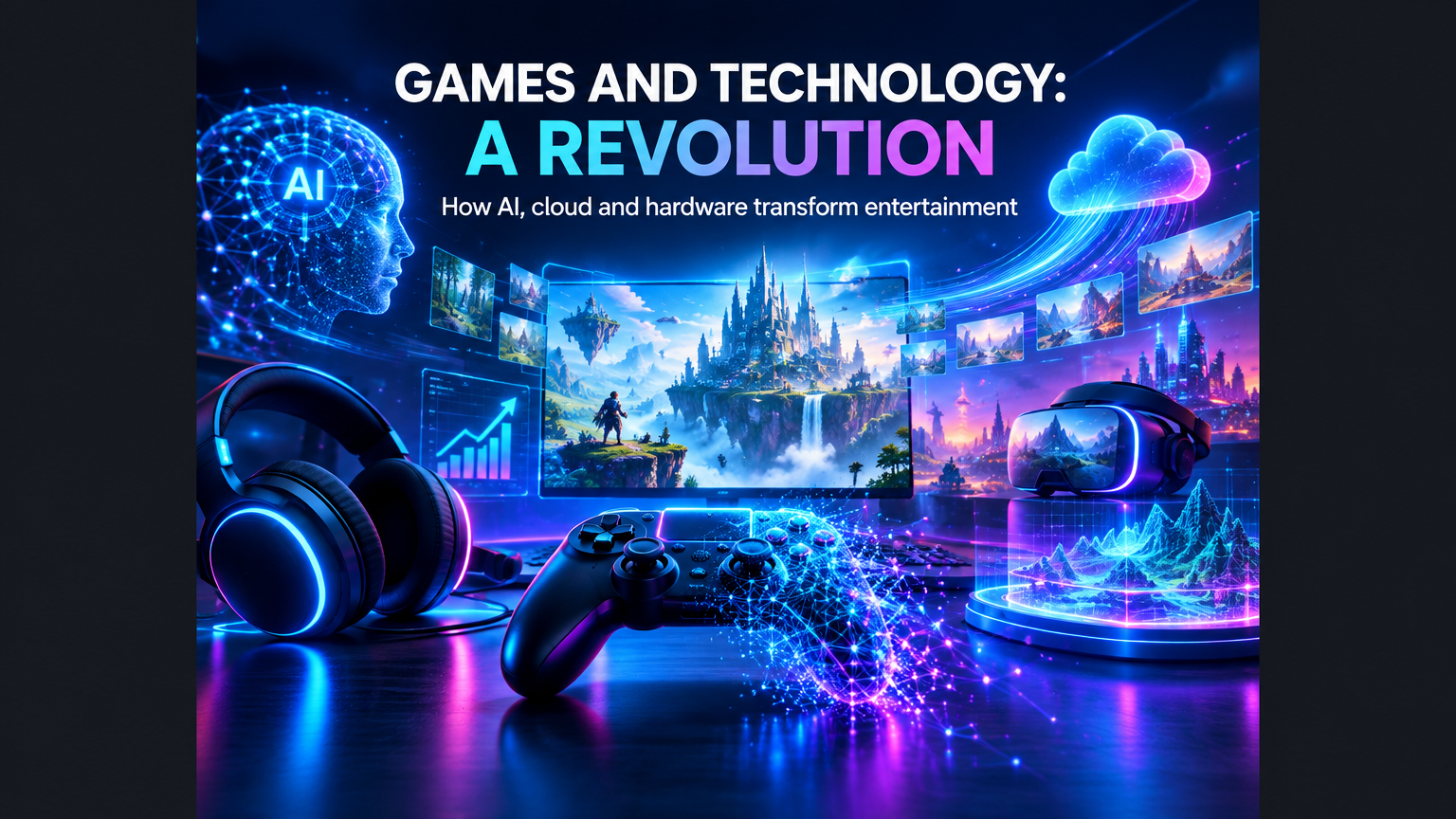
There is an industry that moves more than $213 billion per year, reaches nearly 4 billion people and works as a laboratory for some of the most advanced technologies on the planet.
It is not cinema. It is not music. It is gaming.
According to Newzoo, the global games market is forecast to reach $213.9 billion in 2026, a 6.1% increase over the previous year. Mobile accounts for the largest share at $121.1 billion, followed by console and PC.
But the most interesting number is not the revenue.
It is the role games play in driving technology forward. Graphics cards, artificial intelligence, cloud computing, virtual reality and even conversational AI models advanced because someone needed to run increasingly realistic games.
The relationship between technology and games has never been one-directional. It is a gear system: technology creates better games, and games push technology far beyond entertainment.
How games helped build today’s technology
Many people do not realize that much of modern hardware exists because players demanded more performance.
GPUs, now essential for training artificial intelligence models, began as processors for game graphics. Companies that dominate this market built their foundation selling graphical performance to gamers before selling the same technologies to data centers and AI labs.
The same applies to:
- multicore processors;
- fast memory;
- SSDs;
- high-refresh-rate monitors;
- streaming technologies;
- cooling systems.
Gamers have always been the consumers willing to pay for the next performance leap. That cycle funded entire generations of innovation.
AI inside the studios
AI is no longer just a feature inside the game. It has become part of production.
A survey by CESA, Japan’s game industry association, released at Tokyo Game Show 2026, showed that more than 85% of Japanese developers now use generative AI in their workflows. In the previous survey, the rate was 51%.
This rapid adoption appears in tasks such as:
- concept art generation;
- dialogue creation;
- texture and environment production;
- rapid level prototyping;
- automated testing;
- voice acting and localization;
- code optimization.
On Steam, more than 8,000 games disclosed generative AI use in 2025, and industry analysts expect one in three games on the platform to carry some kind of AI disclosure in 2026.
What began as experimentation has become routine.
AI has also become a character
The most visible change is happening inside the games themselves.
At GTC 2026, Ubisoft presented the Teammates prototype, in which game characters listen to the player, understand spoken commands and respond naturally, replacing traditional NPCs scripted with fixed lines.
NVIDIA, meanwhile, offers the ACE Game Agent SDK, which enables game companions with AI running on the device itself, without depending on external servers.
This changes the experience on three levels:
Dynamic dialogue
Characters stop repeating recorded lines and start interacting according to the context of the match.
Reactive worlds
The environment responds to player choices with greater depth, creating different sessions each time.
Accessibility
Voice commands and intelligent assistants can help new players understand complex systems without leaving the game.
The AI in gaming market, valued at $4.54 billion in 2025, has projections exceeding $81 billion by 2035, according to SNS Insider. It is one of the fastest-growing segments in the industry.
AI is also now the standard renderer
Not all AI in games appears as a character.
A quiet part of this revolution happens in the final image the player sees on screen.
Technologies such as NVIDIA’s DLSS 4.5 use AI models, including a second generation based on transformers, to reconstruct high-resolution images with less hardware effort. The result is more frames per second with better quality.
In practice, AI now draws the image alongside the graphics engine.
This approach allows games with ray tracing to run on a wider range of devices, including mobile. Arm, for example, announced its first AI-native mobile GPU, designed precisely to enable advanced rendering techniques on phones.
Cloud: playing without a powerful computer
Cloud computing changed another old assumption in the industry: that playing demanding titles required expensive hardware.
In the cloud gaming model, the game runs on remote servers and reaches the player as an interactive video stream.
Statista projections indicate around 482 million cloud gaming users in 2026, equivalent to more than 6% of internet users worldwide.
This model brings important consequences:
- demanding games on simple devices;
- lower entry barriers for new players;
- hardware savings for consumers;
- centralized updates;
- instant access without long downloads.
Steam itself recently announced improvements to its streaming system focused on high bandwidth and low latency, a sign that the competition for this experience is just beginning.
The technical challenge is well known: latency. In a racing or shooting game, every millisecond matters. That is why cloud gaming evolves together with 5G networks and data center infrastructure.
Virtual and augmented reality: the promise that keeps renewing itself
Virtual reality is going through a maturing cycle.
Current headsets offer higher resolutions, more precise tracking and more varied content than early generations. Augmented reality, in turn, blends digital elements into the real world and finds one of its most natural uses in games.
Games act as the entry gate for these technologies because they accept experimentation before other sectors.
And the learning does not stay within entertainment. Immersion techniques created for games are reused in:
- medical training;
- industrial simulations;
- education;
- architecture;
- physical rehabilitation.
Esports and streaming: games as sport and media
Games also created their own economy around competition and content.
The esports market is expected to move about $757 million in 2026, according to Fortune Business Insights, with double-digit growth projected over the next decade.
Streaming turned players into content creators and built an audience industry that rivals traditional television in specific age groups.
This ecosystem depends on technology at every layer:
- real-time broadcasting platforms;
- AI-assisted chat moderation;
- audience data analysis;
- editing and automatic clip tools;
- monetization and donation systems.
The complicated side: oversupply, copyright and jobs
Not everything in this revolution is positive.
BCG’s 2026 industry report carries an interesting warning: the ease of creating games with generative AI may produce a flood of low-quality releases, already labeled by analysts as gameslop. In that scenario, curation and discovery become more valuable than ever.
Other issues remain open:
- copyright over AI-generated content;
- impact on art, voice acting and design jobs;
- transparency about AI use in games;
- player data collection;
- aggressive monetization and microtransactions.
The industry will need to balance efficiency and quality. Tools accelerate production, but what makes a game memorable is still creative direction, storytelling and experience.
What can businesses learn from games?
Here is the connection that matters to readers of this blog.
Games are the most successful example of digital engagement in history. No other industry keeps billions of people returning daily, learning complex systems and interacting in real time.
That result comes from principles any business can apply:
Experience above everything
A game that runs poorly gets abandoned. A company whose website loads slowly, whose support takes too long or whose process confuses people loses the customer the same way.
Immediate feedback
In games, every action produces instant visual and audio response. Customers expect the same: order confirmation, status updates, follow-up.
Visible progression
Players see their evolution through levels, rewards and achievements. Loyalty programs work with the same logic.
Community
The longest-lasting games built communities, not just products. Companies that build communities around their brands create assets that are hard to copy.
Data as a compass
Studios adjust difficulty, internal economy and content based on real telemetry. Businesses can adjust products, campaigns and processes based on the data they already collect.
Rapid Genius works with website and app development, digital marketing, data science and AI-powered automation, exactly the competencies that separate memorable digital experiences from forgotten pages.
The future: AI-generated worlds and blurred boundaries
Trends for the coming years point in a clear direction.
BCG identifies platform convergence as the engine of the next growth phase: the boundaries between console, PC and mobile are dissolving, and players expect to carry their progress to any screen.
Generative AI is expected to lower the cost of producing virtual worlds, allowing smaller teams to create experiences once restricted to giant studios.
And games will keep serving as testing grounds for technologies that later spread to other sectors, as already happened with GPUs, streaming and AI.
Conclusion: games are not a niche. They are the frontier
The relationship between technology and games has always been symbiotic.
Games funded hardware advances, adopted artificial intelligence before most industries, popularized cloud computing and turned billions of people into advanced technology users.
In 2026, with a $213.9 billion market and nearly 4 billion players, that relationship became even closer: AI now writes, draws, interprets and even talks inside games.
For businesses, the message is direct:
games have defined the standard of digital experience consumers now expect.
Slow websites, manual processes and delayed support lose to fast, personalized and responsive experiences.
The question that remains is:
If games trained billions of people to demand excellent digital experiences, what is your company offering them?
The answer may be worth more than any marketing campaign.