Every market has two types of company.
Those that react to change after it happens, and those that position themselves before.
The difference between them is not luck or budget. It is method.
The 2026 data shows the race has accelerated. According to Clutch, 55% of small businesses plan to increase technology spending this year, against only 5% expecting cuts. QuickBooks research shows that 77% of US small and midsize businesses now use AI regularly, up from 48% just 18 months earlier.
In other words: the competition is not standing still. And every month of delay becomes accumulated distance.
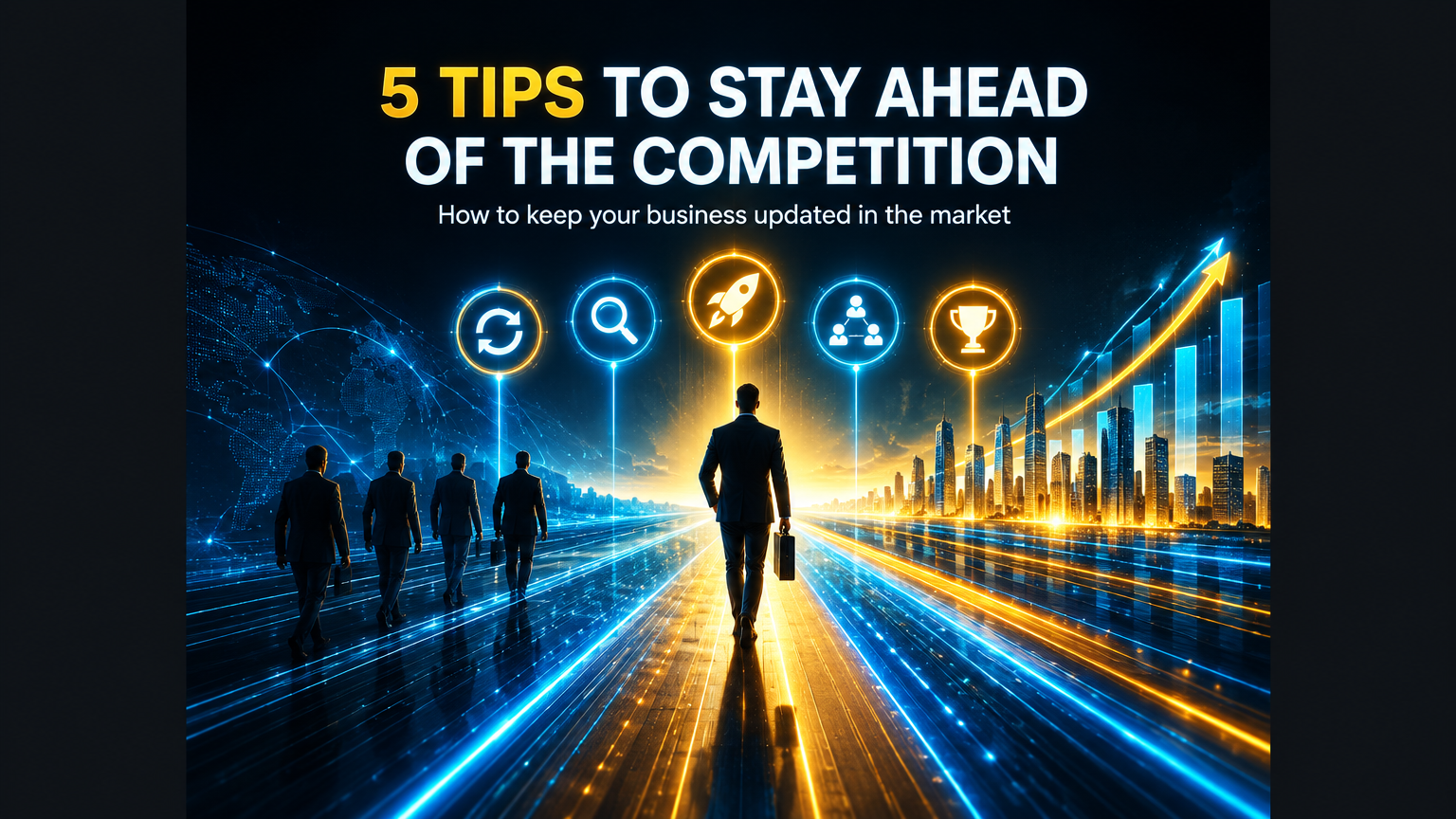
The good news: staying ahead does not require predicting the future. It requires five habits any business can adopt.
1. Monitor the market as a routine, not a reaction
Most companies only study the competition after losing a client to it.
Leaders do the opposite: they turn monitoring into a weekly routine.
In practice, that means tracking:
- what direct competitors are launching and advertising;
- what customers praise and criticize about them;
- which terms the public searches in your sector;
- which prices, offers and conditions circulate in the market;
- what changes on the platforms where you sell or advertise.
Simple alert and social listening tools already cover much of this. The goal is not to copy. It is to spot gaps before they become threats.
A competitor with recurring complaints about service is an open opportunity. A growing search trend in your sector is a product waiting to be born.
Whoever sees it first, acts first.
2. Renew your digital presence before it ages
Websites, profiles and pages age faster than they seem.
A site that looked modern in 2023 can look outdated in 2026, and the customer notices before the owner does. Industry studies indicate that most first impressions of a business are tied to website design.
The update routine should include:
- an annual full website review, focused on speed and mobile;
- updated photos, prices, services and testimonials;
- a complete Google profile, with reviews answered;
- new content with consistency, even at small scale;
- removal of outdated information and broken links.
The practical rule: if a new customer saw your digital presence today, without knowing the business, would it convey trust or raise doubt?
A well-built digital structure is the business card that works 24 hours a day. Letting it age is like leaving the storefront with peeling paint.
3. Automate to free strategic time
The most valuable update for a business is not visual. It is operational.
While competitors spend hours on repetitive tasks, those who automate use that time to think about the next move.
The highest-return points are usually:
- initial WhatsApp support, running 24 hours;
- lead capture straight into the CRM, without manual typing;
- follow-up on quotes and proposals;
- recurring billing and reminders;
- sales and campaign reports built automatically.
The effect is double: operations become faster and more consistent, and the owner recovers hours per week for decisions nobody else can make.
That is exactly the kind of structure Rapid Genius builds with intelligent automation, connecting WhatsApp, CRM, spreadsheets and finance into one flow.
4. Decide with data and adjust fast
Outdated businesses share one trait: they decide from memory.
“It worked this way last year.” “We have always done it this way.” “I think the customer prefers it.”
The market changed pace, and memory fell behind.
The antidote is simple and cheap: measure what already happens. Every channel, campaign, product and interaction generates data. Organized, they answer questions guesswork never can:
- which channel brings real customers, not just clicks;
- which product has the best margin;
- where customers drop off in the buying journey;
- how much it costs to acquire each new customer.
And here is the detail that separates leaders: the speed of adjustment. It is not about having perfect data. It is about looking at the data every week and correcting course in days, not quarters.
Data science applied to business turns scattered records into decisions, and Rapid Genius works exactly on that conversion.
5. Adopt AI with purpose, not fashion
Artificial intelligence has become the marker of the current race. But adoption without criteria produces the opposite effect.
Recent research shows 1 in 4 business owners lost clients last year because customers started using AI to do what they used to hire out. Technology that generates no value of its own becomes a threat.
AI with purpose means applying it where a defined process exists:
- support that qualifies leads before they reach the team;
- data analysis that anticipates demand and bottlenecks;
- content production at scale, keeping the brand’s voice;
- predictability in sales, inventory and cash flow.
The rule is the same as the previous tips: an intelligent tool on top of a messy process accelerates the mess. An organized process plus AI accelerates growth.
The advantage is not a leap. It is a cadence
Notice the pattern across the five tips: none requires one big isolated move.
Monitoring is a weekly routine. Updating presence is a periodic review. Automating is one process at a time. Measuring is a habit. Adopting AI is one use case at a time.
Modern competitive advantage does not come from a heroic leap. It comes from a cadence: small advances repeated week after week, which a standing-still competitor cannot follow.
It is the compounding effect we analyzed in previous articles about countries and companies in the technology race. The distance does not appear suddenly. It accumulates in silence.
Conclusion: the market does not warn you when you fall behind
No company loses position all at once. It loses gradually, in every customer who searched and did not find it, in every lead that waited too long for a reply, in every decision made without data.
The five tips summarize the path: monitor the market, renew the digital presence, automate operations, decide with data and adopt AI with purpose.
The question that remains:
If your direct competitor adopted these five practices tomorrow, how long would your company take to feel the difference?
If the answer is “a long time”, the best moment to act is now, while the distance is still small and reversible.
The market rewards those who move first.
And the cadence starts this week.