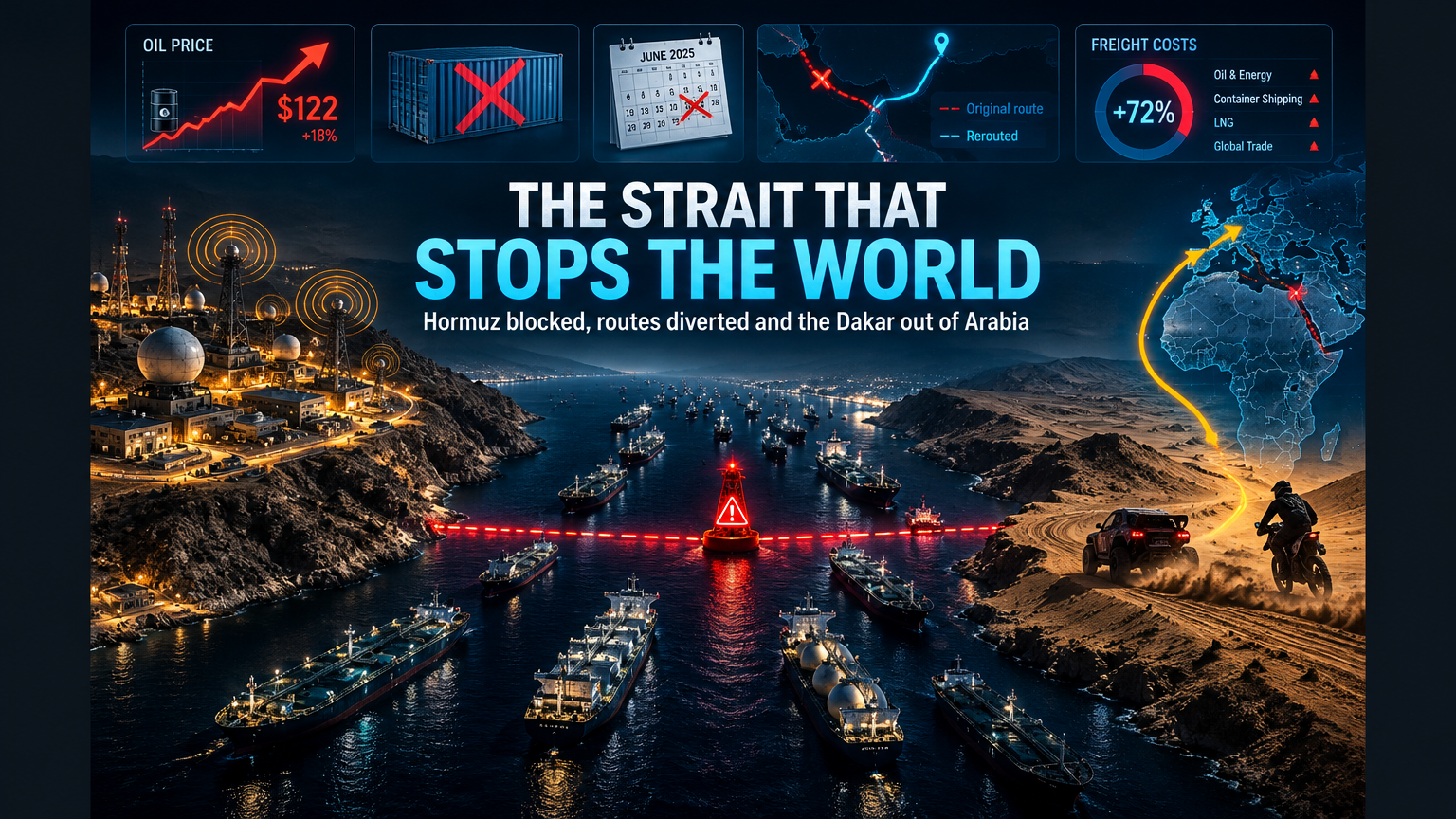
An off-road rally and a 39-kilometre-wide sea strait have, in principle, nothing in common.
In October 2026, they did. The Dakar Rally announced that the 2027 edition will not take place in Saudi Arabia. The official reason was “recent developments in the region”. The real cause sits in the Strait of Hormuz, closed since 28 February, and in Houthi attacks on Saudi territory.
It is the most visible proof of something the markets have known for eight months: when a chokepoint closes, the impact does not stay in oil. It reaches sport, insurance, freight and the invoice of anyone who never thought about Hormuz in their life.
What is blocked, and since when
The Strait of Hormuz has been effectively shut since 28 February 2026, when the conflict between the United States and Iran began, after Israeli and US strikes on Iranian territory.
The figure that gives it scale: roughly one fifth of the world’s oil and liquefied natural gas normally passes through it.
The blockade is not theoretical. On Friday, 30 October, an LNG tanker was attacked. On Sunday, 1 November, UK Maritime Trade Operations received a report of a vessel struck by a projectile in the strait. Ships are transiting the waterway with their transponders off, to avoid detection.
The Iranian two-day proposal
This Monday, 2 November, Tehran changed its tone.
Foreign Ministry spokesman Esmaeil Baghaei said Iran is examining a plan to reopen the Strait of Hormuz in two days, rather than the seven days of the previous proposal. The condition is that Washington accepts Iran’s demands.
The sequence described is mechanical: on day one, the United States implements a set of measures; on day two, the strait reopens and navigation returns to its previous state.
The demands, according to Iranian media and AFP, include a regional ceasefire, the release of Iranian assets abroad, an end to sanctions on the oil sector, an end to the US naval blockade of Iranian ports, and a new maritime route for the strait, defined jointly with Oman.
Foreign Minister Abbas Araghchi had already detailed the proposal in an interview released on 1 November, and confirmed that indirect talks with the United States continue, mediated by Qatar. But he added the caveat that matters: “we have not yet reached a concrete result”.
What Iran says about a new war
The same Sunday, Tehran hardened its language.
According to France 24, Iran said a renewed war with the United States could last longer than the previous round, and threatened retaliation without geographical limits. Trump, for his part, suggested Washington still has targets to strike.
That combination defines the moment: a diplomatic proposal on one side, a threat of escalation on the other, both in the same week.
The warning to the Gulf states
Bloomberg reported on 1 November that Gulf states fear a fiercer Iranian retaliation if US and Israeli attacks resume.
The fear has a technical basis. US bases in the region are, at the same time, the logistical platform for the offensive and the closest target for the Iranian response. Whoever hosts those bases enters the equation without having signed anything.
Secretary of State Marco Rubio said no decision had been made on fresh strikes and that Trump prefers a diplomatic resolution to the eight-month conflict. The White House nonetheless keeps all options on the table.
The price of a barrel, in two days
The oil numbers tell the story better than any analysis.
On Friday, 30 October, Brent rose 2.4% to close at $117.64 a barrel, after touching $118. It was the fourth consecutive monthly gain and a six-month high. WTI closed at $104.12.
On Monday, 2 November, with the Qatar talks reviving hope, Brent fell 2% to around $111, and WTI to around $102.
Two moves of several dollars in two trading days, on the same news: the possibility of the strait reopening.
OPEC+ kept December production quotas unchanged, removing the market’s usual escape valve.
Why the Dakar left Saudi Arabia
Here is the part that matters to anyone running a business rather than a country.
On 25 October, the Amaury Sport Organisation and the Saudi Motorsport Company jointly announced that Dakar 2027, scheduled for 1 to 15 January, would not be held in the Kingdom. The decision was taken with the support of the FIA and the FIM, and described as “exceptional and one-off”.
On 30 October, the FIA confirmed the destination: Portugal and Morocco, from 9 to 23 January 2027. A prologue and first special in Portugal, followed by eleven stages in Morocco, almost 8,000 kilometres in total, with 4,341 kilometres of specials. It is the Dakar’s return to Africa after 20 years.
Saudi Arabia hosts the 50th edition in 2028.
And the Dakar was not an isolated case. According to Al Jazeera and MENAFN, the Jeddah Formula 1 Grand Prix was cancelled, the Bahrain race was called off and later rescheduled in Malaysia under the same name, and the final round of the World Rally Championship in Saudi Arabia, due this month, was also scrapped. The UCI Urban Cycling World Championship in Riyadh, from 3 to 7 November, is cancelled.
What this teaches anyone who does not sell oil
The temptation is to treat this as an energy problem. It is not. It is a supply chain and geographic risk problem, and it reaches sectors that never considered themselves exposed.
First, the cost of transport. Diverted routes and ships sailing with transponders off mean more expensive insurance, longer lead times and thinner margins. Whoever imports or exports feels it on the invoice, not in the news.
Second, the cost of operating in a country. An international sporting event, a corporate event, a trade fair, a business delegation: all depend on a risk assessment that changes week to week. The Dakar did not leave Saudi Arabia for sporting reasons. It left because the security calculation stopped adding up.
Third, the speed of decision. ASO made the decision on 19 October, communicated it internally that day and announced it publicly on the 25th. Six days between perceiving the risk and deciding. A company that discovers the problem through its invoice does not have six days of advantage.
That is the logic behind a well-built digital structure: it is not about predicting the unpredictable, it is about having data organised so you can decide fast when the scenario changes.
What to do with this information
Three concrete actions, in order of usefulness.
Map your geographic exposure. List suppliers, import routes and customers by country. If you cannot answer “where is my operation exposed” in ten minutes, the map does not exist.
Turn the energy price into scenarios. A barrel at $118 and at $111 in the same week is not noise, it is structural volatility. Build three cost scenarios and test the impact on margin. That is the field of data science applied to business: replacing “let’s see how it goes” with “the data shows three paths”.
Automate the watch. Brent price, risk news, freight quotes, supplier alerts. Nobody can read this manually every day. It is exactly the kind of routine intelligent automation sustains without depending on human memory.
This is the kind of structure Rapid Genius builds before the crisis arrives rather than during it: those with data already organised decide in days, those without decide in months.
The limits of this reading
Three caveats, so that analysis does not become prediction.
First, the reopening is a proposal, not a fact. Iran conditioned it on US acceptance of five demands, and the foreign minister himself admitted there is no concrete result. The oil drop reflects hope, not confirmation.
Second, the attacks continue. A ship was struck by a projectile on Sunday, after an LNG carrier attack on Friday. The waterway is not safe just because there are talks.
Third, the US election calendar of 3 November weighs heavily. Several decisions, including the military one, are conditioned on the result. Any reading made before that date has a short shelf life.
Conclusion: 39 kilometres that move everything
The Strait of Hormuz has been closed since 28 February 2026, and one fifth of the world’s oil and LNG used to pass through it. Iran proposed reopening it in two days, with five conditions. Brent closed October at $117.64 and fell to around $111 on Monday. Gulf states fear fiercer retaliation if attacks resume.
And Dakar 2027 moved to Portugal and Morocco, with the prologue and first special on Portuguese soil, between 9 and 23 January.
The lesson is not about Iran or about oil. It is about the distance between a chokepoint and your operation. That distance is always shorter than it looks.
The question that remains:
If the route bringing your products, or the energy moving your operation, closed for two weeks, how many days of real autonomy would you have?
It is worth knowing the answer before the market gives it for you.