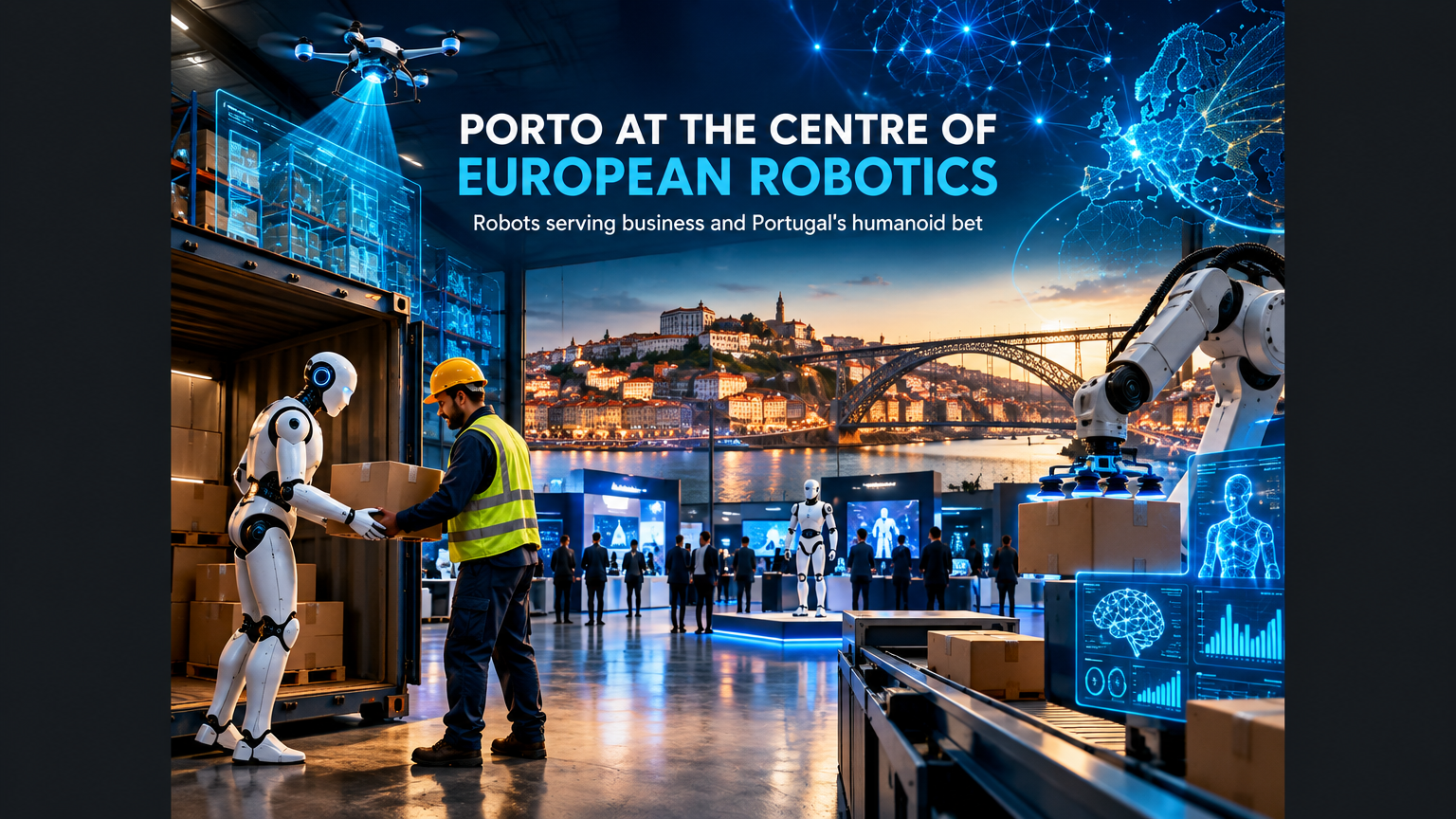
For two days, Porto was the European capital of artificial intelligence, data and robotics.
On 13 and 14 October 2026, the Alfândega do Porto hosted ADRF26, the AI, Data and Robotics Forum, presented as Europe’s largest gathering across the three fields. Around 500 participants from more than 30 countries attended the event, organised by INESC TEC and ADRA, the European AI, Data and Robotics Association, with the support of the European Commission.
But what made this forum different was not the number of attendees. It was what happened on the exhibition floor.
Instead of panels about the future, ADRF26 put Portuguese robots to work in front of visitors and journalists, performing tasks that are still done by hand in real companies today.
What was demonstrated in Porto
The first demonstration took place on the 13th, at 10:00, at the INESC TEC stand.
Inside a shipping container, temperatures can reach 50 °C in summer. That is where the boxes supplying Portuguese retail are still often unloaded by hand, frequently at night. In 2023, 56.8% of the goods arriving in Portugal came in by sea, which makes container unloading one of the tasks major distributors are most keen to automate.
The robot is called CARGO, and it did the job on its own.
The solution combines an omnidirectional mobile base, a robotic arm, a suction gripper and RGB-D vision. The software, developed entirely by INESC TEC, is modular and hardware-agnostic, and it detects boxes even when they are arranged irregularly.
The most interesting detail of the demonstration was the collaboration: a human operator worked alongside a humanoid robot to collect the boxes removed from the container. It is not replacement, it is task division.
The second demonstration, on the 14th at 18:00, showed a drone taking warehouse inventory.
DRIVOLUTION grew out of a Recovery and Resilience Plan (PRR) mobilising agenda that brought together 38 partners and more than €50 million in investment to create the automotive sector’s “Factory of the Future”. It has already been tested at Volkswagen’s facilities. Beyond counting stock, it identifies free spaces on shelves and locates materials, reducing search times and increasing traceability.
Both solutions came from research largely funded by the PRR and have already reached real-world use cases in Portuguese companies. CARGO, for instance, grew out of a use case identified by Sonae MC.
The forum’s central question
ADRF26 brought together officials from the European Commission, industry and research around a question that runs across the whole continent: how do you turn European R&D investment into industrial return?
It is an uncomfortable question, because Europe has a well-known historical problem. It produces first-rate science but loses the commercialisation race to the United States and China. The continent invents, and others scale.
The forum’s programme reflected that concern: more than 40 workshops and 6 plenary sessions, with more than 20 speakers, including Nicolas Schneider of Airbus, Manuela Veloso of JP Morgan AI Research, and Monsignor Vincenzo Paglia of the Pontifical Academy for Life.
The second day was opened by João Barros, president of AI2, Portugal’s new agency for research and innovation, followed by Ricardo Bento, vice-president of CCDR-N. The closing session was led by Arlindo Oliveira, of INESC holding and Instituto Superior Técnico, and Emanuela Girardi, president of ADRA.
Twenty sponsors were present, from AMD and Qualcomm, platinum sponsors, to PAL Robotics and TNO, among others. For the first time, the event also featured a project hub category, represented by entities such as EDP, Norway’s NORCE and Germany’s DFKI AI.
Portugal’s humanoid bet
While Porto discussed how to bring research to market, news from two weeks earlier showed that this transition is already under way in Portugal.
On 6 October 2026, in Lisbon, SDATA AI, a company from Vila Nova de Famalicão in the Minho region, formalised its partnership with China’s AGIBOT and took on the role of official distributor of humanoid robots in Portugal.
The figures the company put forward show the scale of the ambition:
- between 60 and 100 humanoid robots could be working in Portugal within a year;
- sales could reach 1,500 units per year within two to three years, as pilot projects move to larger scale;
- AGIBOT estimates the Portuguese humanoid market could exceed
€10 billionover the next 20 years.
The range available in Portugal goes from the A2 and X2 humanoid series to the G2 industrial robots, the D1 quadrupeds and the C5 cleaning solutions. The anticipated application sectors are industry, logistics, hospitality and services.
Prices vary widely by model. According to Portuguese press, they start at $26,000 for the simplest versions and can exceed $160,000 per unit, with references pointing to even higher figures for top models.
Paulo Silva, executive board member at SDATA AI, sums up the project’s philosophy: physical AI does not intend to replace people, but to free them from repetitive tasks.
Distributing today, manufacturing tomorrow
Precision matters here, because there is an important difference between what is already happening and what lies on the horizon.
What is confirmed is distribution. SDATA AI has been an authorised official AGIBOT distributor since July 2026 and publicly presented the partnership in October.
What lies on the horizon is local manufacturing. The stated ambition of scaling to 1,500 units per year and the possibility of manufacturing on Portuguese soil were mentioned in the context of the partnership, but there is no confirmed humanoid factory in operation in the Minho region yet.
The distinction matters because it defines the country’s real stage. Portugal is entering humanoid robotics through the door of distribution, integration and technical support, which is exactly where competence is built before hardware is built.
And there is a strong argument for that sequence. AGIBOT, founded in Shanghai in February 2023, closed September 2026 with 20,000 units produced since its founding. The pace is revealing: only three months passed between the 5,000th and the 10,000th robot.
In the first half of 2026, AGIBOT delivered 9,700 units, according to Counterpoint, or more than 8,600, according to IDC, in a global market that moved more than 22,000 units in the period. It is a scale no European manufacturer can match alone today.
What this means for businesses
Here is the connection to the ground of this blog.
ADRF26 and the SDATA AI case tell the same story from two different angles: robotics has left the laboratory and entered operations.
Three practical lessons stand out.
1. Automation has reached the physical layer
For years, automating meant connecting systems, eliminating clicks and accelerating information flows. CARGO unloading containers and the drone taking inventory show that automation has reached manual labour, which until recently was exclusively human territory.
Companies that have already organised their digital processes hold an advantage: the physical layer fits on top of a foundation that already exists.
2. The bottleneck changes place
When repetitive tasks start being performed by machines, value shifts to those who know how to define processes, integrate systems and manage collaboration between people and robots. The INESC TEC demonstration is exemplary: the robot removes the boxes, the humanoid and the operator work together, and someone had to design that flow.
That is exactly the work Rapid Genius develops with intelligent automation: mapping processes, connecting tools and putting operations on autopilot, today in the digital layer and increasingly prepared for the physical one.
3. Whoever defines the process controls the result
A humanoid robot does not enter a company and decide on its own what to do. It executes a defined process. Whoever designs that process, with metrics and oversight, extracts value. Whoever improvises accumulates expensive problems.
And there is an earlier layer that decides everything: data. Without organised, auditable records, it is impossible to measure a robot’s return or correct course. That is the role of data science applied to operations.
The honest limits of the moment
A balanced article must mark what is still unresolved.
The price of humanoids, between $26,000 and more than $160,000 per unit, limits adoption to companies with capital and clear returns. The Portuguese market is, as SDATA AI itself acknowledges, small for now. And local humanoid manufacturing in Portugal is a stated possibility, not an accomplished fact.
It is also worth noting that Europe, despite the quality of its research, still depends on Asian and American technology in the most advanced layers. ADRF26 exists precisely because that dependence is uncomfortable.
None of this diminishes the move. It defines what it is: the start of a curve, not its peak.
Conclusion: from the laboratory to the factory floor
ADRF26 placed Porto at the centre of the European debate on artificial intelligence, data and robotics, with 500 participants from more than 30 countries, 40 workshops and demonstrations of Portuguese robots performing real tasks in real companies.
In the same fortnight, SDATA AI, from Minho, presented the distribution of AGIBOT’s humanoids in Portugal, with a target of 60 to 100 robots working in the country within a year and the ambition of scaling to 1,500 units annually in two to three years.
The country entered humanoid robotics through the door of distribution and integration. Mass production is the next chapter, still open.
For businesses, the message is direct: physical automation has reached the Iberian market, and those who organise their processes and data today will be ready to integrate it tomorrow.
The question that remains:
If within two years a robot could perform the repetitive tasks of your operation, would your processes be ready to receive it, or would today’s mess simply be digitized into metal?
The answer to that question separates adoption leaders from those who pay to learn.