Imagine building a technology capable of transforming work, education, marketing, programming and almost every area of human knowledge.
Now imagine that, in order to teach that technology how to work, you need enormous amounts of information created by other people.
Then comes the question:
Who owns that knowledge?
That is where one of the most important legal battles in the history of artificial intelligence begins.
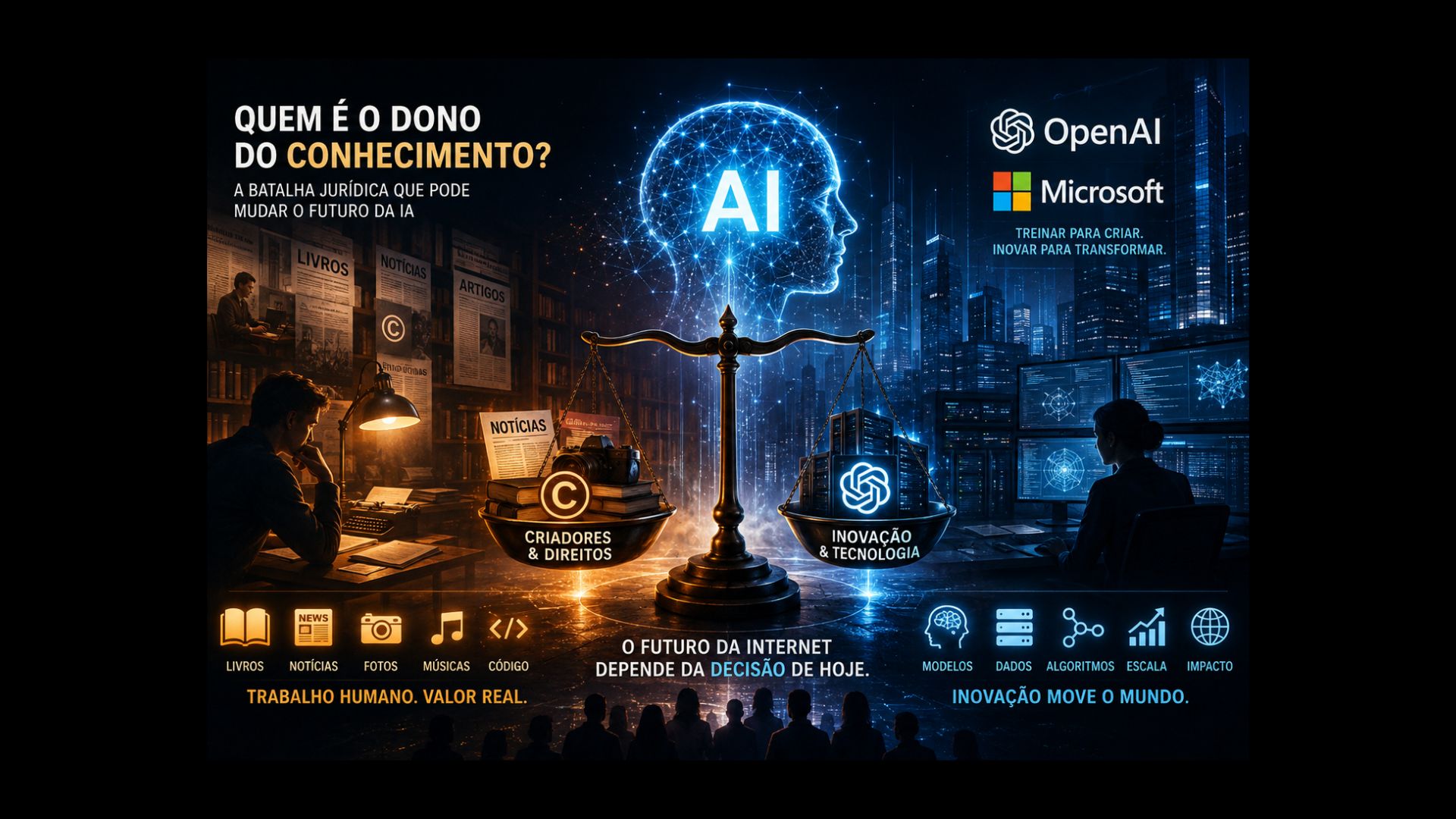
On one side are OpenAI and Microsoft.
On the other are The New York Times, authors and other copyright holders.
At the heart of the dispute is a simple question:
Can an AI company use copyrighted books, news articles and other protected material to train its models without individually obtaining permission from their creators?
It may sound like a legal question.
But it is much bigger than that.
Depending on what the courts decide, the outcome could change how AI models are trained, how creators are paid and even how expensive it becomes to build advanced AI systems.
🚨 What Is Really at Stake?
The dispute revolves around a fundamental concept:
Fair use.
Under U.S. law, certain uses of copyrighted material may be permitted without the copyright holder’s permission, depending on the circumstances.
OpenAI argues that training AI models can fall within this principle.
The company says its models do not simply store books and articles for later reproduction.
Instead, the systems analyze enormous amounts of information to learn language patterns and generate new content.
OpenAI considers this process transformative and therefore protected by fair use.
Authors and publishers strongly disagree.
📰 What Is The New York Times Arguing?
The New York Times lawsuit accuses OpenAI and Microsoft of using millions of Times articles without authorization to develop and train their AI systems.
From the plaintiffs’ perspective, this is not simply about learning from information.
They argue that the companies used copyrighted works to build commercial products that can compete directly with the creators of that content.
And that changes everything.
Because if an AI system can absorb the work of thousands of journalists and writers and then answer users’ questions without requiring them to visit the original websites or buy the original books…
who receives the economic value created by that work?
That is one of the central questions of this legal battle.
🤯 Now Imagine This at Global Scale
Think about all the content available online:
- news;
- books;
- articles;
- photographs;
- videos;
- music;
- research;
- illustrations;
- courses;
- blogs;
- documents;
- software code.
Much of that material was created by humans.
Now imagine AI systems using enormous amounts of that material to learn.
The inevitable question becomes:
Is AI learning from humanity, or is it using humanity’s work without paying for it?
That is precisely the boundary courts are beginning to define.
⚔️ OpenAI vs. Authors: Two Completely Different Views
OpenAI’s position is essentially this:
Training an AI model is not the same as copying a work and selling it.
The company says the purpose of training is to extract statistical and linguistic patterns from large datasets so that models can produce new content.
Authors and publishers argue the opposite:
OpenAI used works created by other people to build highly valuable commercial products.
From their perspective, that should require authorization and potentially payment.
It is a huge philosophical difference.
Is AI learning — or exploiting?
The courts may help determine the answer.
💰 What If the Courts Rule Against OpenAI?
This is where the entire industry could change.
Imagine the court determines that AI companies cannot use large quantities of copyrighted material without permission.
The current development model could undergo a major transformation.
Companies might need to:
💵 License content
Pay copyright holders to use books, news, images and other material.
📚 Negotiate directly with creators
Authors, publishers and media organizations could become data suppliers for AI companies.
🧾 Create compensation systems
Creators could potentially receive payment based on how their works are used.
🔐 Restrict training data
Models could increasingly rely on licensed or public-domain material.
That could significantly increase the cost of developing large AI models.
🚀 But What If OpenAI Wins?
The impact would also be enormous.
An OpenAI victory could strengthen the argument that AI training is a transformative use of copyrighted works.
That could give AI companies greater freedom to develop new models using enormous amounts of information.
And it could accelerate technological progress.
More data.
Larger models.
More competition.
More applications.
Faster development.
But another question would remain:
Who makes sure creators are properly compensated?
⚖️ Why This Case Is Even More Interesting
OpenAI is not entering this battle without legal arguments.
In 2025, federal judges in the United States issued decisions in cases involving Anthropic and Meta that found certain uses of copyrighted works for AI training could qualify as transformative fair use, although the circumstances of those cases were different.
That matters because there is still no single, universal answer.
And that is precisely why the OpenAI case is so important.
🧨 The Entire Industry Is Watching
OpenAI isn’t the only company that needs clarity.
Companies such as:
Google, Meta, Anthropic, Microsoft and many others
also need to know which rules will prevail.
If AI training is broadly protected under fair use, companies will have more freedom to continue developing their models.
If courts decide that certain uses require licensing, the industry changes.
And it changes for everyone.
📰 The Future of Journalism Is Also at Stake
There is another fascinating dimension.
For decades, newspapers made money by getting people to visit their websites and read their content.
Now imagine asking ChatGPT:
“What happened in the markets today?”
And receiving a complete answer without visiting ten different websites.
For the user, that’s fantastic.
For the publisher, it could be a problem.
There is a huge difference between:
“AI helped someone find my content.”
and
“AI answered the user and eliminated the need to visit my content.”
That difference could represent billions of dollars in the future.
📉 What Happens If AI Replaces Website Visits?
This may be one of the biggest concerns for publishers.
If people stop clicking on:
- newspapers;
- blogs;
- magazines;
- specialist websites;
- information portals;
because AI systems already provide the answers directly…
How will those websites make money?
Advertising?
Subscriptions?
Licensing?
Partnerships with AI companies?
A new model may emerge.
And that is why this legal battle is about much more than copyright.
It could redefine the economics of the internet itself.
💡 Content Could Become a New Raw Material
There is an interesting way to look at this situation.
During the Industrial Revolution, raw materials such as oil, coal and metals were essential to building products.
In the AI economy, data and content may become a kind of intellectual raw material.
Books.
News.
Code.
Images.
Videos.
Research.
Documents.
All of these can help AI systems learn.
And if data is such a valuable raw material…
Who controls that raw material?
That may become one of the defining economic questions of the next decade.
🔥 Could Creators Finally Gain More Power?
There is also a potential positive side for writers, journalists and other creators.
If courts determine that companies need permission to use certain content, that could create a huge licensing market.
Imagine:
A writer publishes a book.
An AI company wants to use it for training.
The writer gives permission.
There is a contract.
There is payment.
There is tracking.
The creator gains a new source of revenue.
That could create an entirely new economy around digital content.
🚨 But There Is a Problem: What If You Can’t License Everything?
Now imagine an AI model trying to learn from millions or billions of documents.
Could a company negotiate individually with every author?
Probably not.
That’s why new models may emerge.
Collective licensing platforms.
Data marketplaces.
Automated royalty systems.
Certified content databases.
Standardized contracts.
Perhaps even something like a “Spotify for AI training content,” where companies pay to access huge catalogs of works.
Technology could create an entirely new legal and commercial industry.
⚖️ The Battle Is Now Entering a Critical Phase
On September 4, 2026, OpenAI and Microsoft filed their summary-judgment motions in the litigation involving The New York Times and authors. The plaintiffs also filed their own motions.
A summary-judgment motion allows a court to resolve legal issues without a full trial when there are no material factual disputes requiring a trial.
That means the case has entered a particularly important stage.
This is no longer just a public debate.
The parties are asking the court to make concrete decisions about the legal foundations of the dispute.
🧠 OpenAI Says AI Training Is Transformative
OpenAI’s position is clear.
The company says model training is not intended to reproduce original works, but rather to learn patterns that allow the system to generate new content.
It also points to previous decisions that recognized certain AI training uses as transformative.
But authors argue that:
without the human works used during training, these systems would not have the same capabilities.
And that argument is difficult to dismiss.
💥 The Real Conflict: Human Creativity vs. Machines
Perhaps that is why this legal battle attracts so much attention.
For centuries, creativity was fundamentally human.
A writer wrote.
A journalist investigated.
A photographer took photographs.
A musician composed.
A programmer created.
Now there is a machine capable of learning patterns from all of these forms of human expression.
And an uncomfortable question emerges:
If a machine learns from millions of human works and then produces something new, how much of that creation belongs to the machine — and how much belongs to the humanity that taught it?
There is no simple answer.
And courts may now have to start building one.
🌎 An American Decision Could Influence the Rest of the World
Even though this case is being fought in the United States, its consequences could reach far beyond America.
AI companies operate globally.
Creators are everywhere.
Content crosses borders.
And countries around the world are developing their own rules for artificial intelligence and copyright.
A major court decision could influence:
- new legislation;
- licensing agreements;
- business partnerships;
- data policies;
- business models;
- AI investment.
That is why this is not simply an American dispute.
It is a dispute about the rules of the next digital economy.
🔮 What Could Happen Next?
There are several possibilities.
🟢 Scenario 1 — OpenAI Wins
AI training receives broader protection under fair use.
The industry gains more freedom.
Model development could accelerate.
🔵 Scenario 2 — Authors and Publishers Win
Training on certain copyrighted content requires authorization or licensing.
Model development could become more expensive.
Creators gain greater negotiating power.
🟡 Scenario 3 — A Middle Ground
Perhaps this is the most interesting scenario.
Courts could recognize that some uses are permitted while placing limits on others.
That could encourage a hybrid system:
fair use + licensing + specific rules for certain types of content.
Such a system might allow AI to keep advancing without destroying the economic incentives for human creativity.
💭 Now Think About What Is Really at Stake
This battle is not simply:
OpenAI vs. The New York Times.
It is:
AI vs. the traditional model of intellectual property.
It is:
data vs. copyright.
It is:
innovation vs. creator compensation.
And perhaps it is also:
the old internet vs. the future internet.
🚀 The Industry May Never Be the Same
Imagine looking back ten years from now.
Perhaps this dispute will be remembered as one of the moments that defined the relationship between artificial intelligence and intellectual property.
Perhaps AI companies will have to pay to use certain types of content.
Perhaps enormous licensing markets will emerge.
Perhaps creators will receive royalties whenever their work contributes to AI systems.
Or perhaps courts will decide that AI training is transformative and allow the industry to continue operating much as it does today.
We don’t know yet.
But one thing is already clear:
The answer is far too important to remain inside a courtroom.
It could determine who gets paid in the new AI economy.
And, most importantly, it could help answer a question we are only beginning to ask:
Who owns knowledge when a machine learns from all of us?