There is a detail in this project that almost nobody mentions, and it changes how you read it.
The skin was not glued to the robot. It was grown on it.
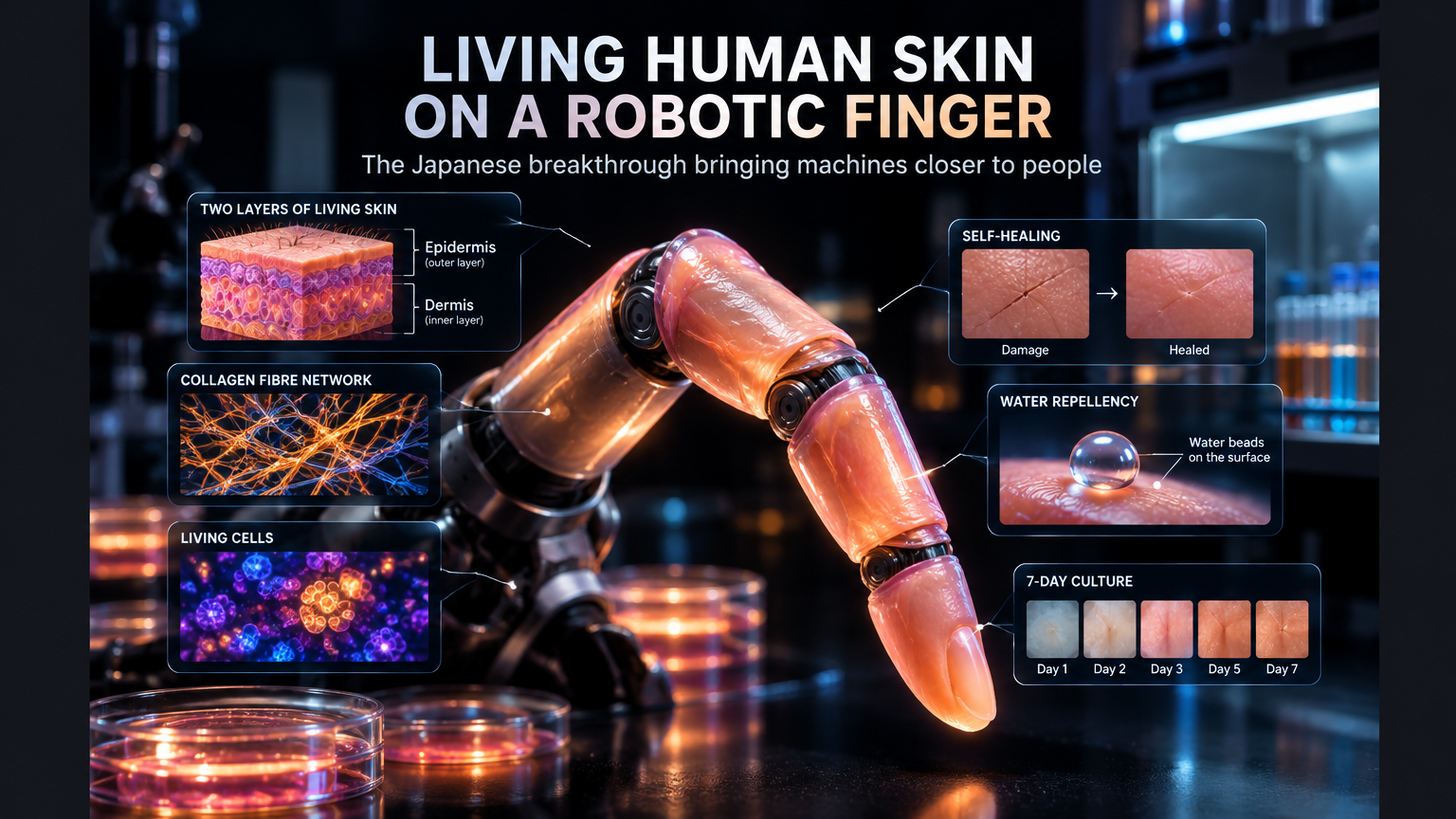
Professor Shoji Takeuchi’s team at the University of Tokyo submerged a three-joint robotic finger in a solution of collagen and human dermal fibroblasts. The tissue formed around the mechanical structure, adapting to its shape. Epidermal cells were then seeded on the surface, creating the outer layer that provides the barrier.
The result was published in the journal Matter and is the world’s first robot covered in living skin.
What the skin actually does
Three properties, and each has a practical consequence.
It repels water. The epidermal layer forms a functional barrier, as in human skin. Without it, the tissue would dry out and die on contact with the environment.
It forms natural wrinkles. When the finger bends, the skin wrinkles at the joints. It sounds cosmetic, but it is not: it means the tissue follows the mechanical movement without tearing.
It heals. Here it is worth being precise, because the difference matters. The skin does not regenerate on its own like something from science fiction. What the team demonstrated was assisted repair: they applied a collagen sheet over a deliberate cut, and within about seven days the fibroblasts migrated into the sheet, sealed the wound and the skin could withstand joint movement again.
The inspiration came from the medical treatment of deep burns with grafted hydrogels. It is tissue engineering applied to a robot, not magic biology.
What comes next
The researchers want to add hair follicles and sweat glands. The stated goal is to let the robot sweat and simulate the sensation of human touch.
It is worth noting that the original 2022 paper already described the finger as “slightly sweaty” when it came out of the culture medium. It was laboratory humour, but it pointed in the right direction: the next frontier is not appearance, it is biological function.
Why this matters to anyone who does not build robots
Here is the part that justifies this article on a business blog.
The medical robots market was valued at around $22.08 billion in 2026, projected to reach $74.07 billion by 2034, according to Fortune Business Insights. Surgical robots account for about 22% of that market.
And the elder care assistive robots segment grew from $3.48 billion in 2025 to $4.05 billion in 2026, projected to reach $7.37 billion by 2030, according to The Business Research Company.
Notice what these two numbers have in common: both depend on physical contact with people. Surgery and elderly care are exactly the two applications the Japanese team identifies as the practical goal.
And that is where skin stops being a scientific curiosity and becomes a product requirement.
The real problem the skin solves
An industrial robotic arm does not need skin. It works in isolation, behind a barrier, with an operator at a safe distance.
A robot that helps an elderly person get out of bed does. Not for aesthetics, for safety.
Three concrete reasons.
First, pressure distribution. A rigid surface concentrates force on small points. A soft surface spreads it. On a human arm, that is the difference between support and a bruise.
Second, friction. Metal or plastic against human skin slips or grips unpredictably. A coating with skin-like properties behaves more predictably.
Third, acceptance. An elderly person accepts being touched by something that does not look like a machine more easily. This is not vanity, it is adherence to care. And adherence is what determines whether a care technology works or stays on the shelf.
This is the kind of reasoning behind a well-built digital structure: technology only creates value when it solves a concrete problem for the person using it, not when it impresses the person funding it.
What is still missing, and it is a lot
I will be direct about the limits, because enthusiasm for this kind of news usually outruns the data.
The skin has no blood vessels. Without circulation, there is no long-term nutrient supply. The tissue survives in culture, not in continuous use over months.
It has no immune system. Any infection has no defence. In a hospital environment, that is a serious problem.
It has no nerve endings. The robot still feels nothing. The skin protects, but does not inform.
Cost and scale are unknown. Growing skin around a finger in a lab is different from producing coatings for thousands of units.
And there is the ethical question. A robot with living human skin raises questions engineering cannot answer: how is it disposed of? What consent is needed for the cells? Where is the line between tool and organism?
None of these objections invalidates the advance. All of them define how long it will take to reach the market.
What this teaches about innovation
Three lessons, and none of them is about robotics.
The first: real advances arrive in layers. This project started in 2022 with a finger and one layer of skin. In 2026, the goal is to add follicles and glands. Each layer solves one problem and creates two new ones. That is how serious innovation works, and it is why press releases always exaggerate the timeline.
The second: value lies in application, not invention. The technique of growing skin already existed for other purposes. What the team did was apply it to a different problem. Many companies look for the next disruptive technology when the advantage lies in applying well what already exists to their own context.
The third: the boundary between sectors is disappearing. Biology and robotics were separate fields. Today they share a laboratory. The same happens in any business: whoever treats data as a separate department loses the advantage of crossing it. That is exactly what data science applied to business makes possible: crossing information that used to live in silos.
What to do with this information
Two concrete actions, and they are simple.
Watch the sectors where physical contact is unavoidable. Healthcare, elderly care, rehabilitation, early childhood education. These are the markets where robotic skin arrives first, because they are the ones with the most to gain from it.
Prepare your operation for shorter innovation cycles. If a laboratory advance can change the rules of a sector in five years, the company that learns about it from the press arrives late. The one with automated signal monitoring arrives on time. It is the kind of routine intelligent automation sustains without depending on someone remembering to read the news.
This is the kind of reading Rapid Genius does before the technology reaches the market, not after: those who understand the signal early decide with margin, those who wait for the product decide in a hurry.
Conclusion: the machine that learned to heal
In 2022, a team at the University of Tokyo grew living human skin around a three-joint robotic finger, with two layers, water repellency and the ability to repair cuts with a collagen sheet in seven days.
The next step is hair follicles and sweat glands. The goal is robots safe for surgery and for caring for the elderly.
The medical robots market is heading towards $74 billion by 2034, and the elder care assistive robots market towards $7.37 billion by 2030. Both depend on touching people.
The question that remains:
If your sector depends on physical contact with people, what changes in your operation when the machine stops being cold?
It is worth thinking about before the answer arrives ready-made.