Article 3 of 3 in the special series on cryptocurrencies and the future of business
The series that began with the market landscape and moved through stablecoin payments now ends at the most important point.
Because, in the end, the question that matters to anyone running a business is not about currencies.
It is about what the technology behind them, blockchain, can do beyond transferring value.
The short answer: record, automate and execute agreements.
The long answer is the subject of this article. And, for the first time in years, it comes with numbers showing real adoption, not just promises.
What a smart contract is, without the jargon
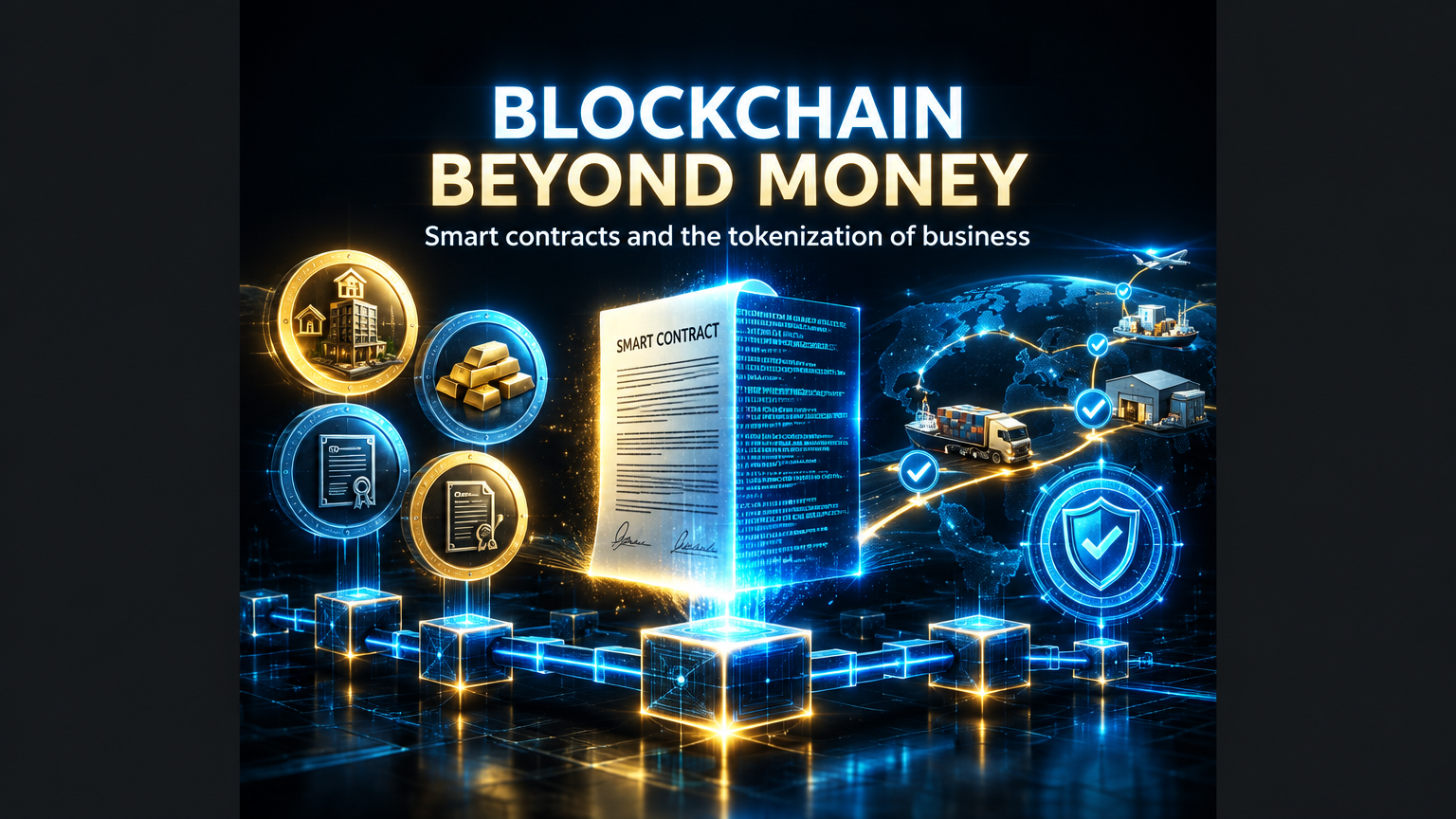
A smart contract is a program stored on a blockchain that automatically executes the conditions agreed between parties.
Think of a vending machine. You insert the coin, the machine delivers the product. Nobody needs to trust the seller, verify the change or wait for an employee. The rule is embedded in the machine.
A smart contract works with the same logic, applied to commercial agreements:
- if the client pays, access is released;
- if the goods arrive at the confirmed destination, the supplier payment is released;
- if the policy meets the stated condition, the claim is executed;
- if the deadline passes, the penalty is calculated.
The difference from a traditional paper contract is that execution does not depend on trust, manual collection or litigation. It depends on code, visible and verifiable by all parties.
This does not replace lawyers or formal contracts. Smart contracts coexist with the legal framework and, in many cases, are accompanied by a legal contract defining what happens outside the code.
But for repetitive and measurable tasks, they eliminate an entire layer of friction.
Tokenization has left the pitch deck and entered the numbers
In article 1 of this series, we mentioned tokenization as the next frontier. It has arrived.
According to Binance Research, the tokenized real-world asset market reached about $38 billion in September 2026, a 50% increase since the beginning of the year, even as the rest of the on-chain market contracted.
The most revealing detail is the composition of that growth.
Tokenized U.S. Treasuries account for the largest share, with about $14.6 billion in distributed value, according to the RWA.xyz tracker. BlackRock operates BUIDL, a tokenized money market fund holding billions in assets, and Circle’s USYC overtook it as the sector’s largest product.
And the fastest-growing category in 2026 is neither bonds nor funds: it is tokenized stocks, which crossed $3 billion in market capitalization in September, according to Binance Research.
This means asset managers, the same firms that run trillions in traditional funds, are putting real products on blockchain. This is not a startup experiment. It is the financial market migrating ownership records to shared ledgers.
A survey released by Coinbase with EY-Parthenon indicates that 67% of institutions are prioritizing asset tokenization over the next two years.
Projections for the next decade vary but point in the same direction: McKinsey estimates $2 trillion in tokenized assets by 2030, excluding stablecoins, and Ark Invest projects up to $11 trillion over the same horizon.
What tokenization changes in practice
Tokenizing an asset means representing its ownership as a digital token recorded on a blockchain.
The practical effects appear on three fronts.
Liquidity
Traditionally illiquid assets, such as private credit fund shares or real estate, can be divided into smaller fractions. An investor who could not afford an entire property can acquire a tokenized fraction.
Operational efficiency
Settling a property transfer that takes days through registries and custodians can be executed in minutes on the ledger, with a complete and verifiable history.
Access
Products once restricted to large investors can be fractionated and offered to a broader audience, within each jurisdiction’s rules.
Technical maturity has also advanced. In May 2026, the ERC-7943 standard reached final status on Ethereum, defining a universal, vendor-neutral interface for compliant real-world asset tokenization. Standards like this are what allow different institutions to interoperate without depending on a single vendor.
Use cases that already work outside finance
Here is the part that matters most to companies that are not banks.
Supply chain traceability
Blockchain provides a shared, immutable record where every movement of goods, transfer of possession, inspection and certification is recorded and accessible to authorized participants.
Real applications include:
- food tracking from origin to point of sale;
- authenticity verification for luxury goods and medicines;
- origin certification in commodities;
- proof of sustainable practices across production chains.
The gain is not blockchain itself. It is the end of disconnected spreadsheets between companies that need to trust each other.
Smart contracts in commercial operations
Payments, purchase orders, approvals and releases can be automated when conditions are verifiable. Industry analyses indicate that the combination of smart contracts with artificial intelligence already operates across supply chains, finance, healthcare and compliance, reducing manual handoffs between systems.
Proof of existence and intellectual property
Recording the authorship of a work, the hash of a document or the creation date of a project on blockchain creates a verifiable proof of existence independent of any single company.
Loyalty programs and digital assets
Loyalty points, coupons and credentials can be issued as tokens, becoming transferable, auditable and integrable across commercial partners.
Separating what works from what is still a promise
A closing article needs honesty.
What already works today:
- tokenization of bonds and funds, with billions in production;
- regulated stablecoins in real payments;
- traceability in specific high-value supply chains;
- ownership and provenance records in selected niches.
What is still a promise or under construction:
- real estate tokenization at scale, blocked by legal registry issues;
- smart contracts for complex agreements with many contingencies;
- full interoperability between different blockchains;
- universal digital identity;
- broad adoption by small businesses outside specific niches.
Forbes brought a relevant warning in July 2026: the tokenized market is worth tens of billions, but much of it is not moving. The promised liquidity remains uneven across categories.
That does not invalidate the technology. It separates strategic adoption from sales-pitch enthusiasm.
What this means for ordinary businesses
The practical question for anyone who is not a bank or a logistics giant is simple: where does this affect me?
On three fronts, over the coming years.
As a customer and supplier
You will buy from companies using blockchain to guarantee authenticity, tracking and provenance, often without noticing. The verification seal will be the interface.
As a competitor
Companies that adopt transparent records and automated agreements will operate with less friction, fewer errors and greater market trust. The efficiency gap compounds, as we saw in the article about countries and businesses left behind.
As a system builder
The technology layer supporting your operation, websites, apps, integrations, automation, will need to talk to this new infrastructure of digital records and payments.
And this is where the conversation returns to the ground of this blog.
None of these technologies generates value alone. They generate value when integrated into organized processes. A company that adopts tokenization without organized data merely digitizes the mess.
Rapid Genius builds intelligent automation that connects tools, eliminates manual work and puts operations on autopilot, exactly the kind of foundation that lets a business adopt new technologies without breaking what already works.
Website and app development is the customer’s gateway to any new experience, including digital payments and authenticity verification.
And data science is what turns the volume of information generated by these systems into business decisions.
The principle running through all three articles is the same: technology does not replace organization. It amplifies what already exists.
Closing the series: three lessons that remain
Across the three articles, one pattern repeated itself.
In article 1, we saw that cryptocurrencies moved beyond speculation and became infrastructure, with banks, ETFs and regulation driving the transformation.
In article 2, we saw that international stablecoin payments already move hundreds of billions, with businesses on the receiving end and century-old banks building the bridges.
In this article 3, we saw blockchain migrating from recording currencies to recording value in general: bonds, funds, stocks, contracts and supply chains.
The three lessons that remain:
- Digital financial infrastructure already exists and is regulated. The question is no longer whether, but when each sector absorbs it.
- The real gain lies in operational efficiency, not speculation: lower costs, faster settlement, fewer intermediaries.
- Those who organize their processes today capture the benefit tomorrow. Technology without a foundation merely digitizes problems.
The question that closes the series is not about cryptocurrencies.
It is about readiness:
When the digital layer of money, contracts and assets becomes the standard, will your company adopt by decision or by pressure?
The difference between those two situations is exactly what separates market leaders from those playing catch-up.
Thank you for following the series this far. If any of the three articles opened a practical door for your business, the next step is talking about how to turn that reading into process.