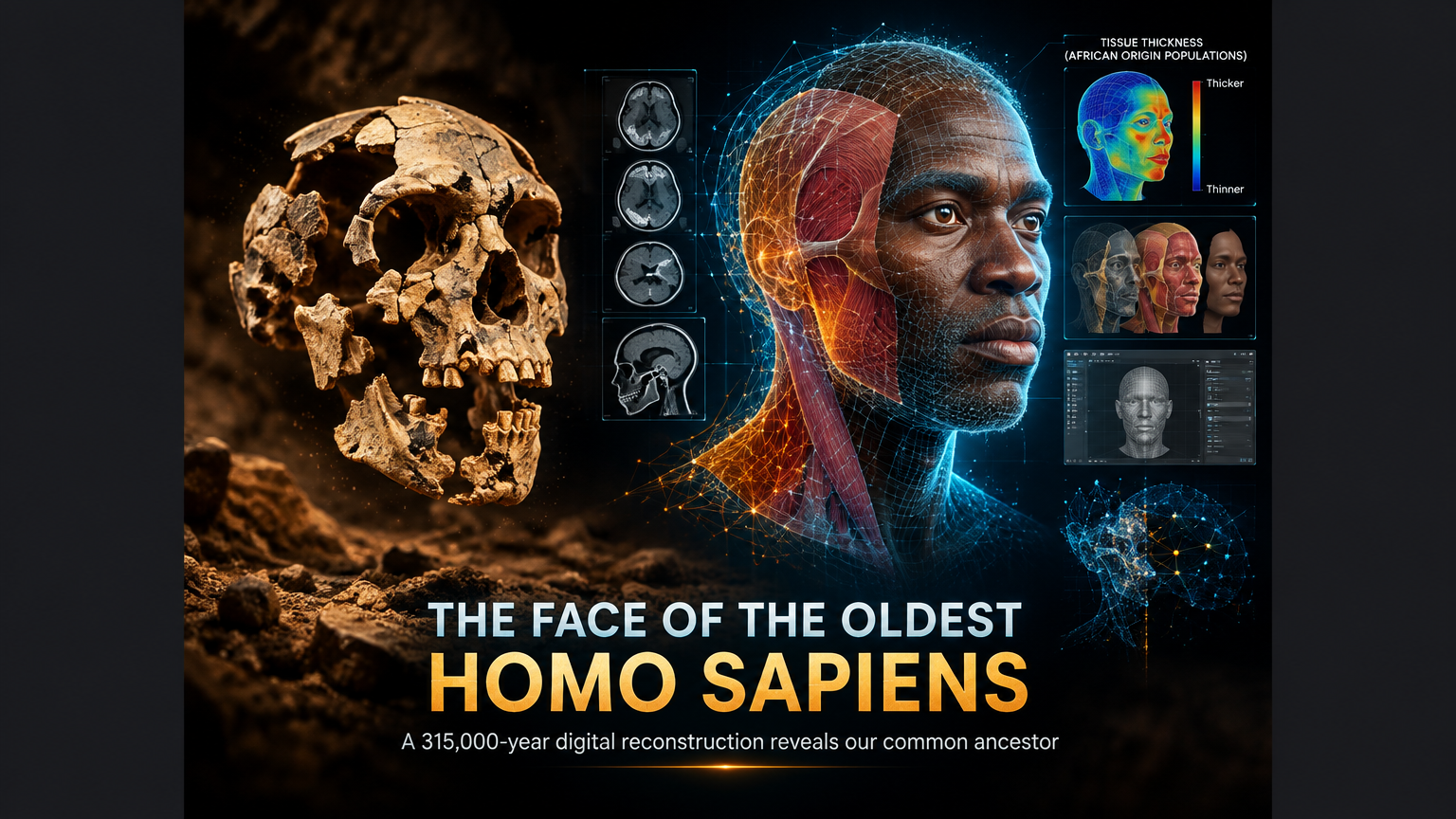
315,000 years ago, in northern Africa, one of the first representatives of our species lived.
For more than half a century, the face of that ancestor remained hidden in bone fragments. Now, for the first time, it has a face.
An international team led by Brazilian forensic facial reconstruction specialist Cícero Moraes created the digital facial approximation of the Jebel Irhoud hominin, the oldest fossil attributed to Homo sapiens. The study was published in September 2026 in the journal Heritage, from MDPI, under the title “Digital Facial Approximation of Jebel Irhoud Composite Skull”.
The detail that makes the work especially notable lies in the technical choice: to estimate the thickness of the tissues covering the bone, the researchers used data from modern populations with African ancestry, selected for geographic and evolutionary proximity to the specimen.
The face of an ancestor from more than three hundred millennia emerged from a fragmented skull, a jaw and loose teeth, combined with modern digital technology.
The site that rewrote the species’ history
The Jebel Irhoud fossils were discovered in the 1960s, during mineral extraction in western Morocco.
The initial classification treated them as an African variant of Neanderthals, about 40,000 years old. In the following decades, the estimated age kept climbing: between 100,000 and 200,000 years in 1991, about 160,000 in 2007.
The decisive leap came in June 2017, when two papers published in the journal Nature reclassified the remains as Homo sapiens and proposed a much older date: approximately 315,000 years, with a margin of 34,000 years either way.
The result made Jebel Irhoud the oldest and richest African Middle Stone Age site with Homo sapiens fossils, pushing the emergence of the species back much further than previously thought.
The bony puzzle
No complete face survived at Jebel Irhoud. The team faced a puzzle with pieces of different origins:
- the braincase of one fossil;
- the jaw of another;
- loose teeth;
- and a 3D digital model of the skull developed by the Max Planck Institute for Evolutionary Anthropology, in Leipzig, Germany.
To reconstruct what was missing, the researchers applied a technique called constrained anatomical deformation: they took a CT scan of a modern adult donor and digitally reshaped it to fit the dimensions and proportions of the fossil skull.
On top of that bony base, the soft-tissue layer was applied using open-source tools such as Blender and OrtogOnBlender, the same ecosystem Moraes had already used in other famous forensic reconstructions.
Why African ancestry data
The most interesting point from a methodological standpoint is the choice of tissue thickness data.
The thickness of the muscles, skin and other tissues covering the bone cannot be measured in fossils, because no soft tissue from Middle Pleistocene hominins survived. Every millimeter of skin on the model is borrowed from people living today.
The team used reference values obtained from datasets of individuals of African ancestry, as reported by researcher Taylor. The justification is direct: geographic and evolutionary proximity to the Jebel Irhoud specimen.
The result is two versions of the reconstruction:
- a grayscale one, closer to scientific rigor, focused on anatomy;
- and a colored one, explicitly an artistic interpretation of possible appearance.
A surprisingly familiar face
The reconstruction suggests something that impressed the researchers: the Jebel Irhoud individual may have looked surprisingly familiar to modern humans, despite having lived tens of thousands of years before Homo sapiens began spreading beyond Africa.
The study demonstrated the feasibility and reproducibility of forensic facial approximation of this hominin based on a three-dimensional composite skull, combining forensic anthropology methods with digital modeling.
The study’s authors are Cícero Moraes, Elena Varotto, Michael E. Habicht, Francesco M. Galassi, Leonardo Moura and J. Y. Abdullah.
What the reconstruction shows, and what it does not
A responsible article must separate the two planes.
What the model offers:
- a visualization of the probable anatomical facial structure, anchored in the real shape of the fossil skull;
- a demonstration that modern forensic methods can be applied to material hundreds of thousands of years old;
- a way to bring the public closer to an ancestor who lived before any civilization.
What the model does not offer:
- it is not an exact reproduction of a specific individual; the cranial assembly combines more than one fossil and a modern donor;
- soft tissues, hair and skin color are estimates, not fossil data;
- no soft tissue from Middle Pleistocene hominins is known, which makes every skin layer on the model an inference based on living people.
The authors themselves acknowledge these limitations. The reconstruction is an approximation of anatomical features, not an individual portrait.
The method lesson: right data, open tools, declared limits
Here is the connection to the ground of this blog.
The Jebel Irhoud work is a rare example of how the combination of adequate data, accessible tools and methodological transparency produces results with global reach.
Three lessons stand out.
1. Data quality defines result quality
What makes the Jebel Irhoud reconstruction more robust than earlier attempts is the choice of bioanthropometric data relevant to the specimen. Wrong or generic data would produce an arbitrary face. Contextualized data produced a scientific hypothesis.
In the business world, the principle is identical: decision quality depends on the quality of the data feeding it. That is the work data science does when turning scattered information into useful context, replacing “I think” with organized evidence.
2. Open tools democratize competence
The reconstruction used open-source software, globally available. What once required expensive labs and proprietary software costing hundreds of thousands of euros now fits in an ordinary computer and a small, determined team.
The same logic applies to businesses: accessible tools, combined with method, allow small companies to execute what was once a privilege of large corporations. The key is correct integration, exactly what intelligent automation does when connecting everyday tools into productive flows.
3. Declaring limits is part of credibility
The study rigorously separates what is fossil data, what is technique and what is artistic interpretation. That methodological honesty is what sustains scientific credibility.
Companies that clearly state what their data shows, and what it does not, build trust. It is the same principle we apply in every analysis on this blog: separating verified from estimated.
Why this matters
The Jebel Irhoud reconstruction goes beyond paleontological curiosity.
It humanizes the origin of the species. Seeing a face, even an approximate one, turns a laboratory fossil into a possible person, with features we still recognize in ourselves.
It also demonstrates the maturity of digital reconstruction technologies: the same methodological framework used for forensic identification of modern people was applied to 315,000-year-old material, with conscious adaptations and declared limits.
Conclusion: a 315,000-year face, reconstructed with today’s technology
The team led by Cícero Moraes digitally reconstructed the face of the oldest known Homo sapiens, the Jebel Irhoud hominin in Morocco, dated to approximately 315,000 years.
The work, published in the journal Heritage, combined skull, jaw and teeth fossils with a Max Planck model, reshaped a modern donor’s CT scan using constrained anatomical deformation, and applied tissue thickness data from populations of African ancestry, for geographic and evolutionary proximity.
The result offers two versions, a scientific grayscale one and a colored artistic interpretation, and suggests a surprisingly familiar face.
It is not an exact portrait. It is an approximation based on method, with declared limits.
The question that remains:
If 315,000 years of distance can be reduced to a face with well-chosen technology and data, what can the same discipline do for the history, and the future, of your business?
The answer starts with the same choice as always: right data, transparent method and honest limits.