Imagine closing the dishwasher door and, before touching a single button, it already knows what to do.
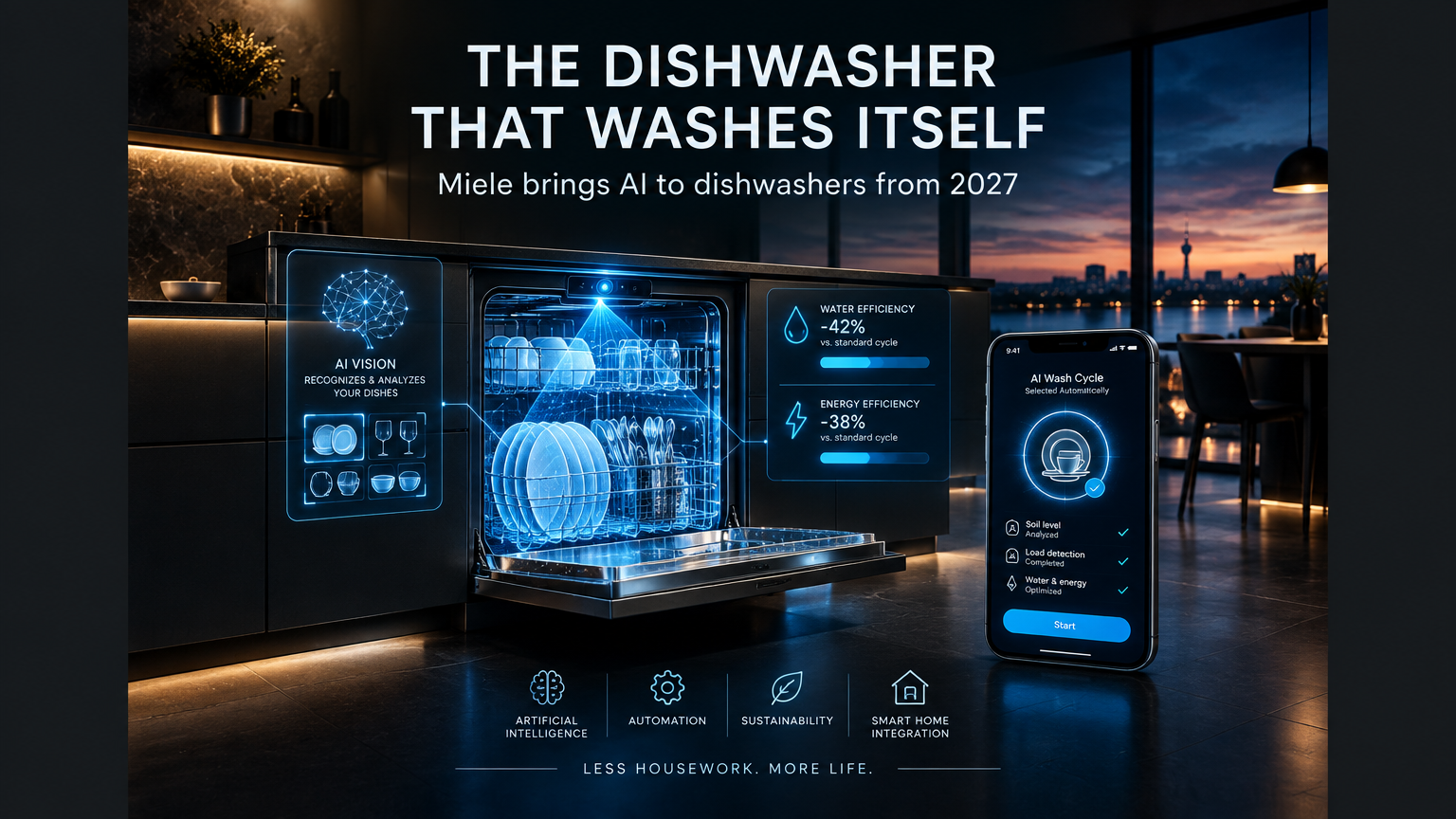
It looks inside, identifies what is there, calculates how full it is and chooses on its own the ideal cycle, the detergent dose and the drying mode.
That is no longer a concept.
Miele, the German premium appliance maker, presented its new generation of AI-integrated dishwashers at IFA 2026 in Berlin, with commercial launch expected in early 2027, initially in Germany, Austria and Switzerland.
The announcement was received as a phase shift for the appliance industry. Not because it adds a “smart feature” to a traditional product, but because it transfers to the machine a decision that always belonged to the user.
That shift is exactly what matters to anyone thinking about technology applied to business.
What Miele announced
The flagship model of the new generation is called the G8 Diamond, and the central feature is called AutoVision.
According to information released by the company at IFA, the technology combines an integrated camera with image processing and artificial intelligence. When the door is closed, the machine photographs the interior, identifies the type of dishes, assesses the level of soiling and the load, and automatically adjusts:
- the wash cycle;
- the detergent dose;
- the hot-air drying mode.
The most interesting detail, from an adoption standpoint, is Miele’s choice to make AutoVision an opt-in feature that ships disabled from the factory. The company acknowledges the potential discomfort of a camera inside the home and prefers that the user decides whether to enable it.
Miele also presented other AI steps, such as CulinaryCoach, an AI-based cooking assistant integrated into the Miele app, capable of suggesting settings for connected ovens.
The era of the “end of housework”
Miele’s IFA 2026 messaging was direct: fewer decisions, less housework.
The logic is simple. Most household effort is not in executing tasks, but in making small repetitive decisions: which program to use, how much detergent to add, at what temperature to wash.
Each of those decisions seems small in isolation. Together, they consume attention every day.
AI enters exactly in that space, automating decisions that never needed to be manual.
The same reasoning applies to business. Much of a company’s operational work is not in execution, but in repeating decisions that have already been made before. Automating those decisions is what frees the team to focus on what truly creates value.
A camera inside the machine: trust as a barrier and a currency
Miele’s decision to put a camera in a dishwasher raises a question that repeats in every new technology: how far will consumers accept a device that “watches”?
The opt-in feature is a smart adoption answer.
Instead of imposing the camera and waiting for the user to trust it, Miele hands over control. Privacy becomes a choice, not an imposition. That reduces initial friction and builds trust gradually.
The lesson for any business launching technology is direct: powerful features generate doubt, and doubt without control pushes customers away. Offering the option to enable or disable turns discomfort into consent.
What this means for the appliance market
Miele’s move does not happen in isolation. It is part of a larger trend in which appliances stop being isolated machines and start operating as connected devices within a home ecosystem.
That transformation relies on technology layers already discussed here:
- sensors and cameras that capture data from the physical world;
- artificial intelligence that interprets that data and decides;
- apps that connect the user to the device;
- remote updates that improve the product after purchase;
- integration with voice assistants and other appliances.
The appliance has become a software product with hardware inside, not the other way around.
For manufacturers and retailers, this changes the nature of competition. Differentiation stops being only about motors and design and starts being about software quality, app experience and the ability to update the product over time.
The same logic applies to companies in any sector currently selling a product or service with little technology: whoever turns an offer into a connected experience moves ahead.
What businesses can learn from Miele
Miele’s strategy offers lessons applicable to businesses of all sizes.
Automate decisions, not just tasks
The difference between ordinary automation and intelligent automation is scope. Automating tasks executes what has already been decided. Automating decisions eliminates the work of deciding.
Companies that map which decisions repeat every week, from lead prioritization to inventory replenishment, discover where technology pays off most.
Trust is built with control
Powerful features need clear consent. A customer who understands what is being used, and who can turn it off, trusts more than one who is surprised.
Transparency about data, security and privacy is no longer a differentiator. It is a requirement.
The product is the software
An appliance that improves through remote updates is a living product. Digital companies already follow this model. Traditional companies are learning: whoever treats the offer as a platform, rather than a static item, builds a long-term relationship with the customer.
Sustainability as an argument
AI-optimized washing consumes less water and energy. Miele, which tests its models to last the equivalent of 20 years of use, uses efficiency and durability as central arguments.
Businesses that combine technology with real efficiency, not just talk, build brands that are harder to copy.
Home AI and the future of connected business
The arrival of AI in dishwashers may seem distant from the reality of a small or medium business. In practice, it is part of the same phenomenon: artificial intelligence is leaving the labs and reaching everyday objects and processes.
Even companies without a physical product feel the effect. Consumers who get used to devices that decide on their own start expecting the same standard of convenience from any service: less friction, fewer steps, more automatic response.
That is where technology becomes competitive advantage.
A company that turns manual processes into automation, measures and organizes data, and delivers a fluid digital experience competes at another level. That is exactly the combination of well-structured websites and apps, intelligent automation and data science that Rapid Genius builds for clients of all sizes.
The question is not whether AI will reach every sector. Miele shows that it has already reached the kitchen sink.
AI is starting to remove everyday decisions
Miele’s announcement is another chapter in a transformation we have mapped throughout this blog: artificial intelligence is becoming infrastructure, in money, games, football, warfare and now appliances.
The pattern is always the same. A technology once restricted to specialists becomes a common tool, and early adopters define the rules, while those who wait play by everyone else’s rules.
With Miele, the frontier advanced into a territory where almost nobody expected AI: the most domestic item in the home.
Conclusion: the machine that decides on its own changes more than the dishwasher
Miele plans the commercial launch of its AI-integrated dishwashers in early 2027. The move is small as a product and enormous as a signal.
It delivers the first dishwasher with a camera and AI capable of looking inside, identifying the load and adjusting the cycle on its own. And, with the feature disabled by default, it shows how to introduce powerful technology without breaking user trust.
What is at stake is not only washing dishes better. It is the demonstration that artificial intelligence is ready to eliminate repetitive decisions in any environment, including the most symbolic one of domestic life.
For companies still postponing automation, the message is uncomfortable and clear:
If AI already knows how to wash the dishes on its own, what can it still not do for your business?
The answer to that question defines the next cycle of those who lead, and of those who fall behind.