A conflict between a coach and a 41-year-old player rarely reaches the business pages.
This one did.
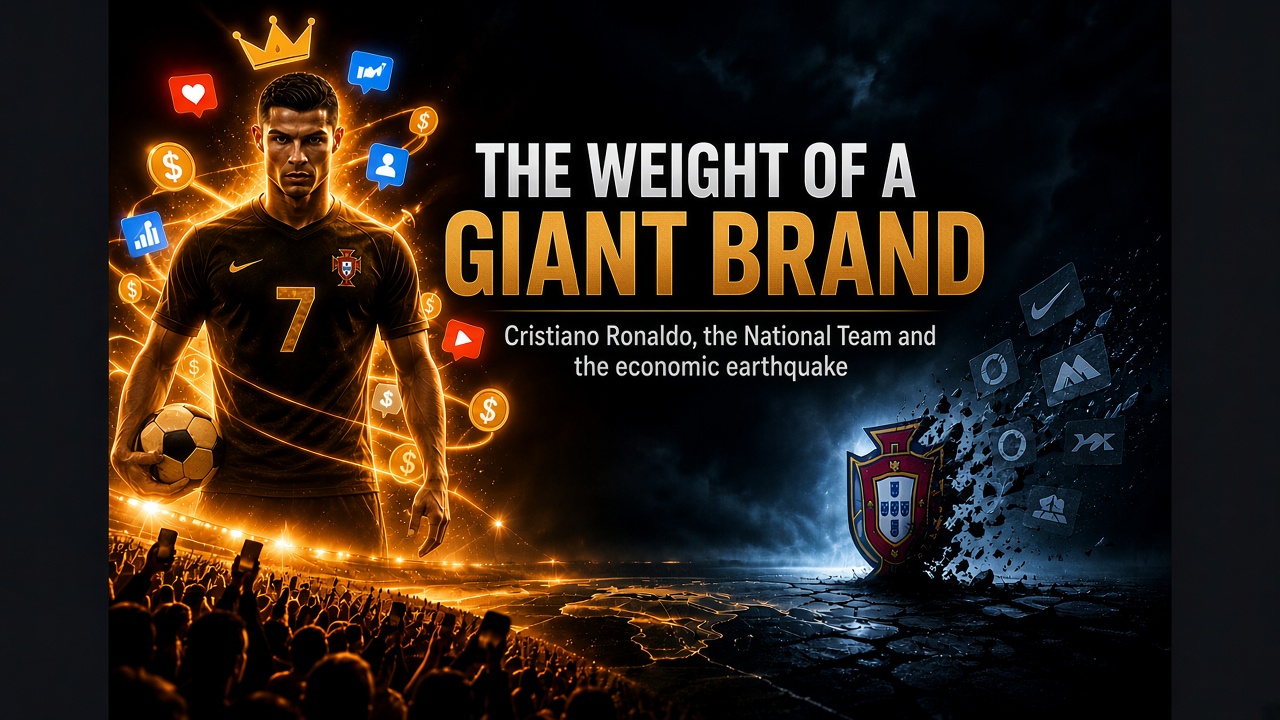
On Sunday, September 27, 2026, Portugal beat Norway 2-1 in the Nations League. Cristiano Ronaldo, captain and the all-time top scorer in international football, with 234 appearances and 146 goals, spent the entire match on the bench.
On Wednesday, September 30, head coach Jorge Jesus confirmed in an interview that Ronaldo would also not start the next match, against Denmark. Hours later, Ronaldo himself announced on social media that he was leaving the national team camp, saying he would explain the reasons “in due time.”
According to Reuters, the coach and the president of the Portuguese Football Federation (FPF) tried, unsuccessfully, to stop the player from leaving at the airport. Jorge Jesus publicly denied a rift. Ronaldo denied the denial.
The sporting episode is big. The economic episode may be bigger.
And that is why this story matters to any company, of any size and in any industry. Because it illustrates, on a giant scale, something that repeats itself in miniature in every market:
a brand’s value does not lie in what it produces. It lies in the attention it attracts.
What is at stake is not just a squad
The FPF is not losing, at least not yet, a player.
It may be losing the most commercially valuable asset in Portuguese football.
A study by sports marketing agency Nossa Sports and audience intelligence platform Felton, released in August 2026, compared the economic audience value of Cristiano Ronaldo and the Portuguese national team itself during the World Cup. The conclusion is striking: the Cristiano Ronaldo brand outperforms the Portugal national team brand.
It does not tie. It outperforms.
In other words: when sponsors sign with the FPF, much of what they are buying is not Portugal’s crest. It is access to the attention one single man generates.
According to Forbes, Ronaldo’s net worth exceeds $1.2 billion, with earnings of about $300 million in 2026, of which roughly $65 million come from endorsements, appearances and licensing. His lifetime deal with Nike, signed in 2016, is valued at more than $1 billion over its life, the largest endorsement agreement in sports history.
Daniel Sa, executive director of the Portuguese Institute of Marketing Administration (IPAM), summed up the risk directly: from a brand perspective, Ronaldo is incomparably bigger than the entire Portuguese national team, and his exit could cost the federation millions. The FPF’s own chief commercial officer, João Medeiros Cardoso, admitted it would be “very stupid” not to build campaigns around Ronaldo, especially at the 2026 World Cup, hosted in the United States, one of football’s biggest commercial markets.
Why the audience follows the brand, not the institution
Here is the mechanism that explains everything.
The FPF has existed for over a century. It has history, structure, tradition and a European title. But what turns all of that into recurring revenue is public attention.
And attention, in the modern market, is concentrated and selective.
At the 2022 World Cup, Ronaldo and Messi together generated more than 1.2 billion interactions on posts related to the tournament. Not the Cup. Them.
The public does not watch football out of institutional loyalty. It follows stories, characters and conflicts. Ronaldo is a character built over two decades: ambition, records, the pursuit of 1,000 career goals, longevity.
When he takes the field, the audience comes with him. When he sits on the bench, it does too.
A Portugal without Ronaldo does not stop existing. It stops having the same traffic. And traffic, in the modern sports economy, is the currency that pays sponsorships, media rights and licensed merchandise.
The silent earthquake: what disappears when the brand disappears
If Ronaldo ends his cycle with the national team, the effects will not appear as an explosion. They will appear as erosion.
Sponsors do not cancel contracts out of anger. They renew based on numbers: audience, impressions, engagement, return on investment.
When the main generator of those numbers leaves the stage:
- new contracts become worth less;
- renewals become harder;
- featured positions in campaigns lose value;
- media rights negotiations weaken;
- international press interest recedes;
- shirt and licensed product sales fall.
None of these effects shows up on the scoreboard. All of them show up in the balance sheet.
That is why Portuguese marketing experts have begun treating the matter as strategic, not sentimental. The FPF’s question is not whether Ronaldo deserves to play. It is how to replace, in attention value, an asset that took 20 years to build.
What this teaches about being a giant brand
The central lesson of this story applies to any business.
A giant brand has three properties that ordinary brands do not.
It attracts attention without buying it
Ronaldo does not need to pay for ads to be noticed. His existence is news. Strong brands live by the same principle: the market comes to them, instead of them chasing the market.
In practice, this means lower customer acquisition cost. A well-known brand spends less to be found, less to be remembered and less to be recommended.
It gives negotiating power
The FPF negotiates more expensive sponsorships because it carries Ronaldo. The player negotiates billion-dollar contracts because he carries his own brand. Strong brands do not ask for price. They set terms.
In the services market, the effect is identical: whoever has a brand charges more, chooses clients and closes deals faster, because trust already exists before the first meeting.
It survives isolated crises
A giant brand absorbs mistakes that would destroy smaller brands. The coach dispute, the bench, the controversy: all of it generates more attention, not less. And attention, well managed, becomes value.
Weak brands, by contrast, do not survive invisibility. Their biggest risk is not crisis. It is silence.
The other side of the coin: when everything depends on a single asset
The story also carries a warning.
The FPF built its commercial machine around a single name. It worked for two decades. But it created a dependence that today becomes risk.
It is the same trap as any business that depends on one acquisition channel, one client representing 70% of revenue, or one person holding all the relationships.
The giant brand is an advantage. Total dependence on it is a fragility.
The answer is not to abandon the valuable asset. It is to build layers: new products, new voices, new ways of generating attention, so that the departure of any element, however inevitable, does not bring down the structure.
The best businesses do not avoid the hard question. They prepare for it before it arrives.
What this means for your business
You do not need a billion dollars to apply the same principles.
Build presence before you need it
Ronaldo’s brand was built over two decades of consistency. For a business, every article published, every project delivered with quality, every well-served client is a brick in that construction.
A professional website, useful content and consistent presence are the business version of this. That is the work Rapid Genius delivers in website and app development, designed to convert attention into results.
Turn attention into a system
Attention without structure is lost. The audience that arrives needs to find process, support and follow-up. That is what intelligent automation does: ensuring every new prospect is captured, served and followed up without depending on memory or manual effort.
Measure the real value of your brand
Your brand is worth what the market does when it appears: searches for your name, mentions, referrals, client returns. Measuring that is the role of data science, turning reputation into numbers that guide decisions.
Rapid Genius works exactly with this equation: technology, marketing and data converted into brand and revenue.
Conclusion: attention is the asset, brand is the vehicle
The dispute between Jorge Jesus and Cristiano Ronaldo will be resolved, sooner or later. There may be reconciliation, there may be farewell.
But the economic lesson is already on the table.
The Portuguese national team, with more than a century of history, discovered that it is worth less, commercially, than a single man. Not because the man is better than the institution, but because he concentrates something institutions take long to build: massive and continuous attention.
That is the essence of a giant brand. It does not just sell products or services. It sells the right to be seen.
For businesses, the question takes a different shape:
“How much attention does my brand attract today, and what happens to my revenue if that attention doubles?”
Whoever answers that question with structure, not luck, builds the kind of asset that no backstage crisis can bring down.
The giant brand is not a privilege of billionaires.
It is a strategic decision, built brick by brick.
And it starts before the market notices it exists.