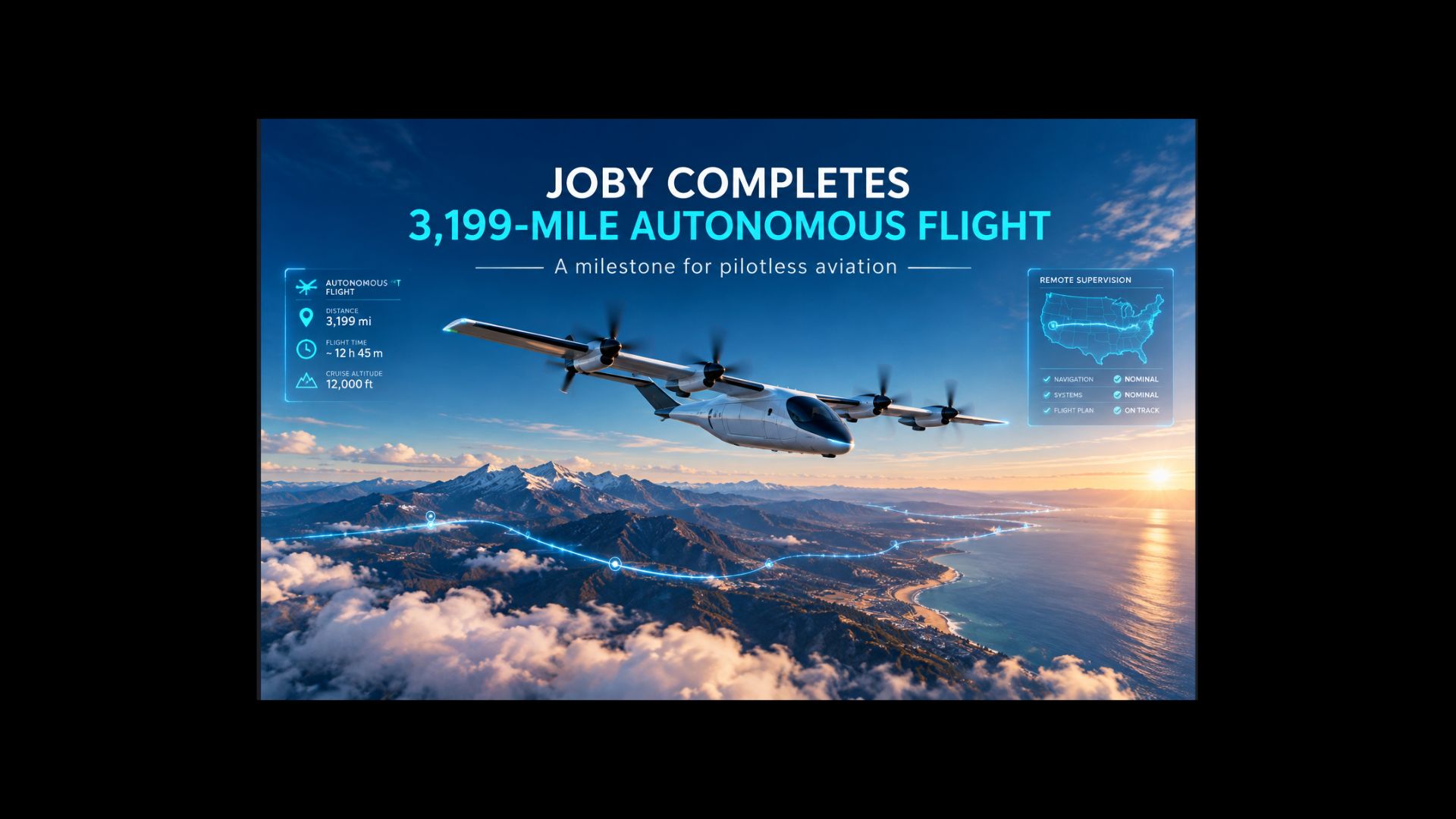
/Autonomous aviation has just reached a new milestone.
Joby Aviation announced that an aircraft equipped with its autonomy technology crossed the United States on a journey of approximately 3,199 miles, or about 5,150 kilometers.
The route was completed without the onboard safety pilot taking control. The aircraft performed tasks such as taxiing, takeoff, navigation, cruise flight and landing autonomously under remote supervision.
The result attracted attention because Joby is best known for developing electric air taxis. The company is now showing that its autonomy technology can also support commercial freight, medical transportation, disaster response and defense logistics.
The unavoidable question is:
Are we getting closer to pilotless aviation?
Autonomous aircraft still sound like something from the distant future.
When people think about autonomy, they usually imagine self-driving cars, industrial robots or remotely operated drones.
A regional aircraft traveling thousands of miles is different.
The aircraft must handle:
- changing weather;
- complex routes;
- different altitudes;
- busy airports;
- obstacles;
- air traffic;
- landing procedures;
- route changes;
- communication with control centers;
- unexpected situations.
That is why Joby presented the flight as an important demonstration of operational maturity.
It does not mean that passengers will immediately board fully autonomous aircraft. It means that systems capable of controlling complete stages of a flight are being tested in increasingly complex environments.
How did Joby’s autonomous flight work?
The journey was completed using a modified Cessna Caravan equipped with Joby’s autonomy system.
The aircraft traveled approximately 3,199 miles from the West Coast to the East Coast of the United States.
According to the company, the journey included:
- autonomous taxiing;
- autonomous takeoff;
- route navigation;
- cruise flight;
- weather avoidance;
- autonomous landing;
- remote supervision;
- operations across different environments.
A safety pilot remained onboard for compliance and safety requirements, but Joby said that the pilot did not need to take control during the crossing.
The flight was supervised remotely from locations that included Joby’s headquarters in California and a United States Air Force facility in South Carolina.
This means the aircraft was not operating without oversight. It was monitored by teams responsible for supervising the system and intervening if needed.
That distinction is essential.
Autonomous does not mean completely independent
The term “autonomous flight” can create confusion.
An autonomous aircraft can perform specific tasks without continuous direct commands from a pilot. It does not necessarily operate without human supervision, rules or a control structure.
In Joby’s demonstration:
- a safety pilot was onboard;
- teams monitored the operation remotely;
- the flight took place in a testing and demonstration context;
- the aircraft was a modified platform;
- the operation does not represent immediate approval for passenger flights without pilots.
The technology is important, but it still requires further testing, certification and evaluation before broad commercial use.
That caution does not reduce the significance of the event. It shows that autonomous aviation is advancing through controlled stages.
Why is Joby looking beyond electric air taxis?
Joby became well known for developing electric vertical takeoff and landing aircraft, commonly known as eVTOLs.
The company’s electric air taxi concept is designed to transport passengers on short trips within or between cities, reducing travel times while using quiet aircraft with no direct emissions during flight.
That market remains strategically important for Joby.
However, autonomy creates a second opportunity: operating aircraft in missions where carrying a pilot may be expensive, dangerous or inefficient.
Possible applications include:
- cargo transportation;
- medical deliveries;
- disaster response;
- support for remote communities;
- defense logistics;
- search missions;
- equipment transportation;
- operations in difficult environments.
This could allow Joby to operate across several markets.
The technology developed for air taxis may also support regional transportation, logistics and defense applications.
Cargo could become the first major market
Passenger transportation requires a very high level of safety, certification, comfort and public trust.
People must be willing to enter an aircraft without a human pilot directly controlling the flight.
Cargo operations may offer a simpler transition.
An autonomous aircraft can carry medicine, food, parts and equipment without transporting passengers. This allows operators to test routes, procedures and safety systems with less operational complexity.
In emergencies, this capability could be especially valuable.
Imagine a region affected by floods, wildfires or earthquakes. Roads may be blocked, airports may be operating under restrictions and rescue teams may need supplies quickly.
An autonomous aircraft could deliver essential items without exposing a pilot to unnecessary risk.
What changes when an aircraft can fly by itself?
Autonomy could change the economics of aviation.
Today, every flight requires licensed professionals, planning, communication, training and crew-related operating costs.
An autonomous aircraft does not eliminate all these costs because it still requires supervision, maintenance, certification and infrastructure. However, it may allow one team to oversee multiple aircraft in certain situations.
That could increase efficiency in:
- cargo transportation;
- surveillance;
- emergency response;
- defense;
- regional aviation;
- medical logistics.
It could also make some routes economically viable because they would not require a full flight crew.
The technology could help remote communities
Many communities are far from major cities, hospitals, airports and logistics networks.
For these regions, receiving medicine, food and equipment can be difficult.
Autonomous aircraft could operate on smaller routes more frequently and at potentially lower cost.
This could be useful for:
- islands;
- rural regions;
- mountainous areas;
- isolated communities;
- disaster zones;
- places without suitable roads.
Autonomous aviation does not need to begin by replacing every commercial flight.
It can begin by solving specific logistics problems.
Joby already has experience with autonomous operations
Joby says its autonomy technology has been used in more than 400 flights and has accumulated over 800 hours of automated operations in controlled and uncontrolled airspace.
The technology also builds on an autonomy stack acquired from Xwing, a company that developed autonomy solutions for conventional aircraft.
This history matters because the transcontinental flight was not presented as an isolated experiment.
Joby says it has been testing the technology across different environments and operational situations.
However, figures published by the company should be understood as corporate information. Independent validation, certification and performance during continuous commercial operations will be essential to determine the system’s actual reach.
Autonomous aviation must handle weather and air traffic
One of the biggest challenges for an autonomous aircraft is making decisions when conditions do not match a perfect plan.
During a long journey, the aircraft may encounter:
- storms;
- strong winds;
- turbulence;
- poor visibility;
- route changes;
- congested airports;
- communication failures;
- priority changes;
- unexpected obstacles.
Joby said the aircraft operated across different environments and avoided severe weather during the journey.
This is important because the aircraft was not only following a fixed route under perfect conditions.
Useful autonomy must interpret the environment and choose appropriate responses.
The role of artificial intelligence in aviation
Artificial intelligence can support many stages of flight operations.
It can help:
- interpret sensor data;
- identify obstacles;
- predict weather conditions;
- calculate routes;
- detect anomalies;
- monitor components;
- suggest decisions;
- optimize energy use;
- coordinate operations;
- support ground teams.
However, aviation systems must operate under very high safety standards.
A small failure in an app may cause inconvenience. A failure in a flight-control system may have serious consequences.
That is why autonomous aviation requires redundancy, testing, supervision, detailed records and strict certification.
Autonomous aviation is not only a software problem
It is tempting to imagine that installing an intelligent system in an aircraft is enough to make it fly by itself.
In reality, the challenge involves several areas:
Hardware
Sensors, computers, communication systems and control mechanisms must operate reliably.
Software
The system must interpret information and make decisions in real time.
Infrastructure
Operations depend on airports, communication networks, remote supervision centers and air traffic services.
Regulation
Authorities need rules for certification, responsibility and operation.
Security
The system must withstand technical failures, interference and cyberattacks.
Public trust
Passengers, businesses and communities must believe the technology is safe.
The combination of these elements will determine whether autonomous aviation can move from demonstrations to daily operations.
What does this mean for electric air taxis?
Joby’s autonomous flight does not replace its electric air taxi project. Both initiatives can develop together.
Electric air taxis are designed to transport passengers on short routes, especially in urban areas.
Autonomous technology, on the other hand, may initially be applied to conventional aircraft for cargo and specialized missions.
This could create a gradual pathway:
- Test autonomy in cargo aircraft.
- Operate on controlled routes.
- Demonstrate reliability.
- Expand remote supervision.
- Obtain specific certifications.
- Apply the technology to new platforms.
- Evaluate autonomous passenger operations.
This process could help companies and regulators learn before placing passengers in fully autonomous aircraft.
Autonomous aviation will need new professionals
The growth of autonomous aircraft will not eliminate the need for people.
It will change the type of work involved.
The sector may need specialists in:
- software development;
- data science;
- artificial intelligence;
- cybersecurity;
- sensor maintenance;
- operations control;
- risk analysis;
- remote supervision;
- regulation;
- systems integration.
This transformation resembles what is happening in other technology sectors. Automation does not eliminate every role, but it changes which skills are most valuable.
Companies that develop data science, automation and digital solutions are participating in a transformation that also reaches traditional sectors such as transportation, manufacturing and aviation.
Conclusion: Joby’s flight could mark the beginning of a new phase
Joby Aviation completed an autonomous flight of approximately 3,199 miles across the United States using a modified aircraft equipped with its autonomy system.
The journey included taxiing, takeoff, navigation, cruise flight and landing without the safety pilot taking control, although the operation was remotely supervised and remains part of a demonstration and evaluation context.
The achievement does not mean that all commercial aircraft will become autonomous soon.
It also does not prove that electric air taxis are ready to operate without pilots in every city.
But it demonstrates something important:
autonomy is now being tested across long distances, varied environments and missions connected to real operational problems.
The technology could help transport cargo, deliver medical supplies, support remote communities, respond to disasters and carry out defense missions.
In the future, autonomous aviation may not begin by carrying passengers.
It may begin by delivering what people need.
The question is:
How long will it take for a pilotless aircraft to move from a technology demonstration to a real part of transportation infrastructure?
Joby’s flight does not end that discussion.
It shows that the discussion has already begun.