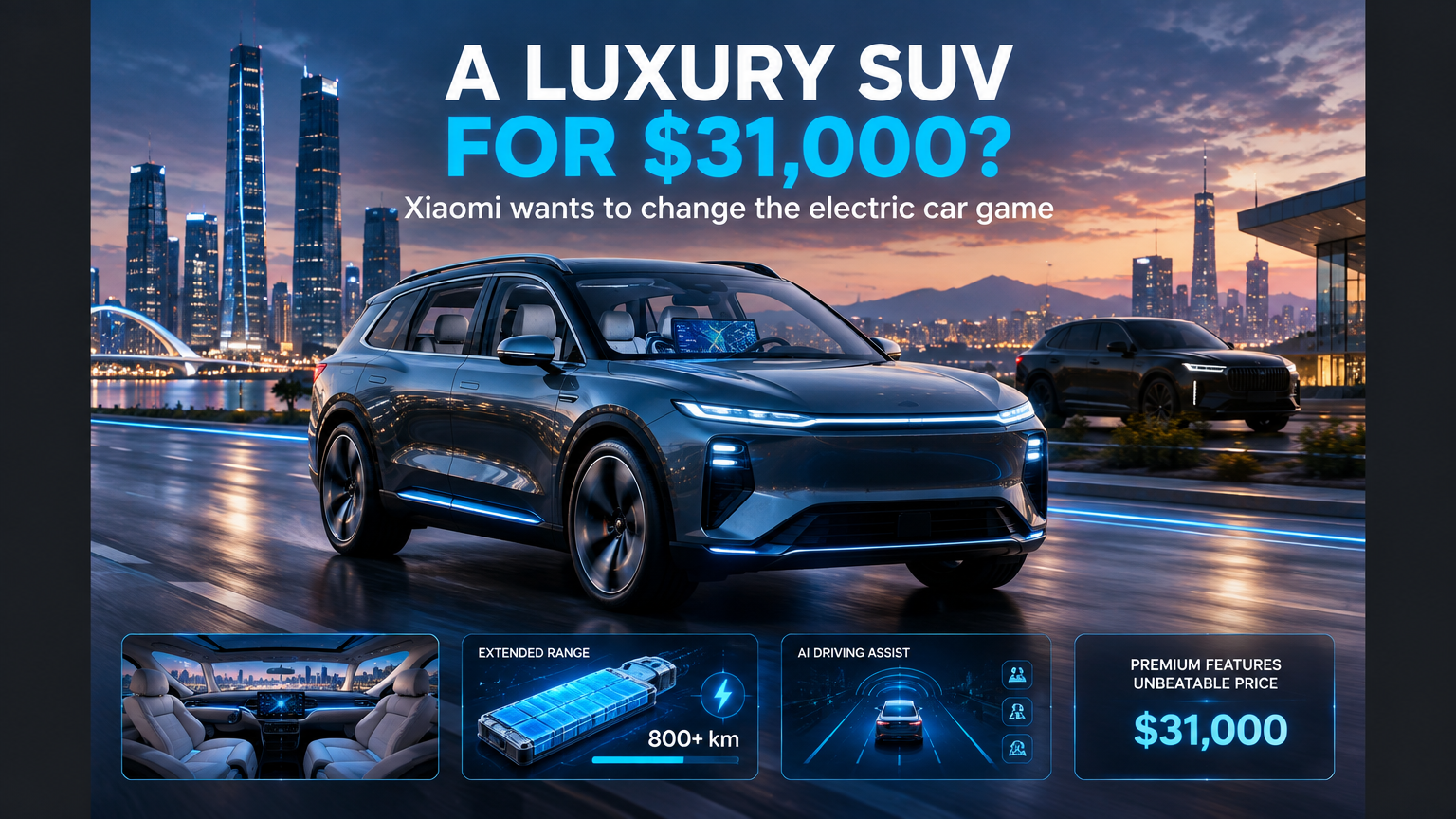
/Imagine entering a large SUV with a sophisticated interior, massage seats, digital displays, artificial intelligence, enough range for long trips and enough space to turn the vehicle into a mobile living room.
Now imagine discovering that the entry-level version costs about $31,000 in China.
That is the proposition behind the new Xiaomi SkyNomad N70, an extended-range SUV introduced by Xiaomi Auto. The model has attracted attention because it combines premium features, large interior space and advanced technology with a price far below many luxury SUVs from traditional manufacturers.
The launch is drawing attention across the automotive industry because Xiaomi is not positioning itself only as a smartphone and smart-device company.
It wants to compete in one of the most competitive markets in the world: intelligent electric vehicles.
First, an important clarification about the name
The new vehicle is often described informally as the “Xiaomi Sky SUV,” but the official name of the product family is Xiaomi SkyNomad.
The lineup includes several versions:
- SkyNomad N70 Pro;
- SkyNomad N70 Max;
- SkyNomad N90 Max;
- SkyNomad N90 Max Studio.
The N70 is the more affordable model, while the N90 occupies a more premium position, with a seven-seat configuration and additional comfort features.
Xiaomi officially launched the SkyNomad family in September 2026. The vehicles were initially introduced for mainland China, so the dollar conversion is only a reference and does not necessarily represent the final price in other markets.
Even with that caveat, the proposal remains aggressive.
A large SUV with premium features and advanced technology at a price closer to that of mid-size vehicles could put pressure on traditional automakers.
How much does Xiaomi’s new SUV cost?
The Xiaomi SkyNomad N70 Pro launched in China at RMB 209,900, equivalent to approximately $31,000 based on the conversion used by specialized automotive publications.
The other versions cost more:
- N70 Pro:
RMB 209,900; - N70 Max:
RMB 239,900; - N90 Max:
RMB 269,900.
The N90 Max had previously been announced with a pre-sale price of RMB 299,900, before the official pricing of the full lineup was released.
These prices refer to the Chinese market. Taxes, shipping, homologation, distribution and dealer margins could significantly change the final price if the vehicles are sold in other countries.
Even so, the strategy is clear.
Xiaomi is offering premium design, digital features, flexible space and extended range at prices that can challenge established luxury brands.
How does it compare with a Range Rover?
The Range Rover comparison gained attention because the SkyNomad offers features associated with the luxury segment while costing much less.
That does not mean Xiaomi’s SUV is identical to a Range Rover in every respect. Traditional luxury brands have decades of experience, global networks, specialized materials, established reputations and premium positioning.
The more accurate comparison is about value.
On one side, buyers find a traditional luxury brand with prestige and a long history.
On the other, Xiaomi offers:
- a more aggressive price;
- deep digital integration;
- a large number of technology features;
- flexible interior space;
- extended range;
- connectivity with other devices;
- advanced driver-assistance systems.
The central issue is not whether Xiaomi has eliminated every advantage of luxury brands. The bigger question is whether high-end technology must continue to carry a very high price.
An electric SUV with a combustion range extender
Although the SkyNomad is often described as an electric SUV, it uses an extended-range architecture.
The wheels are driven by electric motors, while a combustion engine works mainly as a generator to provide additional energy for long-distance travel.
This approach combines two characteristics:
Electric driving for daily use
The vehicle can handle a large part of urban driving using energy stored in its battery.
Additional range for long trips
When the battery needs support, the generator can produce electricity and reduce concerns about charger availability.
This solution may be particularly attractive in regions where charging infrastructure is still developing.
The Xiaomi SkyNomad N70 Pro uses a 52 kWh battery and offers up to 351 kilometers of CLTC electric-only range. Its combined range reaches up to 1,351 kilometers.
The N70 Max uses a larger 76 kWh battery, with up to 505 kilometers of electric-only range and up to 1,461 kilometers of combined range under the CLTC cycle.
The N90 Max reaches up to 464 kilometers of electric-only range and up to 1,705 kilometers of combined range, according to Xiaomi’s published figures.
As with other CLTC figures, real-world results may vary depending on speed, temperature, vehicle load, driving style and road conditions.
The interior was designed as a mobile living room
Xiaomi appears to understand an important change in consumer behavior.
Many people no longer see a car only as a way to move from one place to another. They also want to use it for rest, work, entertainment and family time.
The SkyNomad was designed around that idea.
The N90 Max has three rows and can carry up to seven passengers. Its cabin includes a nearly flat floor and several solutions designed to increase interior flexibility.
Published features include:
- heated seats;
- ventilation;
- 16-point massage;
- interior tables;
- refrigerator;
- screens;
- premium sound system;
- storage-focused center console;
- multiple seating configurations;
- rest areas;
- large cargo space.
Xiaomi also says that the N90 Max can hold seven 20-inch suitcases while all seven passengers are seated. In specific storage configurations, capacity can reach up to 24 suitcases of the same size.
The N90 Max Studio turns the car into an office
The most unusual model in the lineup is the Xiaomi SkyNomad N90 Max Studio.
It is designed to function as a mobile personal space. The cabin may include:
- an electric lifting roof;
- a workspace;
- power outlets;
- storage cabinets;
- an illuminated mirror;
- a bed;
- floor heating;
- a refrigerator;
- configurations for rest and productivity.
This proposal shows how automakers are attempting to redefine the role of a vehicle.
The car is no longer only a machine that transports people. It is becoming a technology platform with different environments and use cases.
For remote workers, frequent travelers and consumers seeking more flexibility, this concept may be particularly appealing.
Xiaomi is bringing its ecosystem into the car
Xiaomi’s advantage is not only its price.
The company already has experience with smartphones, tablets, smart-home devices, artificial intelligence, operating systems and connected products.
Now, these elements can be integrated into the vehicle.
The SkyNomad uses displays, voice assistance, device connectivity and artificial intelligence features to manage the cabin.
Xiaomi also says that the vehicle includes systems capable of recognizing commands, adjusting interior settings and assisting with driving.
This ecosystem could allow owners to control the vehicle in a way similar to how they manage other Xiaomi devices.
This is where Xiaomi is trying to do something different from traditional automakers.
It does not want to sell only an SUV. It wants to sell a broader digital experience connected to the vehicle.
Artificial intelligence and assisted driving
The SkyNomad lineup includes driver-assistance systems and artificial intelligence features.
Xiaomi has published information about high-performance computing hardware, sensors, radar, cameras and lidar in selected configurations.
The system is associated with functions such as:
- automatic emergency braking;
- obstacle recognition;
- parking assistance;
- lane support;
- navigation;
- voice commands;
- environmental perception;
- assistance in parking situations.
These features do not mean that the vehicle is fully autonomous.
Driver-assistance systems still require attention and responsibility from the driver. The person behind the wheel must monitor the system and be prepared to take control when necessary.
That distinction matters, especially when marketing uses terms such as “intelligent” or “autonomous.”
Performance is also part of the strategy
Xiaomi is not positioning the SkyNomad only as a comfortable family vehicle.
The N70 Max uses dual-motor all-wheel drive and accelerates from 0 to 100 km/h in approximately 5.5 seconds.
The N90 Max reaches approximately 5.9 seconds in the same acceleration test and has a published top speed of 190 km/h.
These figures show that Xiaomi wants to combine:
- space;
- comfort;
- range;
- technology;
- performance;
- competitive pricing.
This combination could attract buyers who want a family SUV without giving up performance and advanced features.
Xiaomi wants to change the logic of the automotive market
For decades, the automotive industry operated around a relatively clear division.
Traditional brands controlled design, manufacturing, distribution and reputation. Technology companies supplied specific components, software and services.
Xiaomi is trying to bring these two worlds together.
The company has experience in:
- product design;
- software;
- artificial intelligence;
- large-scale manufacturing;
- connected ecosystems;
- digital marketing;
- direct consumer relationships.
These capabilities may help Xiaomi create a different ownership experience.
This strategy also demonstrates how technology is reshaping entire industries.
The same movement can be seen in companies that combine physical products, digital services, data and automation. Rapid Genius works with websites, apps, data science and AI-powered automation, areas connected to this broader digital transformation.
Aggressive pricing could pressure traditional automakers
Launching a technology-focused SUV for about $31,000 could create pressure at several levels.
Price pressure
Consumers may start questioning why certain features remain so expensive in traditional brands.
Innovation pressure
Automakers may need to provide more advanced systems to justify higher prices.
Software pressure
The digital experience may become as important as the engine, materials and horsepower.
Launch-speed pressure
Companies that take years to release meaningful updates could lose ground to brands that improve through software.
Luxury perception pressure
Luxury may no longer be defined only by leather, performance and prestige. Technology, personalization and connectivity may become equally important.
Important challenges still remain
The SkyNomad has an impressive proposition, but that does not mean every challenge has been solved.
Xiaomi still needs to address issues such as:
- international expansion;
- technical support;
- parts availability;
- homologation;
- safety;
- long-term reliability;
- resale value;
- adaptation to different markets;
- charging infrastructure;
- after-sales service.
The lineup was initially announced as available only in mainland China.
Entering other markets would require regulatory approval and an adequate distribution structure.
A low price is a major advantage, but it is not the only factor that determines a vehicle’s success.
What does SkyNomad mean for the future of cars?
The launch shows that the electric vehicle market is entering a more competitive phase.
The competition is no longer limited to traditional automakers. Technology companies and new automotive groups are also introducing products with:
- larger batteries;
- advanced software;
- artificial intelligence assistants;
- flexible interiors;
- over-the-air updates;
- driver assistance;
- device integration;
- aggressive prices.
Consumers are beginning to compare vehicles using different criteria.
They are no longer looking only at power, size and materials. They are also evaluating:
- connectivity;
- range;
- charging speed;
- interface;
- updates;
- digital security;
- smartphone integration;
- personalization.
The car is becoming a computer on wheels, but with much more direct consequences for safety, mobility and daily life.
Conclusion: Xiaomi wants to turn price into a competitive advantage
The new Xiaomi SkyNomad shows how a technology company can enter the automotive market with an aggressive proposition.
At approximately $31,000 based on the converted Chinese price, the N70 Pro offers space, connectivity, extended range and premium features that normally appear in much more expensive vehicles.
The Range Rover comparison should be made carefully. The products belong to different categories in terms of branding, materials, distribution and ownership experience.
Even so, Xiaomi’s message is clear:
advanced technology and premium comfort do not necessarily have to cost as much as a traditional luxury SUV.
If the company can maintain quality, safety, support and long-term reliability, it may force established manufacturers to reconsider their prices and strategies.
SkyNomad also reveals a broader transformation.
The car of the future will not be judged only by its engine or design. It will be compared through software, artificial intelligence, range, connectivity and the ability to adapt to the owner’s lifestyle.
The question now is:
How many traditional brands will be able to match this combination of technology, space and price?
Xiaomi has already presented its answer.
The automotive market will have to respond.