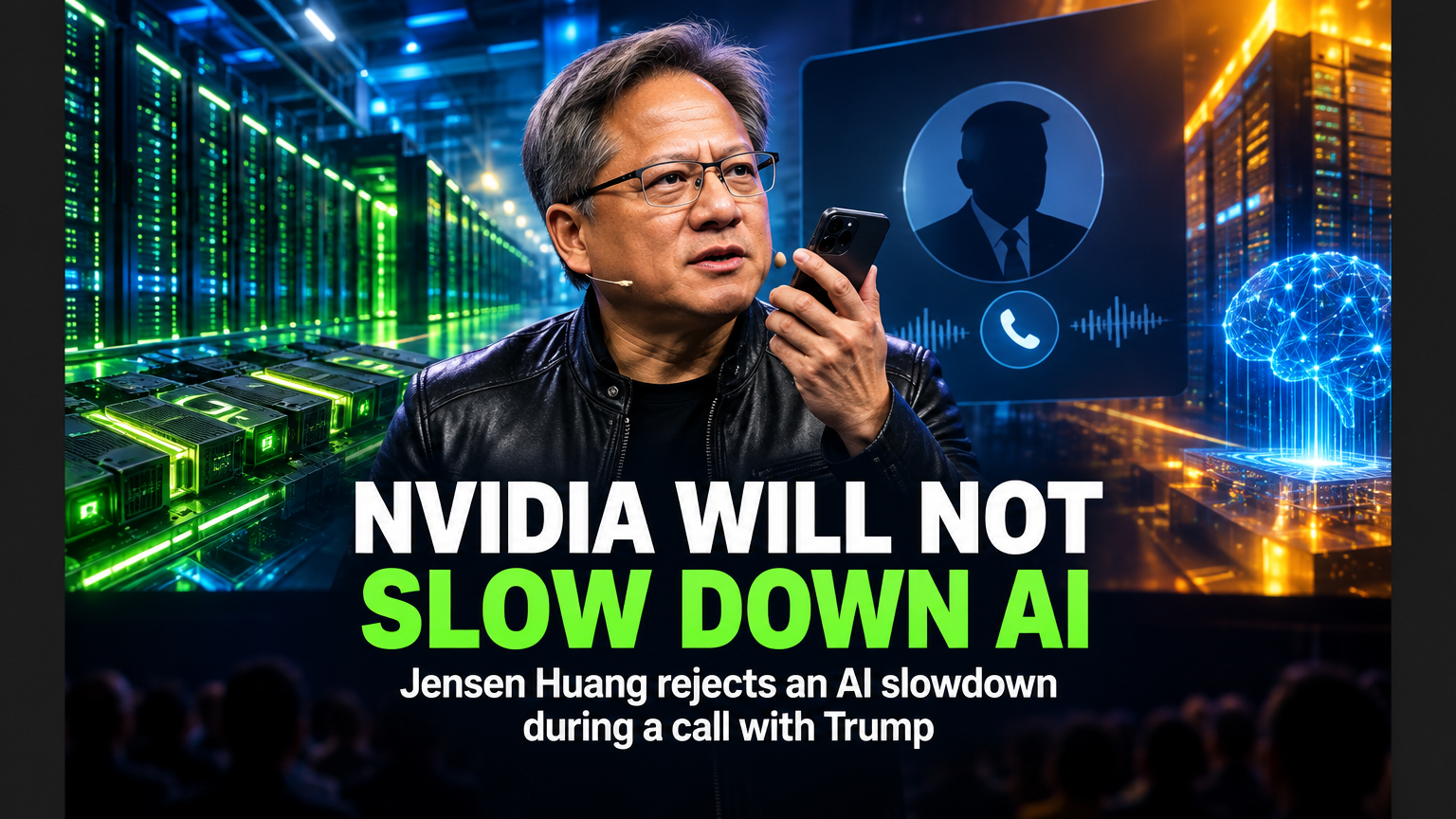
During a conference in Los Angeles, Nvidia CEO Jensen Huang received an unexpected phone call from Donald Trump. The executive answered the phone on stage, put the call on speaker and took part in a conversation that reignited one of the biggest debates in technology:
Should artificial intelligence continue advancing rapidly, or should development slow down because of safety concerns?
Huang’s response attracted attention. By agreeing with Trump, the Nvidia CEO said that he would not allow a slowdown in artificial intelligence development.
The statement came at a time of growing tension between technology companies, public officials and experts debating the risks of increasingly advanced AI systems.
What did Jensen Huang say to Donald Trump?
According to reports about the episode, Jensen Huang was attending the All-In Summit in Los Angeles when President Donald Trump called him.
Trump criticized warnings about the dangers of artificial intelligence and described some concerns as a hoax or political exaggeration. He also defended the expansion of data centers and argued that the United States could not slow down while competing with China for technological leadership.
During the call, Trump said that he would not allow efforts to develop AI to be stopped. Huang agreed with the president.
The statement became widely discussed because it was interpreted as direct support for maintaining the race toward increasingly advanced artificial intelligence.
However, an important distinction is necessary. The comment was made during a public and spontaneous conversation, not as a formal Nvidia corporate policy announcement. The company has publicly supported AI infrastructure expansion and U.S. technological leadership, but Huang’s words should be understood within the specific context of that event.
Why is this statement so important?
Nvidia is at the center of the artificial intelligence revolution.
If AI models were engines, Nvidia’s chips would be part of the infrastructure that allows those engines to operate. Technology companies, research laboratories and cloud providers depend on advanced processors to train and run artificial intelligence systems.
As AI advances, demand tends to increase for:
- GPUs;
- servers;
- data centers;
- cooling systems;
- high-speed networks;
- data storage;
- electricity;
- development tools.
That is why Nvidia has a direct interest in the continued expansion of artificial intelligence investment.
This discussion is not only about the future of technology. It also involves infrastructure, jobs, investments, industrial policies and economic power.
The AI race has become a competition between countries
During the call, Donald Trump emphasized that the United States needs to maintain an advantage over China in artificial intelligence development.
This concern is not new. Governments around the world now treat AI as a strategic technology with potential effects on:
- defense;
- healthcare;
- education;
- industry;
- finance;
- cybersecurity;
- transportation;
- communication;
- energy;
- productivity.
The country that builds the strongest models, the largest data centers and the most efficient infrastructure could gain a significant advantage over the next several decades.
That is why any proposal to slow down AI development can be interpreted as a threat to national competitiveness.
At the same time, accelerating without limits creates difficult questions. Who will supervise these systems? How will data be used? What happens when a model makes a wrong decision? Who is responsible when an autonomous system causes damage?
Nvidia wants to maintain the pace of the revolution
Nvidia became one of the most important companies in the AI economy because it supplies much of the computing infrastructure used by companies and research laboratories.
Its growth is closely connected to the expansion of language models, image-generation tools, autonomous agents and artificial intelligence systems used by businesses.
Every more powerful model requires more computing capacity. This creates a cycle of growth:
- Companies develop larger models.
- Larger models require more processing power.
- Demand for chips increases.
- More data centers are built.
- New AI applications are created.
- The market demands even more infrastructure.
Nvidia occupies a strategic position in this cycle.
A significant slowdown could reduce investments and affect the entire technology supply chain. That is why Huang’s statement was interpreted as a signal that the company intends to keep pushing for artificial intelligence expansion.
Data centers are also at the center of the debate
One of the issues raised during the conversation with Trump was data center expansion.
These facilities house the servers responsible for training and running AI systems. They require large amounts of electricity, cooling systems and network capacity.
Data center construction can generate investment and jobs, but it also creates concerns in local communities.
Common criticisms include:
- high energy consumption;
- pressure on power grids;
- water use for cooling;
- environmental impact;
- noise;
- the need for new transmission lines;
- industrial concentration.
This is one reason the debate over AI speed is no longer limited to research laboratories.
Infrastructure construction affects cities, states, energy companies, governments and local communities.
The argument that AI is bigger than the internet
During the conversation, Trump said that artificial intelligence is bigger than the internet.
The comparison is powerful because the internet transformed communication, commerce, work, education and entertainment on a global scale.
AI could create a similar transformation, with one important difference: it does not merely connect people and information. It can interpret data, create content, automate decisions and perform tasks.
A company can use AI to:
- answer customers;
- create campaigns;
- analyze sales;
- develop software;
- classify documents;
- generate reports;
- forecast demand;
- identify opportunities;
- automate processes.
In practice, this means artificial intelligence can participate in many stages of business operations.
That is where intelligent automation solutions can help companies reduce manual work and improve internal processes.
The impact on small and medium-sized businesses
The conversation between Jensen Huang and Donald Trump may seem distant from small business owners, but its consequences could reach smaller companies quickly.
As AI tools become more accessible, smaller businesses can use technologies that were once available only to large organizations.
A local company can use AI to:
- create social media content;
- develop video scripts;
- answer frequently asked questions;
- analyze advertising campaigns;
- organize leads;
- generate product descriptions;
- produce reports;
- automate customer service;
- interpret sales data;
- improve Google visibility.
Rapid Genius works with digital marketing, website development, automation and data science, areas directly connected to this transformation.
The most important point is that a company does not need to automate everything at once. The best approach is to identify repetitive processes, select the right tool and introduce improvements gradually.
Can AI grow without losing control?
This is one of the questions that will continue to shape the next few years.
The case for rapid AI expansion is based on innovation, productivity and new economic opportunities. However, speed should not be the only measure of success.
It is also necessary to evaluate:
Transparency
People should understand when they are interacting with AI and how important decisions were made.
Security
Models and agents must be protected against malicious use, attacks and manipulation.
Human supervision
High-impact decisions should not depend exclusively on automated systems.
Privacy
Personal and business data must be handled responsibly.
Accountability
There must be clarity about who is responsible when an AI system causes harm.
Access
The benefits of the technology should not remain limited to a small group of companies.
Concern about these issues does not necessarily mean opposing artificial intelligence. It means recognizing that powerful technologies require appropriate rules and control systems.
Nvidia, Trump and the future of artificial intelligence
Jensen Huang’s statement shows that the future of AI is increasingly connected to politics and economics.
This is no longer only a debate about which model produces better answers. Countries now need to decide:
- who will control the infrastructure;
- who will have access to advanced chips;
- how data centers will be regulated;
- which industries can use autonomous agents;
- how risks will be monitored;
- who will receive the productivity gains;
- how workers will be affected.
Nvidia is defending continued expansion. Trump is supporting rapid infrastructure growth. Other technology leaders are calling for more caution and stronger safety mechanisms.
This conflict is likely to continue.
Conclusion: the AI race does not appear to be slowing down
Jensen Huang’s message was clear: Nvidia does not intend to support a slowdown in artificial intelligence development.
The statement was made during an intense political and technological dispute in which the United States and China are competing for leadership in one of the most strategic fields of the century.
For technology companies, this scenario represents a major opportunity. AI tools, automation, data analysis and digital development may become increasingly important for improving productivity and attracting customers.
At the same time, progress must be accompanied by responsibility.
The question should not only be:
“How quickly can we develop AI?”
We also need to ask:
“How can we move quickly without losing safety, transparency and control?”
The answer is still being developed.
While governments debate limits, companies such as Nvidia continue expanding the infrastructure that powers this revolution. For the market, one thing is becoming increasingly clear:
the artificial intelligence race is not slowing down. It is only beginning to reach an even larger scale.