Have you ever stopped to think about how much information a company generates every day?
Every website visit.
Every click on an advertisement.
Every purchase.
Every WhatsApp message.
Every form submission.
Every customer who stops buying.
Every product searched for.
All of this generates data.
The problem is that having a lot of data does not mean knowing how to use it.
This is exactly where Data Science comes in.
Understanding this subject can make a major difference for any company that wants to make better decisions, reduce waste and discover new opportunities.
But what exactly is Data Science? How does it work? And how can a small business benefit from it?
Let’s understand it in a simple way.
🔎 What Is Data Science?
Data Science is a field that combines statistics, mathematics, programming, technology and business knowledge to collect, organize, analyze and interpret data.
Its purpose is not simply to create attractive charts.
The real goal is to find useful information inside data that can help people and companies make better decisions.
Imagine, for example, that a store notices its sales have decreased.
A quick analysis might lead the owner to think:
“We need more advertising.”
But the data could tell a completely different story.
Perhaps website traffic increased while the number of completed purchases decreased.
In that case, the problem may not be advertising.
It could be the price, checkout process, website, product or customer experience.
This is what Data Science helps uncover.
📊 Data Alone Is Not Knowledge
This is one of the most important ideas to understand about Data Science.
Imagine a company with 100,000 customer records.
It knows:
- names;
- ages;
- cities;
- products purchased;
- amounts spent;
- purchase dates;
- channels used;
- campaign interactions.
That is a large amount of data.
But without analysis, those records may not mean much.
When we identify patterns, relationships and trends, we begin transforming data into information.
And when that information helps someone make a better decision, it starts generating business value.
We can think of it like this:
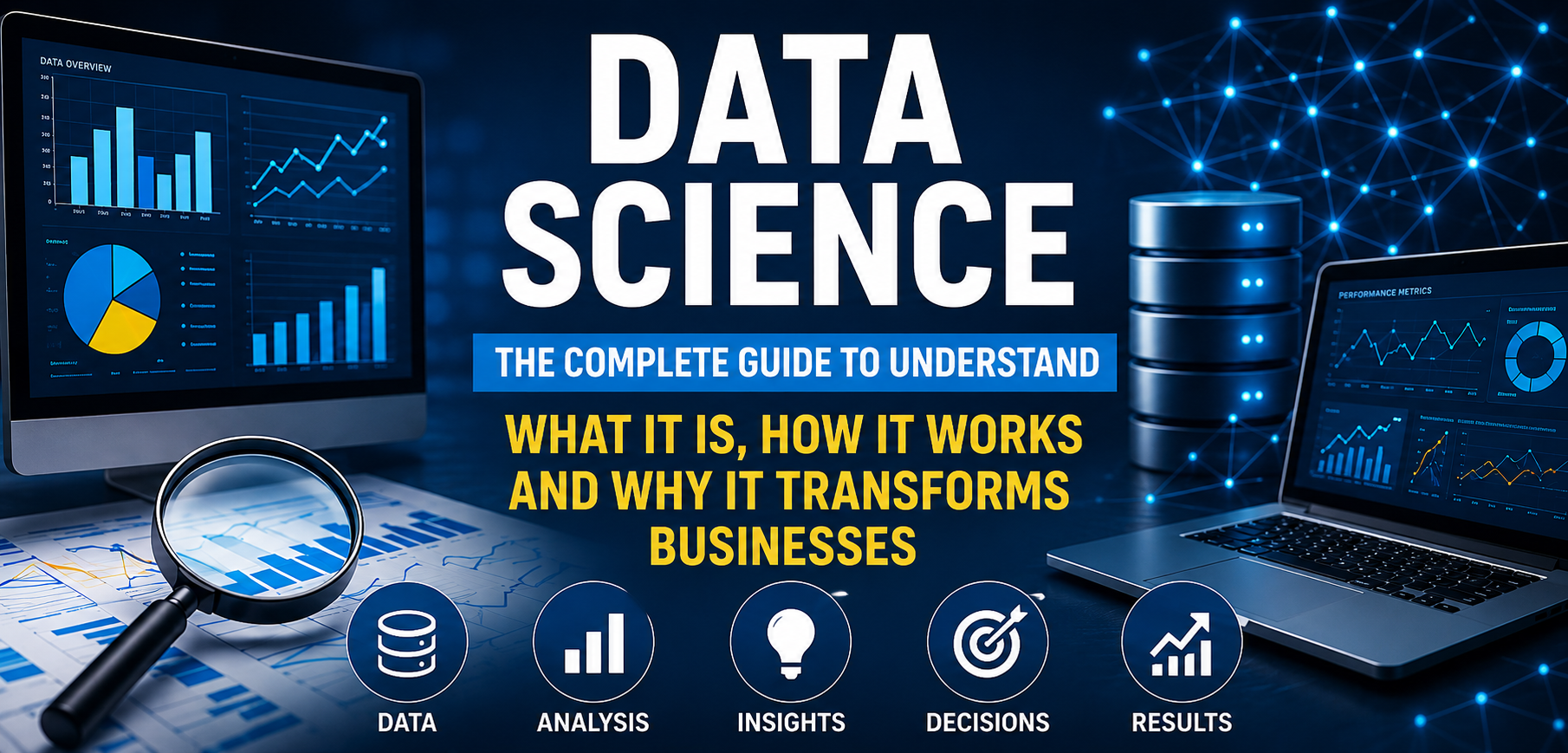
Data → Information → Knowledge → Decision → Result
That transformation is what makes Data Science so powerful.
⚙️ How Does Data Science Work in Practice?
Although some projects are extremely complex, the process can be explained in a few basic stages.
1. Data Collection
First, we need to understand what data exists and where it is stored.
Data can come from:
- websites;
- applications;
- social networks;
- sales systems;
- online stores;
- CRMs;
- spreadsheets;
- sensors;
- surveys;
- advertising campaigns.
The better the collection process, the greater the potential of the analysis.
But there is an important detail:
more data does not necessarily mean better data.
Incomplete, duplicated or incorrect data can lead to incorrect conclusions.
2. Organization and Preparation
Once collected, the data needs to be prepared.
Imagine a spreadsheet containing thousands of customers where:
- some names are duplicated;
- phone numbers have different formats;
- some fields are empty;
- certain dates are incorrect;
- some records are outdated.
Before analyzing everything, these problems need to be addressed.
This stage may not seem exciting, but it is essential.
A sophisticated analysis based on poor-quality data is still a poor analysis.
🧠 3. Analysis
Now one of the most interesting parts begins.
Data professionals look for patterns, relationships, trends and behaviors.
For example:
A company may discover that customers buy more on certain days of the week.
An advertising campaign may have a much higher cost for a particular audience.
A product may sell extremely well when offered alongside another product.
Or customers displaying certain behaviors may be more likely to cancel a subscription.
These discoveries may seem small.
But when used correctly, they can represent significant amounts of money.
🔮 4. Predictive Models: What If We Could Anticipate the Future?
This is where things become even more advanced.
Using statistical techniques and Machine Learning, we can build models capable of identifying patterns and making predictions.
For example:
Which customer is most likely to buy?
Which customer may stop using the service?
Which product will have greater demand?
Which transaction may represent fraud?
How much could the company sell next month?
There is one important thing to understand:
prediction does not mean fortune-telling.
A model does not know the future.
It uses historical data and identified patterns to estimate possibilities.
The better the data and model, the more useful the estimate may become — although no prediction is guaranteed.
🤖 Where Does Artificial Intelligence Fit In?
It is common to confuse Data Science with Artificial Intelligence.
They are related, but they are not exactly the same thing.
Data Science is a broad field involving data collection, preparation, analysis, interpretation and application.
Artificial Intelligence, on the other hand, includes techniques and systems capable of performing tasks that would normally require some form of human intelligence.
Within this field we find Machine Learning.
It allows systems to learn patterns from data and use those patterns to make predictions, classifications and other decisions.
That is why many projects combine:
Data Science + Machine Learning + AI
💼 How Can Data Science Help a Business?
Now we reach the practical part.
Imagine a company investing €1,000 every month in advertising.
It could simply look at the number of sales and say:
“This campaign worked.”
But deeper analysis can answer much better questions:
- Which advertisement brought the best customers?
- Which audience had the highest conversion rate?
- Which region generated the best return?
- How much did it cost to acquire each customer?
- Which product generated the highest margin?
- At what stage did customers abandon the purchase?
- Which channel brought customers with the greatest potential for repeat purchases?
See the difference?
The company stops making decisions based only on feelings and assumptions and starts making decisions based on evidence.
📈 Data Science in Marketing
Marketing is one of the areas where data can generate particularly interesting results.
Imagine an advertising campaign with a €1,000 budget.
Instead of looking only at how many people saw the advertisement, we can analyze:
Impressions → Clicks → Leads → Customers → Revenue
This helps identify where problems are occurring.
Perhaps the advertisement receives many clicks but generates very few leads.
Or perhaps there are plenty of leads but very few sales.
Each situation requires a different strategy.
With properly analyzed data, marketers can test hypotheses, identify patterns and allocate budgets more effectively.
🏭 And It Is Not Just About Marketing
Data Science can be applied to practically any industry.
🏦 Finance
Risk analysis, fraud detection and prediction of certain financial behaviors.
🛒 Retail
Demand forecasting, customer analysis, product recommendations and inventory management.
🚚 Logistics
Route optimization, cost analysis, maintenance prediction and operational monitoring.
🏭 Manufacturing
Machine monitoring, failure detection and production optimization.
👥 Human Resources
Performance analysis, recruitment and identification of employee turnover patterns.
📱 Technology
Product personalization, usage analysis and development of intelligent systems.
In other words:
where there is data, there is potential for analysis.
🛠️ Which Tools Are Used?
There is no single tool capable of doing everything.
Depending on the project, Data Science professionals may use technologies such as:
- Excel and Google Sheets — organization and initial analysis;
- SQL — querying and managing databases;
- Python — analysis, automation and Machine Learning;
- R — statistics and data analysis;
- Power BI — dashboards and visualization;
- Tableau — visual analysis and reporting;
- BigQuery and Snowflake — large-scale data storage and processing.
The most important thing, however, is not knowing dozens of tools.
It is knowing which problem needs to be solved and which tool is appropriate for solving it.
⚠️ Is There a Dangerous Side to Data Science?
Yes.
And discussing this is just as important as discussing its advantages.
Data can be extremely valuable, but it also creates responsibilities.
Companies need to consider issues such as:
- privacy;
- security;
- data protection;
- consent;
- data quality;
- transparency;
- potential model bias.
An algorithm can be mathematically sophisticated and still produce unfair results if it is trained using inappropriate or biased data.
Therefore, using data intelligently also means using it responsibly.
🚀 The Future Belongs to Companies That Know How to Interpret Their Data
For a long time, simply having information was an advantage.
Today, simply possessing information is no longer enough.
The real competitive advantage lies in being able to answer:
What is happening?
Why is it happening?
What is likely to happen next?
And what should we do now?
This is where Data Science, automation and Artificial Intelligence begin to come together.
A company capable of turning thousands or millions of records into practical decisions can identify opportunities that competitors simply cannot see.
💡 Can Small Businesses Use Data Science?
Absolutely.
This is one of the biggest misconceptions about the subject.
You do not necessarily need millions of customers or a huge technology department.
A small business already has enough data to begin:
- sales;
- customers;
- leads;
- campaigns;
- website visits;
- products;
- costs;
- conversions.
The first step may simply be organizing this information.
Then, creating useful indicators.
Next, identifying patterns.
As the company grows, it can adopt more sophisticated analytics, automation and predictive models.
Data Science does not begin when a company has millions of data points.
It begins when a company decides to stop ignoring the data it already has.
🎯 The Big Question Is Not “How Much Data Do You Have?”
It is:
“What Can You Discover From the Data You Already Have?”
This question can completely change the way a company manages its resources.
Data can reveal customers who are close to buying.
It can show campaigns that are wasting money.
It can identify products with growth potential.
It can reveal bottlenecks.
It can help predict problems.
And it can uncover opportunities before they become obvious to everyone else.
In business, that represents something extremely valuable:
the ability to make better decisions before the competition does.
🌐 Conclusion
Data Science is not simply about numbers, spreadsheets or programming.
It is about transforming information into intelligence that enables better decisions.
This transformation is already happening across virtually every industry.
In the future, the difference between competitive companies and companies that fall behind may have less to do with how much information they possess and more to do with their ability to interpret, use and act on that information.
The data is already being generated.
The technology to analyze it already exists.
Artificial Intelligence is making this process increasingly powerful.
Now there is only one question left:
Is your company simply collecting data, or is it actually learning from it?
Because in an increasingly competitive market, those who understand their own data can see the next move before it happens.