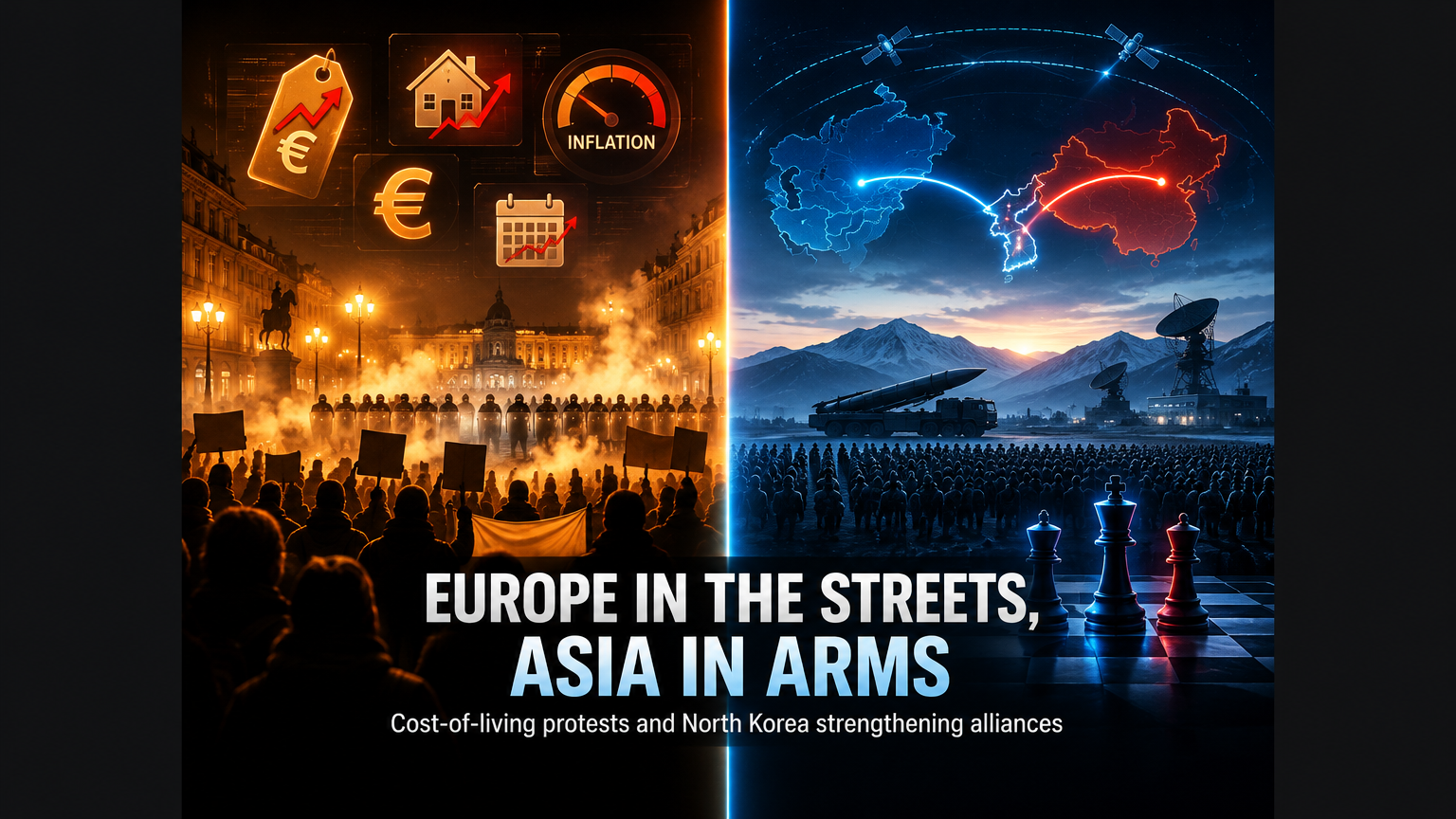
In the same weekend, two things happened at opposite points on the map, and they are rarely read together.
In France, 320,000 people took to the streets on Saturday, 31 October, the third consecutive weekend of protests. In Italy, a general strike brought workers and students into more than 40 cities. In Germany, demonstrations in 34 cities. In Portugal, tent camps dismantled.
In North Korea, Kim Jong Un called for a “stronger army” and a “Korean-style military revolution”, and the next day visited China across the new bridge over the Tumen river.
They are two different crises with different causes. But both say the same thing about the moment: the structures that organised the world since 2022 are being reorganised from within.
What is happening in Europe, in numbers
The wave began in France and spread. The timeline is the most revealing data point.
On 17 October, 550,000 people in the streets, with violence the French government described as the worst in years. On 24 October, 410,000. On 31 October, 320,000.
The trend is downward. But the important figure is not that: it is that turnout stayed above 300,000 for three consecutive weekends, which in France is a level of sustained contention, not an isolated peak.
The composition also changed. The movement began led by secondary school students, against the cost of living and the state of schools. By the third weekend, unions and the Yellow Vests were integrated. That is the difference between a student revolt and a social movement.
In Paris, the Interior Ministry counted 70,000 demonstrators. Organisers claim 200,000. The country deployed around 70,000 police officers and gendarmes, and Interior Minister Laurent Nunez announced 422 arrests in a preliminary tally.
In Italy, the general strike on 30 October was called by the USB union and brought together truck drivers, taxi drivers and farmers alongside students. The slogan circulating in the streets sums up the agenda: “We need houses, not bombs”. There were minor clashes in Turin and eight arrests in Rome.
In Germany, the “Gen Z Regelt” movement called protests in 34 cities against the cost of living, budget cuts and the return of compulsory military service. In Frankfurt, shops were looted. In Berlin, Cologne and Hamburg, police used water cannons.
The economic cause behind all of it
The protests are not about an abstract theme. There is a number behind them.
According to Eurostat, annual euro area inflation rose to 3.8% in September 2026, up from 3.2% in August. A year earlier, it stood at 2.2%.
The detail that explains the streets is in the breakdown. Energy had the highest annual rate, 18.8%, and alone added around 1.7 percentage points to headline inflation. Services rose to 3.2%.
And there is a figure that connects directly to youth discontent. Between August 2021 and August 2026, food and non-alcoholic beverage prices in the European Union rose 34%. The amount of food the gross monthly minimum wage can buy fell 6% in Malta, 5% in Spain and 4% in France.
In other words: in five years, the French minimum wage buys less food than it used to. That is the sentence written on the placards, even when the placards say something else.
Housing adds to the picture. In its September consumer expectations survey, the European Central Bank recorded that respondents aged 18 to 34 remain the most pessimistic group.
What governments can do, and what they cannot
Here is the part that rarely enters the analysis, and which explains why the protests do not stop.
France is the eurozone’s second-largest economy, but it is dealing with mounting debt. The government has limited fiscal room to respond to students with additional spending. It can negotiate, it can make targeted concessions, but it cannot solve the cause.
In Italy, the protesters’ agenda explicitly includes defence spending. And that is where the two sides of this article meet.
The link connecting European protests to Asia
Europe is increasing defence investment at the same time as its citizens protest the cost of living. That is not a coincidence, it is a choice with a political price.
At the June 2025 NATO summit, member countries committed to spending 5% of GDP annually by 2035. At the July 2026 summit, they reaffirmed that commitment.
According to NATO’s own data, in 2026 five Allies are already expected to meet the 3.5% guideline for core defence requirements, and five are projected to meet the overall 5% guideline.
In a September 2026 article, the European Central Bank estimated that euro area defence spending rose slightly to almost 1.5% of GDP in 2025.
The political problem is arithmetic. Every euro that goes to defence is a euro that does not go to housing, schools or subsidies. And when energy inflation is at 18.8%, the voter feels both things at once: the state spending more on weapons and their electricity bill rising.
That is why the Italian placard “houses, not bombs” is not rhetoric. It is a budget position.
What is happening in North Korea
On the other side of the world, the movement is the inverse: not social pressure on the state, but the state concentrating power.
On 23 October, Kim Jong Un spoke at the Third Company Leaders’ Meeting of the Korean People’s Army. The stated aim, according to state agency KCNA, is to “build the strongest army and accelerate the Korean-style military revolution”.
The next day, 24 October, he crossed the new road bridge over the Tumen river and visited China. The bridge opened on 7 September and exists precisely to increase the flow of goods, military equipment and people between the two countries.
On 2 November, this Monday, Pyongyang returned to military rhetoric. Kim Jong-sik, first vice department director of the Workers’ Party Central Committee, denounced the joint South Korea-United States exercise known as Iron Mace as “the most hideous nuclear war rehearsal aimed at using nuclear weapons against the DPRK”, and called strengthening the country’s nuclear capabilities “immutable”.
The alliances that changed status
Here is the structural shift worth retaining.
In June 2024, Putin and Kim signed a Comprehensive Strategic Partnership Treaty in Pyongyang, including a mutual defence commitment. In April 2026, the two countries announced a defence agreement valid until 2031.
The involvement moved from declaration to practice. Ukrainian and South Korean estimates indicate North Korea has sent between 14,000 and 16,000 combat soldiers to Russia since late 2024.
In September 2026, on the country’s 78th founding anniversary, Kim publicly thanked the troops deployed to Russia. In a message to Putin, he spoke of “unwavering support” and described Russia’s war as a “sacred war for defending the country’s security interests and international justice”.
In October, in a birthday message to Putin, he described strengthening the alliance as an “unshakeable option”.
What North Korea receives in return is known and relevant: real combat experience, foreign currency and access to new military technology.
Why this matters to anyone in Europe
It might seem these two subjects do not intersect. They do, at three concrete points.
First, in the budget. European military reinforcement is justified in part by the perception of global risk, and that perception includes Asia. Every increase in defence spending is a political decision that faces the street.
Second, in energy. The 18.8% energy inflation in the euro area does not come from nowhere. It is tied to supply chain disruptions and geopolitical tensions, including those involving the Gulf and maritime routes. Asia and its repositioning are part of that chessboard.
Third, in predictability. When military alliances change status, from declaratory to operational, risk stops being calculable. And incalculable risk makes everything more expensive: insurance, transport, credit, investment.
What to expect in the coming weeks
In France, a nationwide day of strikes and protests is called for 5 November, across the public and private sectors. The Union Étudiante announced school and university blockades on Tuesday and Thursday. The CGT and other union confederations support it.
Disruption is expected on high-speed trains, regional TER services and possibly international routes to Spain, Italy and Switzerland. The disruption timetable will be published by Wednesday at 17:00.
In Spain, unions CCOO and UGT, alongside housing organisations, announced a 24-hour general strike for 11 November.
In North Korea, the next date to watch is the response to the Iron Mace exercise and whatever emerges from Kim’s visit to Beijing.
The limits of this reading
Three caveats, so that analysis does not become prophecy.
First, crowd figures diverge. In France, the Interior Ministry counted 320,000 on the 31st; organisers claim nearly 500,000. The gap is normal and is not fraud on either side: they are different methodologies. I always use the official figure and flag the organisers’.
Second, the European wave is not homogeneous. The agendas vary: in France it is cost of living and schools, in Italy it includes defence spending, in Germany it includes compulsory military service, in Portugal it is housing. Treating this as a single movement would be an oversimplification.
Third, North Korea is an opaque box. Everything known comes from KCNA, foreign intelligence services or estimates. Troop numbers sent to Russia are estimates, not verified counts.
Conclusion: two pressures, one question
In Europe, 320,000 people in France, a general strike in more than 40 Italian cities, protests in 34 German cities, with euro area inflation at 3.8% and energy at 18.8%. Governments with narrow fiscal room and defence commitments rising towards 5% of GDP.
In Asia, North Korea calling for a stronger army, consolidating a defence agreement with Russia until 2031, sending thousands of soldiers to Ukraine and tightening its link with China across a new bridge.
Two crises with opposite signals. In one, society pressures the state. In the other, the state concentrates power.
But both answer the same question, and that is where they meet:
Who pays the bill for security, and with whose money?
In Europe, that bill shows up in the electricity bill and the rent. In Asia, it shows up in the military parade and the signed treaty.
The question that remains for anyone running a business, anywhere:
If the cost of energy and the cost of risk rise together over the next six months, which of your two budget lines gives way first?
It is worth knowing the answer before the market gives it for you.