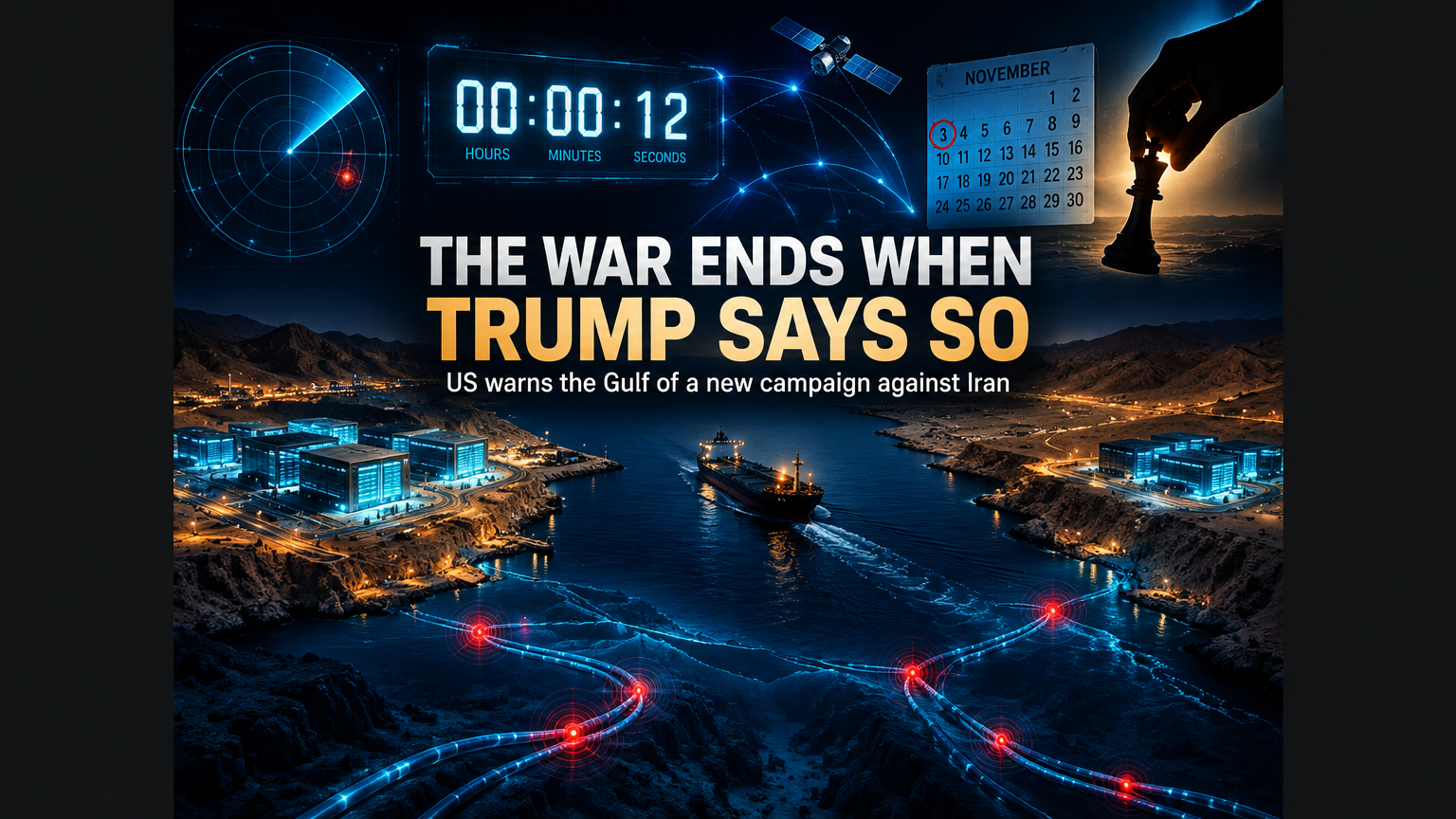
The sentence was delivered at a rally, with the lightness of someone answering a curiosity.
“Somebody asked me before, ‘When will the war in Iran end?’ I said, ‘Whenever I want it to end.'”
Donald Trump repeated the formula in Texas on the night of 27 October 2026, adding that the end “will be very quick” but has to happen properly, with a guarantee that Tehran will never have a nuclear weapon.
The same day, the Wall Street Journal reported something else, more concrete and far less comfortable for anyone living in the region: the United States has told several Gulf Arab countries to prepare for a “short, intense” military campaign against Iran, to take place after the 3 November midterm elections.
Read together, the two pieces of information describe the moment precisely. There is a military calendar, there are defined targets, there are troops moving, and there is a decision that, according to the president himself, sits with one person.
What was actually said
The statements deserve separating, because a great deal of paraphrase circulated.
At the Lubbock, Texas rally on 27 October: “Somebody asked me before, ‘When will the war in Iran end?’ I said, ‘Whenever I want it to end.'” And also: “It’ll be very quick, but we have to have it end properly, with a total statement that they will never have a nuclear weapon.”
In Corpus Christi, also in Texas, the same day: asked whether he would attack Iran again, he said yes, “absolutely”.
At Joint Base Andrews, Maryland, on 28 October: asked by reporters whether he planned to attack Iran after the elections, he was evasive. “I can’t tell you that. But anything’s possible.” He added that Tehran wants a deal and may be waiting for the election result, but warned that delaying “is not going to help”.
The White House, asked about the warning to Gulf countries, declined to comment on “sensitive military plans that may or may not exist”, saying only that Trump keeps “all options on the table to ensure that Iran can never have a nuclear weapon”.
There is a relevant detail in the background. Trump had previously stated he would not attack Iran before the midterms. The phrase “whenever I want” arrives precisely as that commitment loses the date that constrained it.
What the Gulf warning means in practice
According to the Wall Street Journal, citing people briefed on the conversations, the message was conveyed through diplomatic and military channels to several Gulf Arab countries, without specifying which.
The request is specific: prepare for a short, intense campaign, and take preventive measures against the risk of Iranian retaliation against energy installations and other essential infrastructure.
The military movements accompanying the warning, according to the same reports, include sending a Patriot battery from Texas to Israel, moving US personnel away from bases where they would be exposed to Iranian fire, restocking munitions and preparing bombers and fighter jets, alongside concentrating around 20 warships in the region, with the addition of an aircraft carrier and a marine expeditionary unit.
The list of targets under consideration has been expanded. It includes Iranian nuclear facilities, energy infrastructure, missile and drone arsenals, and sites vital to the country’s economy.
The phrase “short and intense” is not rhetorical. It describes an operating model that concentrates effort into a handful of days rather than a prolonged campaign, with the stated aim of weakening Tehran and pushing it towards the negotiating table.
The cost already paid
The war began in February 2026 with joint American and Israeli strikes, and is now eight months old. In June, the two countries signed a memorandum of understanding to end the conflict, but negotiations remain stalled.
The price is now visible in numbers.
According to a Pentagon document reviewed by ABC News, the war has cost $47.1 billion through mid-October. That is an increase of $3.5 billion over the previous estimate of $43.6 billion through mid-September.
The composition of the figure says a lot about the kind of war being fought. Around $11.9 billion corresponds to operational expenses and roughly $6 billion to the loss of military equipment. The largest individual expenses sit in Patriot and THAAD interceptor missiles, used to neutralise Iranian attacks.
In other words: a significant share of the cost is not destroying, it is defending.
Oil has already reacted twice
The markets did not wait for the decision.
On 23 October, Brent crude rose above $117 a barrel, its highest level in five months, after Tehran announced it would attack oil facilities, undersea cables, data centres and artificial intelligence facilities in the region if a new offensive were launched.
Four days later, on 27 October, the same Brent fell 1.7% to close at $113.88, after Iran’s supreme leader and a senior security official discussed conditions for ending the war.
Two swings in four days, with moves of several dollars, on the same uncertainty. It is the portrait of a market trying to read presidential intentions rather than supply and demand data.
The threat that matters to this blog
Here is the part usually treated as a footnote, and which deserves to be the headline.
On 23 October, two senior Iranian security officials told Reuters that Tehran has detailed plans to target undersea communications cables in the Gulf if the United States and Israel attack again. One of them added a new element: the aim would also be to prevent repairs, prolonging the disruption.
The threat was also made publicly. Yadollah Javani, a senior Islamic Revolutionary Guard Corps official, said seven major internet cables beneath the Strait of Hormuz could be targeted if Iranian infrastructure is attacked. Before that, Mohsen Rezaei, secretary of Iran’s Supreme National Security Council, had already included cables, data centres and AI facilities among possible targets.
The numbers help size it, and also correct the exaggeration.
Undersea cables carry around 99% of the world’s internet traffic. But those crossing the Strait of Hormuz represent less than 1% of the world’s international bandwidth. Operators can normally route traffic around a single break. Several at once, with repairs blocked, is another scenario entirely.
The real risk does not sit in that 1%. It sits in the combination of three factors: the concentration of data centres in the region, dependence on alternative maritime routes close to conflict zones, and the stated intention to prevent recovery.
What this means for businesses outside the Gulf
Here is the connection to the ground of this blog, and it is more direct than it looks.
1. Geography is an infrastructure variable again
For a decade, choosing a cloud region was mostly a decision about latency and price. It has become a decision about geopolitical risk as well.
A European company hosting services in the Gulf region, or depending on suppliers with nodes there, now carries exposure to a scenario that was not in the contract. The question to ask suppliers has changed: not “where is the data”, but “where is the data and what happens if that maritime route closes”.
2. Redundancy stopped being a technical detail
If your operation depends on a single cloud provider, a single network route or a single data centre, your resilience is that point’s resilience. And that point is now subject to decisions you do not control.
Real redundancy means, at minimum, a second region in a different jurisdiction, backups outside the production environment, and a tested plan to keep operating at reduced capacity.
This is the kind of structure Rapid Genius builds before any crisis rather than during one: a well-built digital structure starts by deciding where each thing lives.
3. Energy costs are back in the spreadsheet
A barrel above $117 does not stay on the Brent chart. It enters transport, logistics, production and the final price.
Companies with thin margins feel this with a delay of weeks. Those with cost data organised by line item can anticipate the impact and renegotiate in time. Those without discover the problem when the invoice arrives.
That is exactly the field of data science applied to business: turning external variation into internal scenarios before it becomes a surprise.
4. Concentrated decision-making is a management risk
There is a governance lesson here that goes beyond geopolitics.
When the end of a war depends on one person’s will, every agent around it, allied countries, markets, companies, suppliers, starts operating on interpretation of intent rather than on predictable rules. That makes everything more expensive, because risk stops being calculable.
The same happens inside companies where critical decisions depend on a single decision-maker with no documented process. The organisation loses the ability to forecast, and forecasting is what makes investment possible.
That is why recording criteria, deadlines and reversal conditions is not bureaucracy: it is what keeps an operation navigable when the decision-maker is unavailable.
The diplomacy still open
It would be inaccurate to present the war as decided. There is a negotiating process under way, and it is more concrete than it appears.
On 25 October, Qatari mediators presented Tehran with a new draft deal to end the conflict. According to an official briefed on the negotiations, the text sets out a seven-day timeline, with daily confidence-building steps each side must take, and several countries acting as guarantors.
The proposal, according to reports cited by the Times of Israel, would trade authorisation for UN inspectors to visit bombed nuclear sites for some sanctions relief.
Iran’s foreign minister, Abbas Araghchi, confirmed that Tehran is discussing with mediators ways to implement a seven-day plan and reopen the Strait of Hormuz.
But a senior Iranian official, cited by Reuters, said Qatar presented “unacceptable ideas” rather than a real proposal, and insisted Tehran would show no flexibility on the nuclear question.
In parallel, US Vice President JD Vance sent a letter, through Qatari mediators, proposing an early meeting between officials from both countries, with himself leading the American negotiating team. The letter was read and approved by Trump before being sent, and Rezaei’s formal reply was expected by Thursday, 29 October. According to officials on both sides, direct talks could begin as early as the following week, in Qatar or Turkey.
The United Arab Emirates, through Anwar Gargash, called for restraint.
In other words: two tracks are running at the same time, one military and one diplomatic, and neither is closed.
The honest limits of this reading
Three things must be stated clearly.
First, the warning to Gulf countries is reported by the Wall Street Journal based on unidentified sources. It is solid journalism, but not official confirmation. The White House neither confirmed nor denied it.
Second, Trump did not announce a decision. He said “anything’s possible” and that the end depends on him. There are reports that he leans towards a larger attack after the elections, and also that he could ultimately authorise no action at all. Both remain open.
Third, the cable threat is a declared threat, not an attack in progress. Capability and execution are different things, and most technical analysis stresses that the impact would be regional and partial, not a global blackout.
I would therefore follow primary sources: Pentagon and State Department statements, IEA oil data, and whatever emerges from the Qatari mediation.
Conclusion: one date, two infrastructures
The United States has warned Gulf countries to prepare for a short, intense campaign against Iran after 3 November, with military movements under way, an expanded target list and an accumulated cost of $47.1 billion.
Trump summed up the calendar in one line: the war ends when he wants it to.
And meanwhile, the Iranian threat has shifted to terrain that matters to any company: undersea cables, data centres and AI facilities. Not because they are easier to hit, but because they are where today’s economy actually runs.
There are two infrastructures in play right now. The first is physical, made of ships, missiles and pipelines. The second is digital, made of cables on the seabed and rooms full of servers.
The second is the one your company uses every day.
The question that remains:
If the route connecting your operation to the world closed for two weeks, how many days of real autonomy would you have before stopping?
The answer is not decided in a crisis. It is decided in the architecture already in place today.