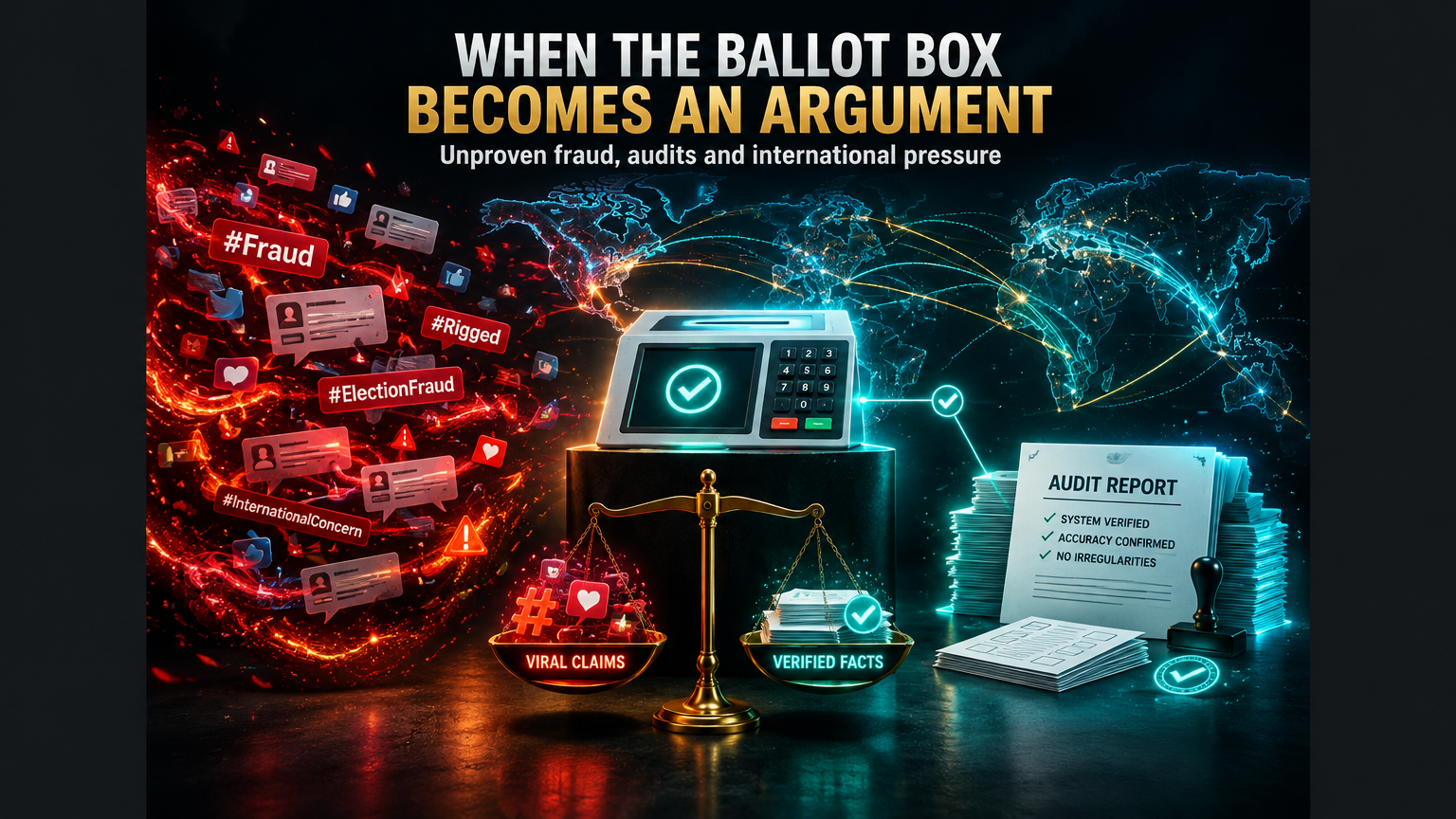
On the night of October 25, 2026, Brazil’s Superior Electoral Court announced the runoff result.
Luiz Inácio Lula da Silva won with 51.8% of valid votes against 48.2% for Flávio Bolsonaro, a gap of nearly 4.4 million votes, according to official TSE data confirmed by CNBC, Fortune and NPR.
Minutes later, the defeated candidate refused to recognise the result and asked for the election to be annulled.
From there, what should have been the end of an electoral process became something different: a dispute over the legitimacy of Brazil’s electronic voting machines that crossed borders in under 24 hours, involving foreign political actors, unproven claims, technical audits and an official United States statement that was held back.
This article reconstructs what happened, separates fact from allegation, and then examines what the episode reveals about information, verification and risk in the digital environment, which is this blog’s ground.
The result and the allegation
Lula, who turns 81, secured his fourth term, his fourth non-consecutive one, unprecedented in Brazilian history.
In the first round on October 4, Flávio Bolsonaro had led with 47.03% against Lula’s 45.16%, according to the Rio Times, a reversal the polling institutes did not foresee.
The defeated campaign’s central claim is not about the machines themselves, but about a procedural decision.
Supreme Court Justice Cristiano Zanin extended voting nationwide until 7 p.m. Brasília time, after both campaigns requested it: Lula’s coalition cited bus shortages and Flávio Bolsonaro’s cited rain in 17 cities.
That decision is what began being presented as the irregularity.
What the official data shows: according to a TSE survey published by Folha de S.Paulo and Jornal de Brasília, only 34,330 votes, or 0.03% of the total, were recorded after 5 p.m.
In São Paulo, 80% of polling zones had effectively closed by 5 p.m. The final gap was 4.43 million votes.
Mathematically, 0.03% of votes does not explain a gap of that magnitude, and none of the sources consulted presents evidence that late votes decisively favoured one side.
What the audits say
This is where the article has to be rigorous, because it is the point public discussion tends to skip.
The TSE itself ran the runoff’s Integrity Test on election day. According to the court’s official statement, 389 votes were audited and the result ended with no divergences between paper ballots and electronic records.
The same had happened in the first round on October 4.
The audit was monitored by cameras for 24 hours, with live streaming.
Leonardo Hernandez of the TSE stated: “In 30 years of electronic voting, no fraud has been proven. The machines passed the test and democracy was once again assured.”
Brazil has used electronic voting machines since 1996. Each machine prints a tally bulletin when polls close, and the bulletins are published per polling section, allowing any party to check them.
There is one honest technical limit to register: the country has no paper recount. In 2022, the Defence Ministry found no sign of fraud but said it could not rule out malicious code because it lacked full access to the source code. That is a legitimate criticism about verifiability, different from an allegation of fraud.
The American reaction: what actually happened
Here the facts must be split into three layers, because mixed versions circulated.
What Trump said before the result
On Sunday the 25th, asked by reporters in Washington who he hoped would win, Donald Trump declined to answer: “I don’t want to get into that, but we are watching”, according to CNBC, Reuters and Veja.
He endorsed no candidate. Analysts interviewed by Gazeta do Povo describe a posture of neutrality throughout the dispute, despite the American government having imposed significant tariffs on Brazilian exports and sanctioned Justice Alexandre de Moraes.
What the administration did after the result
This is the most concrete and least reported point.
According to Folha de S.Paulo, the State Department had a ready draft of a statement congratulating the Brazilian people on the election, as is customary after votes around the world.
The order was to hold back publication and “assess” the situation, after Flávio Bolsonaro declared on Sunday night that he did not recognise Lula’s victory and called for annulment.
Asked about it, the US Embassy in Brazil gave no indication of when the statement would be released.
By the morning of October 26, neither Trump nor Argentina’s Javier Milei had congratulated Lula, according to O Globo, while presidents of several Latin American countries, including right-wing governments in Colombia, Chile and Peru, and Canada’s prime minister already had.
For historical comparison: in 2022, under Joe Biden, the United States was one of the first countries to recognise Lula’s victory, even amid the fraud allegations made then by Jair Bolsonaro.
What the Trump family amplified
On the 26th, Donald Trump Jr. shared on X a post by Martin De Luca accusing the Brazilian government of manipulating the 2026 election, comparing Lula to Nicolás Maduro and questioning Zanin’s decision, according to Exame.
That same day, Eduardo Bolsonaro published a video in English in which he claims, without presenting evidence, that there was fraud and calls for international pressure so the result is not recognised. “Do not recognise these elections,” he says in the video, according to G1.
Al Jazeera recorded Trump Jr.’s criticism of the result, citing the two-hour extension.
It matters to distinguish: the US president did not declare fraud. What happened was presidential silence, the withholding of an official statement, and amplification of allegations by relatives and allies.
The background that helps explain the context
This episode did not come from nowhere, and three earlier elements matter.
In early October, after the first round, Trump posted on Truth Social that 125 million people had voted in Brazil and that results came out the same day, using it to attack vote counting in Detroit, Philadelphia and California. PolitiFact rated the claim as unsupported, and Forbes noted the post appeared to confuse India with Brazil.
In July, Brazil denied visas to two State Department officials, saying they sought to cast doubt on its electoral system. Washington called the trip routine.
And Reuters revealed, on the Saturday before the vote, a campaign within the US State Department to help get the Bolsonaros back into power.
None of this proves electoral irregularity. It proves the environment was already charged before voting, and that the dispute over the legitimacy of the machines had incentives on both sides of the ocean.
The layer that matters to this blog: information as infrastructure
Here is the connection to the technology ground.
The Brazilian case is not only political. It is a case study in how information circulates, validates and becomes contaminated in 2026.
1. Unproven claims travel faster than audits
A procedural decision to extend voting hours became, within hours, an accusation of widespread fraud. On the other side, an audit with 389 votes checked, live streaming and per-section published bulletins got a fraction of the circulation.
This is not a Brazilian problem, it is a platform architecture problem. Emotional content is distributed by design; verification is distributed by effort.
For businesses, the parallel is direct: a complaint from an unhappy customer on social media travels faster than the technical report that disproves it. Whoever does not have the report ready beforehand loses the narrative.
2. Verification has to exist before the crisis
The TSE could only respond within hours because the integrity test was scheduled, the audit structure existed and the tally bulletins were public by design.
That is engineering, not luck.
The same principle applies to any business: if your company were publicly accused of an error, how long would it take to produce evidence supporting your version? If the answer is “days”, the architecture is wrong. Organised, traceable and auditable records are the business equivalent of the tally bulletin. That is exactly what data science applied to business makes possible: operational memory you can query in minutes, not weeks.
3. Foreign amplification is the new reputational risk vector
An allegation born in Brasília gained global reach because it was translated, published in English and shared by figures with millions of followers.
An English-language video aimed at an international audience, asking that elections not be recognised, is a communications operation, and was treated as such by the outlets that reported it.
Businesses experience something similar at smaller scale: a local problem becomes an international case if the narrative is well packaged. Monitoring mentions across multiple languages and channels stopped being a luxury, and is one of the routines intelligent automation sustains without manual work.
4. Trust in systems depends on explainability, not outcomes
The debate over electronic voting machines has run for decades and will not end with this election, because the real argument is not about the result, it is about whether any citizen can verify the process on their own.
It is the same tension that appears in AI today: models that produce results the user cannot reconstruct generate structural distrust, even when they are right.
Anyone building digital products should take a simple lesson from this: an opaque system is a contestable system. Explainability is not a technical refinement, it is reputational armour.
What remains open
Three things must be stated clearly, because the matter is far from closed.
First, the fraud allegation was not substantiated by any source consulted, and the official TSE audits found no divergences. This does not mean every criticism of the model is illegitimate. The absence of a paper recount is a real verifiability weakness, flagged even by the Defence Ministry in 2022.
Second, the annulment request filed by Flávio Bolsonaro has no known outcome. It is not clear, according to AP, whether it meets the legal threshold to annul the result. A recount request is possible, but may not change the outcome.
Third, the US government’s final position had not been announced by the time this article closed. The statement may come out, and may change the framing.
The honest recommendation for anyone following this: confirm in primary sources, at the TSE and the State Department, before treating any position as final.
Conclusion: whoever controls verification controls the narrative
Lula won the runoff with 51.8% of the vote, a gap of nearly 4.4 million. Flávio Bolsonaro asked for annulment. The TSE audits, with 389 votes checked and live streaming, found no divergences, and the court maintains that no fraud has been proven in 30 years of electronic voting.
Donald Trump did not declare fraud. He said he was “watching”, declined to endorse, and his administration held back a recognition statement that was already drafted. His sons and allies amplified the allegation, in Portuguese and in English.
What this episode exposes is not only an electoral crisis. It is the cost of living in an environment where the allegation is instant and verification is slow.
For businesses, the lesson that remains:
Whoever cannot prove what they did loses the argument to whoever can claim whatever they want.
The question that remains:
If your company were accused today, publicly and in three languages, how long would it take to produce evidence supporting your version?
The answer measures digital maturity more precisely than any innovation report.