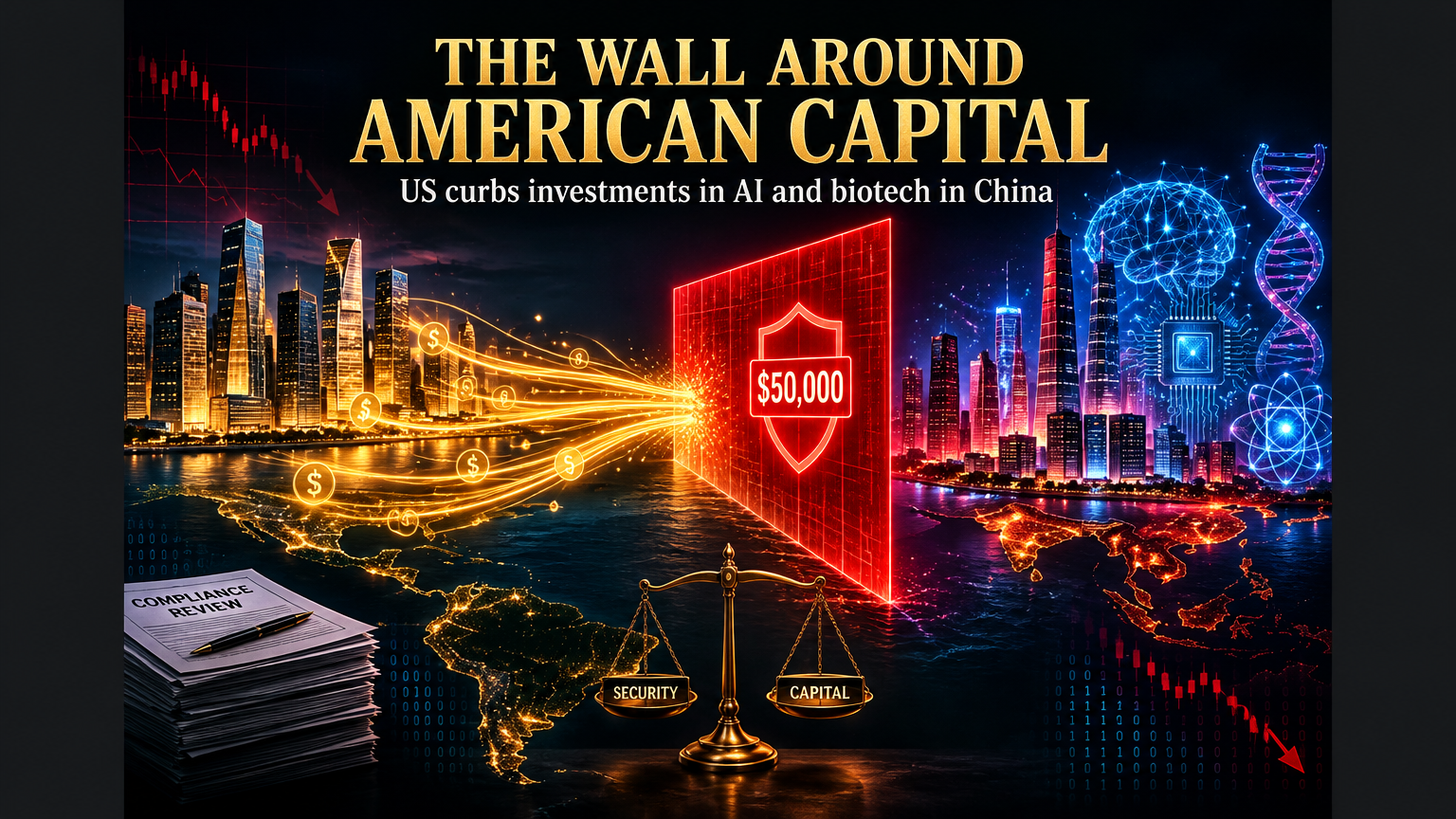
For decades, American capital was the quiet fuel behind Chinese technological innovation.
This Thursday, October 22, 2026, the US Treasury Department presented the rules that could close that tap across six strategic sectors.
The proposal covers semiconductors and microelectronics, artificial intelligence systems, quantum technologies, high-performance computing and supercomputing, hypersonic systems and, by Treasury’s own decision, biotechnology as well.
The detail that defines the practical reach: the rules apply only to investments exceeding $50,000, and exclude many purely financial investments, including stock purchases.
Before any hasty conclusion, one essential point most headlines missed: this is a proposal, not a law in force.
What exactly was published
The document is a Notice of Proposed Rulemaking, or NPRM. It is the instrument through which Treasury opens the draft of the rules it intends to adopt.
The deadline for public comments is December 7, 2026. Only after that can Treasury revise definitions, exceptions and compliance requirements, and issue the final rule, which will set the effective date.
Until then, the current regime applies, the Outbound Investment Security Program, in force since January 2, 2025.
What changed was not the day, it was the legal basis. The previous rules came from an executive order. The new ones come from a law passed by Congress: the Comprehensive Outbound Investment National Security Act, the COINS Act, enacted on December 18, 2025 as part of the annual defense bill.
The difference is structural. An executive order can be revoked or loosened by presidential decision. An act of Congress cannot.
The six sectors and what each means
The COINS Act named five sectors. Treasury added a sixth, using the legal authority to include areas capable of expanding the military, intelligence, surveillance or cyber capabilities of countries considered adversaries.
Semiconductors and microelectronics. The core of the problem since the start. It covers advanced chips, manufacturing equipment and components that feed both smartphones and weapons systems.
Artificial intelligence systems. Here lies the most significant change. Current rules cover only a subset of AI-related activities. The proposal extends the prohibition to any “superintelligence” system, the term Treasury has adopted, developed by a covered foreign person. It is a change of perimeter, not of detail.
Quantum technologies. Computing, sensors, communications. The area where American advantage is most fragile and most decisive in the long run.
High-performance computing and supercomputing. An entirely new sector in this regime, reflecting the perception that computing power at scale is now strategic infrastructure.
Hypersonic systems. Weaponry capable of travelling at five times the speed of sound. The most clearly military component of the list.
Biotechnology. The big novelty. According to analysis by law firm Ropes & Gray, biotechnology would be subject only to prohibition, without the mandatory notification layer that exists in other sectors. The scope includes specific biological compounds and materials and, according to Portuguese and international press, brain-computer interfaces as well.
How the $50,000 threshold actually works
This is the part that generates the most confusion, and it deserves precision.
The $50,000 figure is not a tax or a fee. It is a de minimis threshold.
In practice, a US investor whose transactions, summed over the preceding twelve months, do not exceed $50,000, is exempt from the requirement to notify Treasury.
Two practical consequences:
First, it is hard for a relevant institutional investment to fall below that value. The threshold excludes the small individual investor, the occasional angel and symbolic operations, not venture capital funds.
Second, the count is aggregated over twelve months. Making ten separate $6,000 investments in the same company does not avoid the rule. Everything adds up.
In addition, the proposal excludes many financial investments, including purchases of shares on secondary markets. Buying stock in a listed Chinese company is not the target. The target is new capital, which directly finances technology development.
What is prohibited and what is merely notified
The regime has two layers, and the distinction matters for any company operating between the two countries.
Mandatory notification: the US investor must inform Treasury before completing certain transactions in “notifiable” technologies. It is not prohibited, but it is on record.
Prohibition: certain transactions in “prohibited” technologies are barred, regardless of value above the threshold.
Biotechnology, in the proposal, falls entirely into the second category. AI and semiconductors are distributed across both, depending on the technical nature of the activity and the type of transaction.
The document also provides two flexibility mechanisms: a pre-notification consultation process allowing confidential, non-binding feedback from Treasury on a potential deal, and a national-interest exemption.
Who is on the list
The central concept is that of a “country of concern”.
The list includes the People’s Republic of China, including Hong Kong and Macau, plus Cuba, Iran, North Korea and Russia.
The inclusion of Hong Kong and Macau is not a technical detail. For years, those regions worked as a bridge between Western capital and the Chinese market, with their own rules and greater openness. Closing that side door was predictable, and it is now formalized in the proposal.
The signal that already arrived in July
There is one data point that turns this proposal from intention into concrete warning.
In July 2026, Treasury issued the first civil penalty under the outbound investment program: $200,000 against Amidi, LLC, for failing to submit the required notification of an investment by its controlled foreign entity into a Chinese embodied artificial intelligence company.
Two readings follow. The first is that the current regime already has teeth. The second is that the most common failure was not an attempt to circumvent the law, it was the absence of an internal compliance procedure.
For any company with exposure to these sectors, the practical lesson is direct: the immediate risk is not the prohibition, it is the missing paperwork.
What changes for companies and investors
Here is the connection to the ground of this blog.
This is an article about geopolitics, but the practical effect runs through very concrete business decisions.
1. Compliance has become a product function
For years, due diligence meant checking numbers and contracts. Now it includes checking the jurisdiction and technology of every counterparty.
A European company with American investors, Chinese suppliers or partners in Hong Kong can be affected by rules that are not from its own country. The question “who is on the other side of this deal and where does the money come from” has stopped being a formality.
2. The capital map is being redrawn
When American venture capital becomes conditioned in China, three movements appear: money looks for alternative jurisdictions, Chinese companies look for domestic and other market sources, and Europe gains a strange position, between opportunity and exposure.
For European technology companies, including in Portugal, this creates a window and a risk at the same time. It is easier to attract American investment that can no longer go to China. It is riskier to be the intermediary of a structure that violates the rules.
3. Technology is no longer neutral on the balance sheet
An AI system is no longer just a software asset. It is a classified technology, with implications for export, investment and compliance.
Companies that clearly document which technologies they use, where they come from and where they go hold an advantage. That is exactly the kind of organization data science applied to business makes possible: tracking origin, flow and destination of assets nobody used to record.
And it is also why Rapid Genius insists on a solid digital foundation before any leap: when rules change, those with organized records respond in days, those without respond in months.
The honest limits of this analysis
I do not want to sell the idea that we are facing a total rupture.
The proposal is not in force. It can change substantially before the final version. Technical definitions will determine, in practice, how many transactions are really covered, and that is where most of the uncertainty lies.
It is also true that the American regime has been narrower than the rhetoric suggests. It covers specific sectors, specific activities and specific countries, with thresholds and exceptions. It is not an embargo.
And there is a second-order risk worth naming: restricting capital can accelerate exactly what it aims to slow. Chinese companies pushed to develop domestic alternatives can become stronger competitors in the medium term. It is an old debate and it remains open.
Conclusion: capital is no longer global by default
On October 22, 2026, the US Treasury Department proposed the broadest regime yet to restrict American investments in strategic technologies abroad. Six sectors, with biotechnology added on its own initiative, a $50,000 threshold aggregated over twelve months, a country list that includes China, Hong Kong and Macau, and a public comment period running to December 7.
The regime in force remains valid until the final rule is published. And it has already issued its first fine, in July.
For companies and investors, the message is clear: the globalization of capital has gone from default to exception, and compliance has gone from department to strategic competence.
The question that remains:
If capital no longer flows freely between technology blocs, does your company know where the money financing it comes from, and where the technologies it develops are going?
Because from now on, that answer is worth as much as the balance sheet.