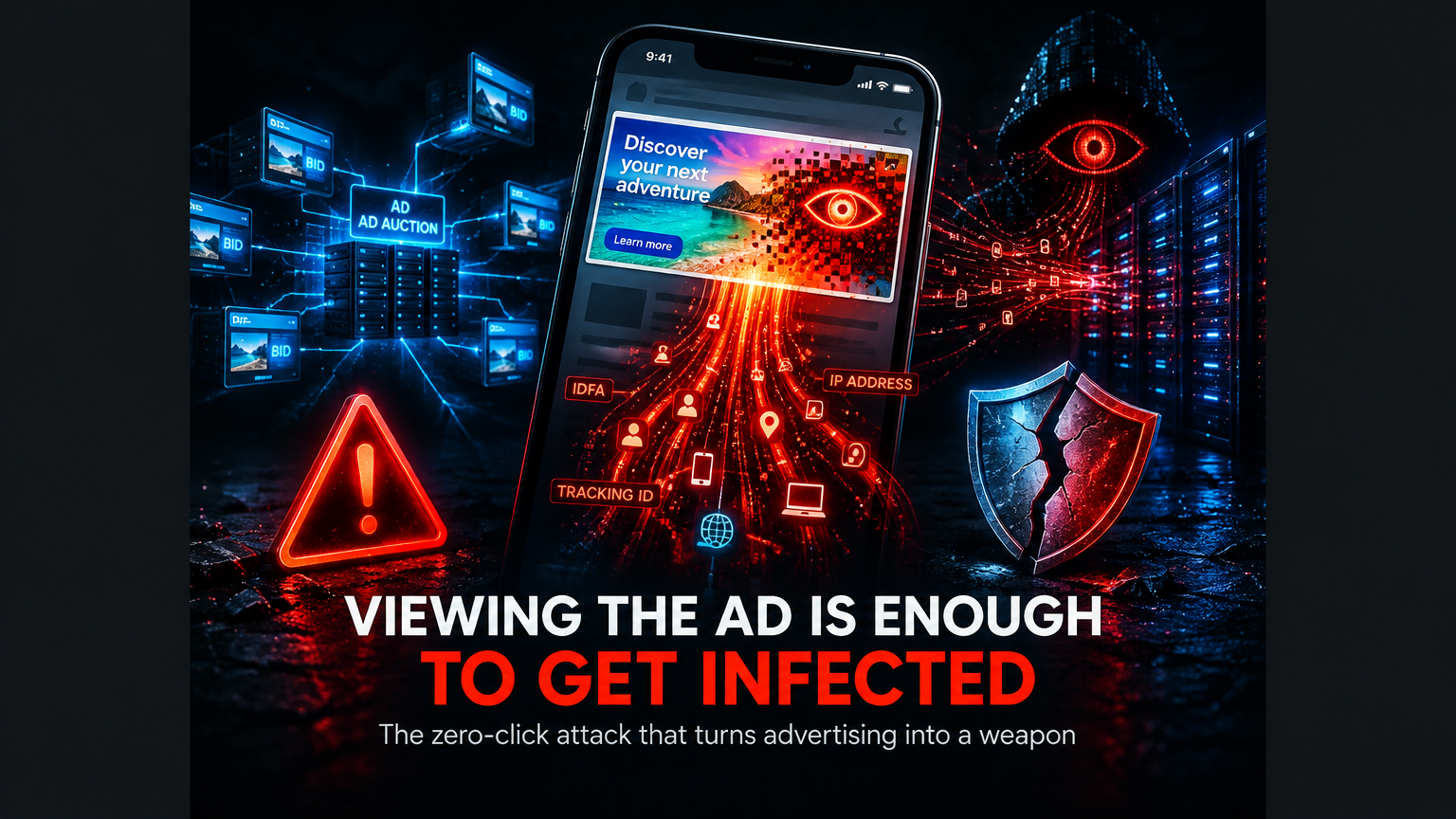
For decades, the golden rule of digital security was simple: do not click strange links and you are relatively safe.
That rule just died.
An investigation by the Citizen Lab, the University of Toronto research group, published on October 15, 2026 and covered by Wired, Ars Technica and Pplware, revealed a technique dubbed AdFection: the first detailed public technical evidence of sophisticated spyware infecting devices through digital ads, with no click, no tap, no interaction at all.
The user opens a perfectly ordinary website or app. The banner loads. The malicious process starts in the background. Nothing strange appears on screen.
The attack worked on both iOS and Android devices, and Wired called the scenario a “nightmare”.
How AdFection works
The scheme exploits the very architecture of online advertising.
The programmatic ad auction, the system that decides which banner appears for each user in milliseconds, was designed to enable individual targeting based on identifiers: the phone’s advertising ID, the browser cookie, the IP address.
Discover-Tech, an Israeli advertising firm registered and certified as a legitimate partner, built a platform called Controlium on top of that infrastructure. According to the Citizen Lab, it allows clients to:
- profile and de-anonymize millions of people;
- fingerprint devices;
- select specific targets by advertising ID, cookie or IP;
- deliver to those targets a form of zero-click hacking.
The technical mechanism is surgical. Discover-Tech’s ads, apparently banal, promoting ordinary phones or headphones, contained a script that, when rendered, connected the device back to the company’s servers and submitted the user’s identifiers. If the profile matched a pre-defined target, the server returned malicious JavaScript, exploited a browser vulnerability and installed the Candiru spyware, built by an Israeli company that sells surveillance tools to governments.
If the visitor was not the target, the deep intrusion did not happen. But the ad kept harvesting identifiers and cross-referencing cookies without authorization.
The scale of the problem
The numbers documented by the Citizen Lab, with support from ad security firm Confiant, show this was no isolated experiment.
- At least 718,748,885 auction bids, about 19% of those analyzed, contained the script pointing to the operation’s servers;
- The ads appeared across 75,373 Android and iOS apps and 120,768 websites;
- Confiant estimates the operation served at least 10 million ads per day.
The infectious ads appeared in everyday apps: Yahoo Mail, Opera Mini, weather apps like Germany’s Wetter Online and learning apps.
The targets: journalists and international infrastructure
The most detailed documented case involved the Al Jazeera network.
Analysis of network logs provided to the Citizen Lab showed the attack’s temporal signature: infected devices first contacted Discover-Tech domains, indicating the ad impression, then connected to a Candiru validator server.
The tally: at least 45 devices across Al Jazeera compromised between 2024 and 2025, with no victim clicking anything.
And the reach went further. The malicious traffic was detected on sensitive networks linked to the UN, NATO and the European Commission.
The industry’s response
After the researchers’ alert, with advance notice to the companies involved, Google and IAB Europe cut access and removed Discover-Tech from their authorized partner lists in early October 2026.
The removal was fast, but the case exposed a structural weakness: the same system that delivers the right ad to the right person can deliver malware to the right person. The targeting infrastructure, built for marketing, worked perfectly as a weapon.
What this changes for anyone and any business
Here is the connection to the ground of this blog.
AdFection is not just a security story. It is a change of premises.
The premise that fell
Until now, standard advice was behavioral: do not click, do not download, be suspicious. Zero-click eliminates that defense layer, because there is no behavior to correct. The perfect victim is the one who did everything right.
This shifts security from behavior to architecture. What protects you is not what you do, it is what your environment allows.
The defenses that work
The recommendations from the Citizen Lab and experts interviewed by Al Jazeera are concrete:
- install an ad blocker, removing the delivery vector;
- disable the advertising ID in your phone’s privacy settings, cutting the targeting mechanism;
- keep the system and apps always updated, closing the vulnerabilities the attack exploits;
- enable Lockdown Mode on iOS or Advanced Protection on Android for anyone with elevated risk, such as journalists, executives and officials;
- periodically reset the advertising identifier, reducing continuous cross-platform tracking.
None of these measures requires technical knowledge. All fit within minutes of configuration.
For businesses, the risk is organizational
An employee with an infected phone on a corporate network is an open channel. And the vector now requires no human error, which makes policies based only on training insufficient.
The business response runs on three layers:
- MDM, mobile device management, with the advertising ID disabled by policy on corporate devices;
- mandatory automatic updates on every device with access to company systems;
- network monitoring able to detect anomalous connections, just as the Citizen Lab did analyzing Al Jazeera’s logs.
That is exactly the kind of continuous vigilance intelligent automation sustains: alerts, monitoring and automatic responses that do not depend on someone remembering to look.
The deeper lesson: invisible infrastructure is an attack surface
The AdFection case teaches something beyond security.
Nobody sees the ad auction. It happens in milliseconds, behind the scenes of every opened page. And it was precisely that invisibility that made it feel safe.
The discovery inverts the logic: what nobody audits is what nobody protects. The advertising supply chain, with dozens of certified intermediaries, worked as a spyware delivery corridor for years, carrying Google’s and IAB Europe’s legitimacy seals.
For businesses, the parallel is direct. Tools, plugins, third-party scripts and integrations operating silently inside your website and systems deserve the same scrutiny as your own code. A professional, well-structured website is not just fast and beautiful: it is lean, auditable and free of invisible dependencies nobody reviewed.
And when something anomalous happens, the difference between discovering it in hours or in months lies in the quality of data and records. That is the role of data science applied to operations: turning scattered logs into response capability.
Conclusion: the era where looking is enough to be a target
AdFection, documented by the Citizen Lab on October 15, 2026, marks a turning point in digital security: for the first time, there is public technical evidence of mercenary spyware being delivered through targeted ads, with zero victim interaction.
The operation, built on Discover-Tech’s certified infrastructure and delivering the Candiru spyware, compromised at least 45 Al Jazeera devices between 2024 and 2025, reached 75,000 apps and 120,000 websites, and served about 10 million ads per day.
Google and IAB Europe removed the company from their lists. But the structural lesson remains: digital advertising’s targeting infrastructure is an attack surface, and the click is no longer the front door.
The question that remains:
If your business’s security depends on employees “not clicking anything”, what happens when clicking stops being necessary to get infected?
The answer to that question defines whether your company protects by architecture or by hope.