Artificial intelligence has stopped living only inside screens.
In Portugal, it is about to gain legs, arms and a job.
On October 6, 2026, in Lisbon, during the Beyond AI event, SDATA AI, a company from Vila Nova de Famalicão, formalized a strategic partnership with Agibot, a Chinese manufacturer from Shanghai, to become the official distributor of humanoid robots in Portugal.
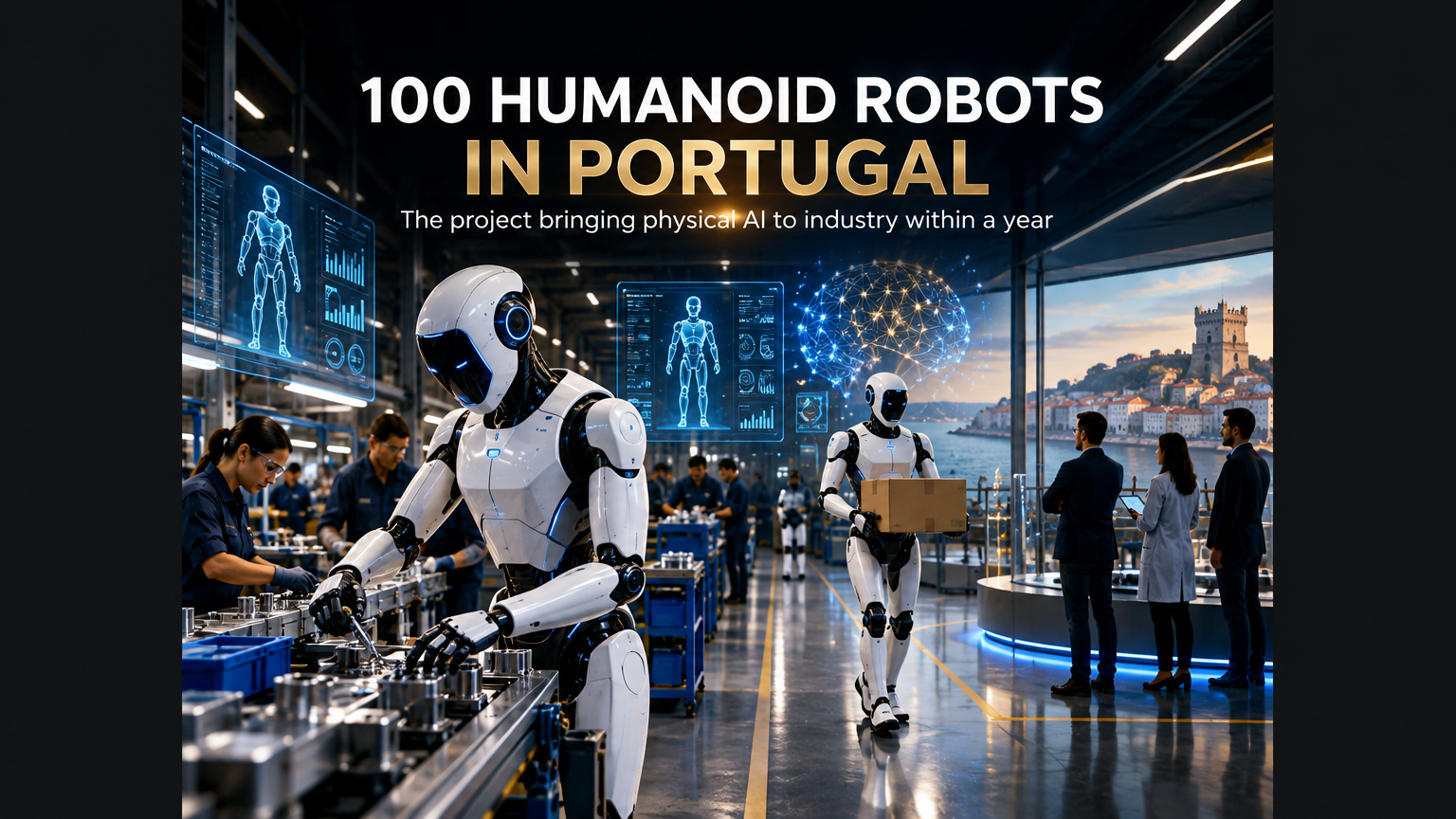
The forecast the company gave to Expresso is direct: between 60 and 100 humanoid robots could be working in Portugal within a year, with industry, logistics, hospitality and services among the application sectors.
The announcement marks a turning point. Humanoid robotics, until now seen as a topic of tech fairs in China and the United States, has gained a commercial channel, a Portuguese address and an implementation deadline.
Who is behind the project
SDATA AI is a company incorporated in 2024, based in Vila Nova de Famalicão, in northern Portugal, and has operated in the territory for over a year.
Agibot, in turn, is a Shanghai manufacturer founded in February 2023, positioning itself as a world leader in humanoid robotics. In September 2026, the company announced the production of 100 X2 robots for ASD stores, a Japanese supermarket chain, a sign that the technology has already left the lab and entered commercial operation.
The partnership was presented at an event gathering entrepreneurs and technology experts in Lisbon, with live demonstrations of the autonomy and functional capacity of several robot models.
Paulo Silva, member of SDATA AI’s executive board, summarized the project’s philosophy: physical AI does not intend to “replace people”, but to allow them to stop performing repetitive tasks.
What the robots do and how much they cost
SDATA AI already offers five families of robots in Portugal, with variants for different uses.
The sectors anticipated for the first years are clear:
- industry, in repetitive production line tasks;
- logistics, in internal handling and transport;
- hospitality, in reception and support services;
- food service and services, in standardized functions.
Prices can reach €300,000 per unit, according to Jornal Económico, positioning humanoids as a capital investment, not a gadget.
Agibot estimates the Portuguese humanoid robot market could exceed €10 billion over the next 20 years.
The global context: a market in explosion
The Portuguese move does not happen in isolation. It fits into a global industry that is accelerating.
According to MarketsandMarkets, the global humanoid robot market is estimated at $5.41 billion in 2026, projected to reach $50.27 billion by 2035, a compound annual growth rate of 28.1%.
In China, the industry is building manufacturing capacity and training infrastructure at scale, with companies like Galbot already operating robots in pharmacies across more than two dozen cities, with success rates above 95% in product selection and preparation.
In the United States, Tesla pursues the ambitious goal of producing one million units per year of its Optimus robot.
Europe, traditionally more conservative in this segment, sees its regional market grow at a slower pace, which makes initiatives like the Portuguese one even more significant: they anticipate adoption before it becomes mandatory.
What this means for Portuguese industry
Portugal is a country with a strong industrial base, labor shortages in specific sectors and rising labor costs. It is exactly the market profile where humanoid robots find practical application.
The arrival of 60 to 100 units within a year is, at national scale, a pilot of relevant size. It is not a revolution, it is a seed. But technology seeds have a habit of growing fast when they find fertile soil.
Three effects are predictable.
Technology normalization
Every robot operating in a Portuguese factory, hotel or warehouse is a living showcase. Companies that today see humanoids as science fiction will start seeing them as a budget line.
Ecosystem formation
Distribution, maintenance, integration, operator training: every deployed robot creates demand for local services. That is how technology ecosystems are born, not in isolated labs.
Competitive pressure
Early-adopting competitors gain measurable efficiency. Those who wait will feel the difference in costs and deadlines, as we analyzed in previous articles on those left behind in the technology race.
The business lesson: physical AI is the next frontier
Here is the connection to the ground of this blog.
Until now, the conversation about AI revolved around software: models that write, analyze, decide. SDATA AI and Agibot represent the next layer: AI that manipulates the physical world.
For businesses, this transition changes the opportunity map.
Automation stops being digital
Automation so far meant connecting systems, eliminating clicks and accelerating information flows. With humanoid robots, automation reaches physical tasks: carrying, assembling, organizing, delivering.
Companies that have already organized their digital processes are ready to integrate the physical layer. Companies still operating on paper and loose spreadsheets will have two leaps to make.
The bottleneck changes place
When repetitive labor can be physically automated, value shifts to those who know how to define processes, train systems and manage the human-machine combination. Management, integration and data become the valued skills.
Whoever defines the process controls the result
A humanoid robot does not enter a company and decide on its own what to do. It executes a defined process. Whoever designs that process, with clarity, metrics and oversight, extracts value. Whoever improvises, accumulates problems.
That is exactly the work Rapid Genius develops with intelligent automation: mapping processes, connecting tools and putting operations on autopilot, today in the digital layer, and increasingly prepared for the physical layer that is arriving.
The honest limits of the moment
A balanced article must mark what is still unresolved.
The price of up to €300,000 per unit limits adoption to companies with capital and clear returns. Functional maturity varies between models and tasks: robots that perform well in structured environments still struggle in chaotic ones. And real integration, with management systems, safety and team training, is months of work, not days.
The estimate of 60 to 100 robots in a year is a distributor’s forecast, not an accomplished fact. The real number will depend on demand, financing and the Portuguese market’s integration capacity.
None of this invalidates the move. It defines what it is: the start of a curve, not its peak.
Conclusion: Portugal enters the physical AI era
SDATA AI, from Famalicão, formalized on October 6, 2026 the official distribution of Chinese Agibot’s humanoid robots in Portugal, forecasting 60 to 100 units working in the country within a year, in industry, logistics, hospitality and services.
The global humanoid market grows at 28% a year, China already operates robots in pharmacies and supermarkets, and the United States pursues million-scale production. Portugal, with this project, stops watching and starts participating.
For businesses, the message is twofold: physical automation is reaching the Iberian market, and those who organize their digital processes today will be ready to integrate it tomorrow.
The question that remains:
If within two years a humanoid robot could perform the repetitive tasks of your operation, would your processes be ready to receive it, or would today’s mess simply be digitized into metal?
The answer to that question separates adoption leaders from those who pay to learn.