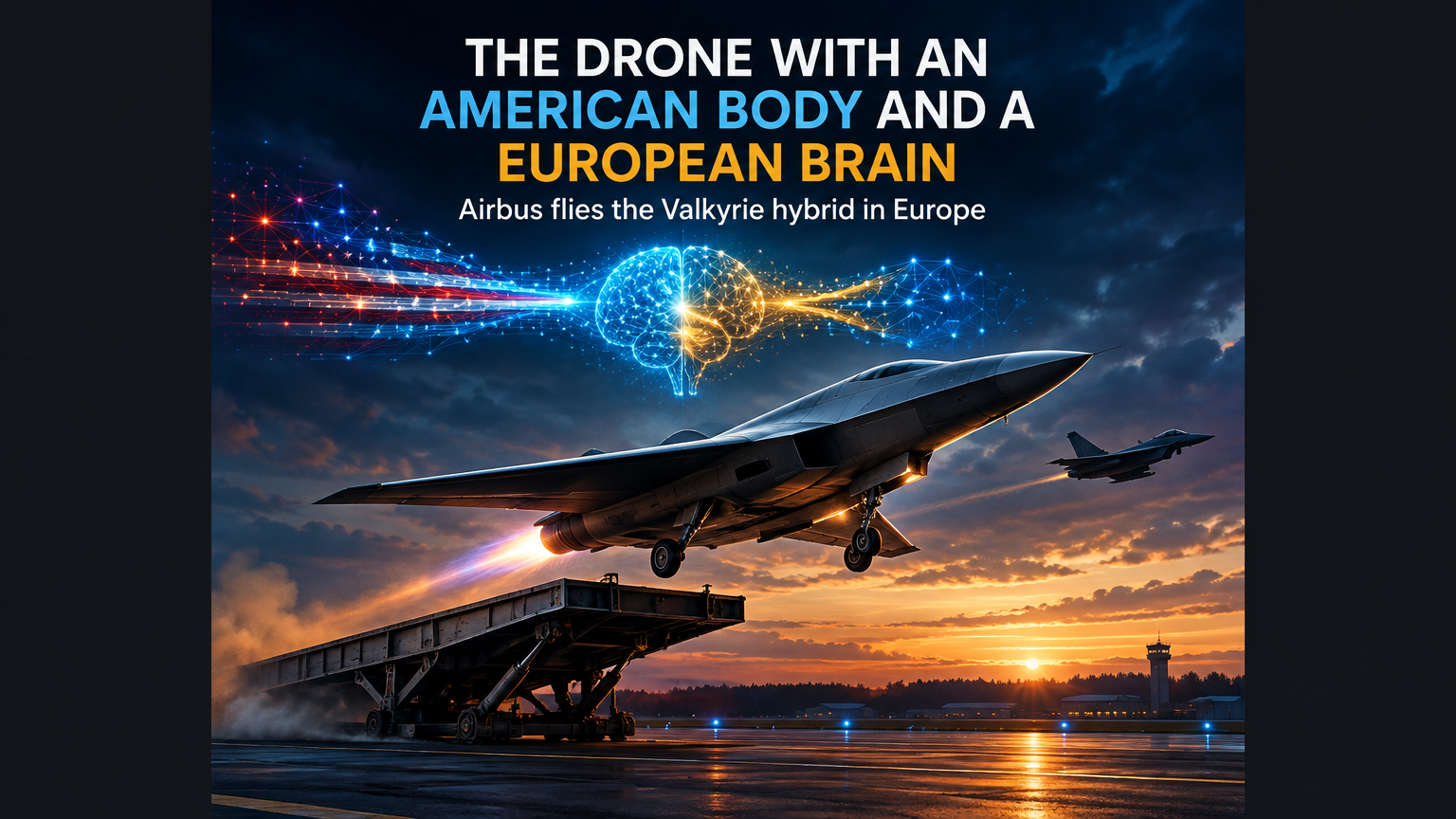
At a test range in northern Europe, a combat drone took off with rocket booster assistance, no runway, climbed, maneuvered at various altitudes and reached Mach 0.8.
The flight itself is not the record. The detail that makes it news lies in the engineering behind it.
The U740 Valkyrie has an American body and a European brain.
The airframe comes from Kratos Defense, the US company that developed the original design. The mission system, the software that decides, coordinates and controls, is MARS, developed by Airbus as a sovereign European platform.
On October 12, 2026, Airbus confirmed the Valkyrie’s first flight on European soil, conducted on September 29, and detailed the plan: turning this combination into the “wingman” combat drone that will fly alongside Eurofighter jets, with combat readiness targeted for 2029.
The news, covered by Reuters and Pplware, captures in a single flight the smartest strategy in the European defense industry: buy what already works and control what matters.
What the U740 Valkyrie is
The Valkyrie is an uncrewed combat aircraft about nine meters long, ramp-launched, designed to operate alongside crewed fighters.
In its European maiden flight, conducted at an undisclosed location in northern Europe, the aircraft launched with rocket boost, performed maneuvers at different altitudes and reached Mach 0.8, that is, 80% of the speed of sound.
The intended use is the CCA, Collaborative Combat Aircraft concept: drones flying in formation with fighters such as the Eurofighter, extending the formation’s reach, detection capacity and firepower without putting pilots at risk.
The European “wingman” market is contested. Boeing is negotiating the entry of the MQ-28 Ghost Bat into the German Air Force, also targeting 2029, and Airbus’ own Ravenstorm, the U760b, will not be ready before the 2030s.
That is where the Valkyrie comes in as a mid-field play: a drone already mature, developed and tested in the US, adapted for Europe long before a fully European solution is ready.
What MARS, the “European brain”, is
If the airframe is American, sovereignty lives in the software.
MARS, Multi-platform Autonomous Reconfigurable and Secure, is the mission system developed by Airbus that serves as the Valkyrie’s “European brain”.
According to the company’s official release, MARS guarantees:
- full control over software, mission applications, data and system hardware;
- national German or European sovereignty over the aircraft’s operational use;
- AI-enabled autonomy, conducting missions autonomously and coordinating entire mission groups;
- a strict control hierarchy, with a human on the loop for all critical decisions, complying with rules of engagement and ethical and legal standards.
The keyword is sovereignty. A drone bought from an American manufacturer, operated with the vendor’s closed software, would leave the European operator dependent on decisions made on another continent. With MARS, Airbus delivers the ready-made airframe but keeps command, data and usage rules in European hands.
MARS is not exclusive to the Valkyrie. It already powers Ravenstorm, Bird of Prey and is planned for the U950 Eurodrone, forming a family of platforms sharing the same brain.
The roadmap to 2029
Airbus’ plan is staged.
The maiden flight, without MARS on board, served to prove that regulatory barriers that hampered past efforts to integrate military drones into Europe’s complex airspace can be overcome.
The next step comes in the first quarter of 2027, when the Valkyrie is expected to fly with the MARS mission system installed.
Also in 2027, the first flight in formation with a Eurofighter is scheduled.
The final goal is a European combat-ready configuration by 2029, at an estimated cost of about €20 million per unit.
Why the hybrid strategy makes sense
Airbus’ move deserves analysis, because it contradicts the most common instinct in defense projects: developing everything from scratch, start to finish.
The traditional European path, an entirely new combat drone, would take a decade or more. Ravenstorm, the native project, only arrives in the 2030s. The threat does not wait.
The hybrid alternative solves the dilemma on three fronts.
Speed
The Kratos airframe already exists, has already flown and is already a “program of record” in the US. Europe does not need to reinvent the plane, only to Europeanize the brain.
Sovereignty
Control of the mission software is what defines who commands the aircraft. With MARS, data, engagement rules and updates stay under European control, without depending on licenses or decisions from Washington.
Cost
At €20 million per unit, the Valkyrie costs a fraction of a modern crewed fighter, allowing squadrons of drones to scale without draining budgets.
It is the same pattern we analyzed in previous articles on the global technology race: whoever combines the best available with control over the critical layer, gains time and advantage at once.
The lesson that goes beyond defense
Here is the connection to the ground of this blog.
Airbus’ strategy is, at its core, a technology architecture lesson applicable to any business.
What Valkyrie teaches:
Do not rebuild what already works
Airbus did not develop a new airframe to prove a point about sovereignty. It bought maturity where it existed and concentrated effort where it makes a difference.
Businesses often make the opposite mistake: they rebuild tools, processes and systems that already exist mature in the market, spending time and money instead of adopting them.
Control the layer that decides
The Valkyrie’s value is not in the body, it is in the brain. The mission software defines who commands, which data stays home and how the system behaves.
In the business world, the equivalent layer is data and decision flows. A business can use third-party tools for almost everything, but it must keep its own data, its own contacts and its own processes under control. That is exactly the principle Rapid Genius applies in intelligent automation: connecting the best tools available, but with the logic and the data belonging to the client.
Human on the loop is not optional
MARS keeps critical decisions under human control by ethical, legal and operational requirement. It is the same standard we defended in the case of the AI agent that sent a false tip to the police: automation executes, humans approve what has real consequences.
The bigger context: Europe rearming with software
The Valkyrie’s flight happens amid accelerated European rearmament, in which “wingman” drones take center stage.
Germany and France discuss jointly developing drone systems and data networks after cancelling a common fighter project. Airbus demonstrated, in October, autonomous interaction between two drones operating as a swarm for the first time in Europe. And MARS itself was presented as the mission system for the company’s entire new UAS family.
The strategic message is clear: Europe wants American speed with European sovereignty. The Valkyrie is that commitment made flesh.
For businesses following the sector, the signal is the usual one: the software and AI layer has become the real battleground, in aircraft, in business and in markets.
Conclusion: the future is hybrid, and control lives in the software
The U740 Valkyrie flew for the first time in Europe on September 29, 2026, with a body from America’s Kratos and the commitment to receive the European brain MARS by the first quarter of 2027.
By 2029, Airbus aims to offer Germany and its allies a sovereign combat drone, flying in formation with Eurofighters, at about €20 million per unit.
The flight symbolizes a strategy that transcends defense: buy maturity, control the intelligence, keep the human in the loop.
The question that remains:
In your business’s digital structure, what is rented airframe, and what is your own brain?
Those who can answer precisely build fast operations without giving up command.
Those who cannot, find out the answer at the worst possible time.