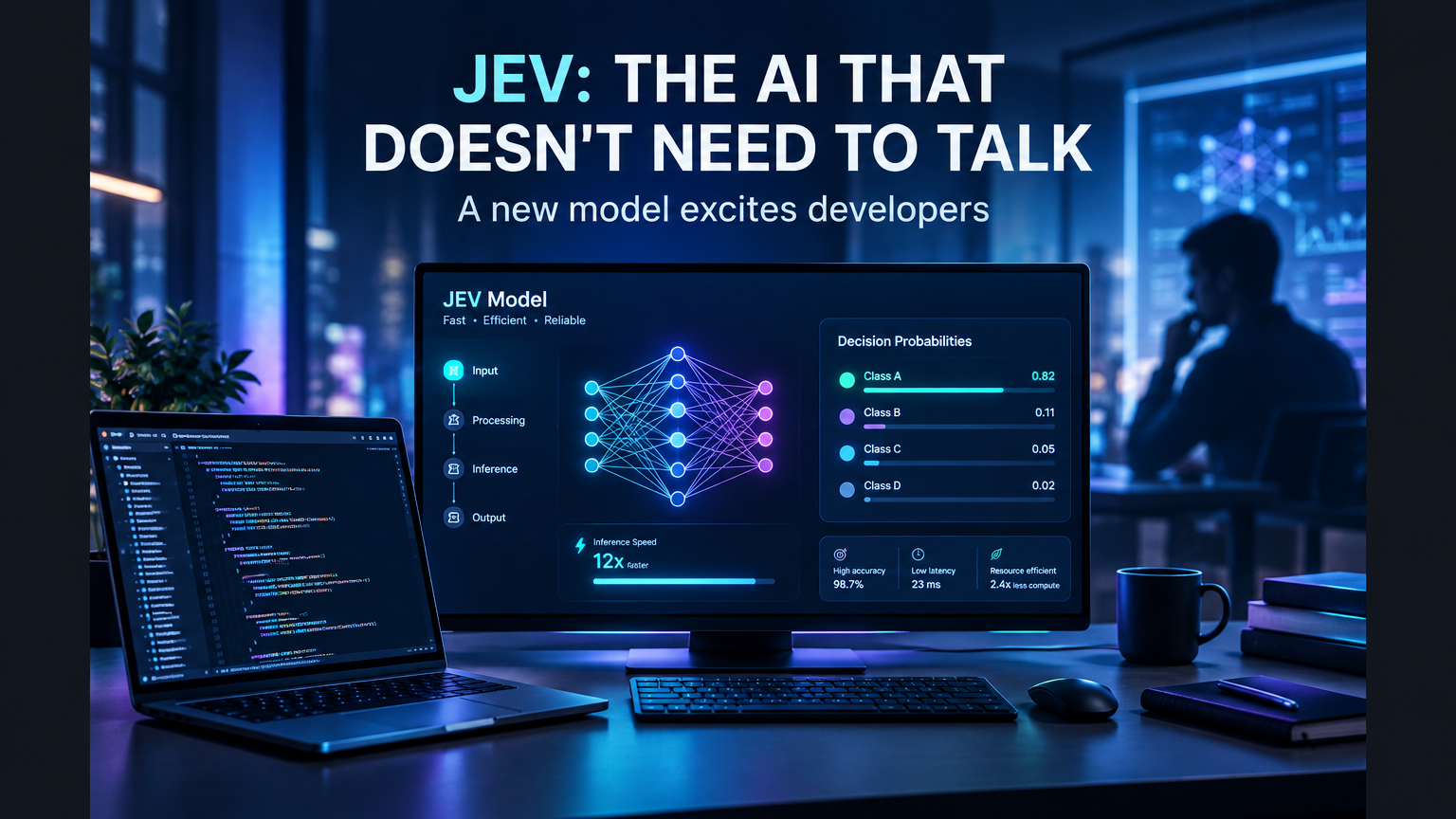
/For the past few years, almost every discussion about artificial intelligence has revolved around one idea: models that understand questions and generate increasingly convincing text.
Now, a new approach is attracting attention from the technical community.
Jev, a model developed by TypeSafe AI, is designed to follow a different path. Instead of working like a traditional chatbot, it focuses on calibrated decisions, evaluating possibilities and returning structured results that can be used by software systems.
The company was founded by Diogo Almeida, a researcher who helped build ChatGPT and contributed to important techniques used in the training of modern AI models.
According to a recent TechCrunch report, the proposal is generating strong enthusiasm among developers because it could make certain AI applications faster, more affordable and more predictable.
Who created the Jev model?
Jev was developed by TypeSafe AI, a startup founded by Diogo Almeida, Erik Gafni and Sasha Sheng.
Diogo Almeida previously worked at OpenAI and contributed to research related to ChatGPT and reinforcement learning from human feedback, commonly known as RLHF.
This technique played an important role in the development of modern language models because it helped systems produce responses that were more aligned with human expectations.
After leaving OpenAI, Almeida began questioning some of the limitations of large language models.
Although LLMs can write, program, summarize documents and talk to users, they can also:
- invent information;
- sound confident while being wrong;
- produce inconsistent responses;
- use significant resources for simple tasks;
- make decisions that are difficult to audit;
- generate text when the system only needed a classification.
TypeSafe AI was created in response to this problem.
What makes Jev different?
Jev is not presented as a traditional large language model.
It is described as a transformer-based model with a different purpose: producing calibrated decisions instead of generating long natural-language answers.
This means that in certain scenarios, the system can return:
- a choice;
- a classification;
- a probability;
- a recommendation;
- a confidence level;
- a structured evaluation.
Imagine a system that must determine whether a transaction appears suspicious.
A chatbot might explain in several paragraphs why it considers the transaction risky. A specialized model could return something more useful for software:
- high risk;
- estimated probability;
- category;
- recommendation for human review.
For a developer, this output may be much easier to integrate into a real product.
An AI that does not need to talk all the time
Most people experience artificial intelligence through conversational interfaces.
You type a question and receive an answer.
This format is useful for:
- customer service;
- research;
- content creation;
- brainstorming;
- explanations;
- programming;
- user support.
However, many systems do not need a complete conversation.
A payment platform does not need AI to write an essay about every transaction. A logistics system does not need a long explanation for every route. A security tool does not need to turn every alert into a multi-page response.
In many cases, software only needs an objective decision.
That is the space Jev is trying to address.
The proposal is to use a specialized model for evaluation and decision tasks without relying on the entire structure of a generative chatbot.
Why are developers interested?
Developers tend to evaluate technology according to practical criteria.
They want to know:
- how much it costs to run;
- how long it takes to respond;
- whether the result is predictable;
- how to integrate it;
- whether it works at scale;
- whether its decisions can be monitored;
- whether its output can be tested;
- whether its behavior remains consistent.
Large language models are highly versatile, but that versatility may be unnecessary for specific tasks.
If an application only needs to identify a category or calculate a probability, using a huge model may create additional cost and complexity.
Jev is attempting to offer a more specialized alternative.
This approach could appeal to companies that want to integrate AI into real products while controlling budget, latency and predictability.
The problem of hallucinated answers
One of the biggest challenges facing language models is hallucination.
The system produces an answer that sounds correct but contains false information, incorrect interpretations or references that do not exist.
This happens because LLMs are trained to generate probable sequences of language. They are not necessarily perfect databases or systems that verify every statement before responding.
In an informal conversation, a small inaccuracy can be corrected by the user.
In an enterprise system, the impact can be much larger.
A wrong answer may:
- approve a suspicious transaction;
- classify a customer incorrectly;
- send inappropriate information;
- recommend the wrong action;
- create financial losses;
- cause regulatory problems;
- damage customer trust.
A model focused on calibrated decisions could reduce part of this problem in specific tasks, especially when an application needs probabilities and well-defined categories instead of creative text.
That does not mean Jev cannot make mistakes. No AI system should be treated as infallible.
The potential advantage is that its output may be more structured and easier to test.
What does a calibrated decision mean?
A calibrated decision attempts to provide not only an answer, but also an indication of confidence.
For example, instead of returning:
“This customer will probably leave the service.”
The system could provide:
- an estimated probability;
- observed factors;
- a risk category;
- a confidence threshold;
- a recommendation for human review.
This information helps developers determine how the application should behave.
If confidence is low, the system can send the case to a human.
If confidence is high and the risk is low, the process may continue automatically.
This logic is especially important for applications that need to balance automation with human oversight.
The model can complement large language models
TypeSafe AI’s proposal does not necessarily mean replacing large language models entirely.
In many cases, Jev can work alongside them.
An LLM can interpret a complex request, summarize a document or communicate with the user. Jev can then evaluate the result, identify risks and determine whether the decision meets expected criteria.
This creates a kind of supervision layer.
A generative system produces an answer. The specialized model checks:
- whether the answer is suitable;
- whether there is a risk of error;
- whether confidence is sufficient;
- whether the result should go to a human;
- whether the output follows business rules.
The idea is to use different models for different tasks.
This architecture can be compared to a team of specialists. One system creates, another verifies, one classifies and another monitors.
AI agents can also be monitored
The growth of AI agents has created a new challenge.
Agents can research information, access tools, execute tasks and make decisions across multiple steps.
The more autonomy they have, the greater the need for supervision.
A company may use a large model to control an agent, but using another LLM to monitor every action can be expensive.
According to TypeSafe AI’s proposal, Jev could act as a lighter and more specialized verification layer.
It could help identify:
- unusual decisions;
- high-risk actions;
- inconsistent responses;
- unexpected behavior;
- requests that require approval;
- changes that should be blocked.
This is interesting for companies that want to explore advanced automation without giving systems complete freedom.
Rapid Genius works with AI-powered automation, data science and digital solution development, areas connected to the creation of more controlled and efficient processes.
Training with synthetic data
TypeSafe AI says Jev was trained exclusively with synthetic data.
Synthetic data is artificially generated information designed to reproduce specific scenarios, behaviors or decisions.
This approach can offer several advantages:
- greater control over examples;
- the ability to create rare scenarios;
- reduced exposure of personal data;
- generation of large numbers of cases;
- task-focused training;
- easier testing of different conditions.
At the same time, synthetic data must be designed carefully.
If the examples do not accurately represent the real world, the model may fail when it encounters situations different from those used during training.
This is one of the points developers and companies will need to evaluate carefully.
A model trained with synthetic data should be validated against real-world scenarios before being used for important decisions.
What is reinforcement learning from calibrated decisions?
TypeSafe AI uses the term “reinforcement learning from calibrated decisions” to describe its training approach.
The general idea is to train the model to make decisions with greater control over confidence, probability and expected outcomes.
This differs from training that focuses primarily on producing pleasant or human-like text.
The goal is to create a system that better understands the type of decision required and the uncertainty involved.
For business applications, this distinction can be valuable.
A company usually does not need AI to sound intelligent. It needs a system that is useful, predictable and correctly integrated into a business process.
The name Jev has an economic inspiration
The name Jev refers to British economist William Stanley Jevons.
The choice is also connected to the Jevons paradox, which suggests that lower costs for using a resource can lead to an increase in total consumption.
Applied to artificial intelligence, TypeSafe AI appears to be betting that cheaper and faster models will be used in many more situations.
Instead of limiting AI to a few expensive and complex tasks, businesses could integrate specialized models into thousands of smaller workflows:
- quality checks;
- triage;
- classification;
- monitoring;
- risk detection;
- recommendations;
- validation;
- agent control.
If the cost of performing these functions falls, the number of automated processes could grow quickly.
Could Jev help smaller businesses?
This is one of the most interesting possibilities.
Large companies can usually afford advanced models, private infrastructure and specialized teams.
Smaller companies, however, need to choose carefully where to use artificial intelligence.
A faster and more affordable model could support processes such as:
- lead qualification;
- message analysis;
- customer classification;
- task prioritization;
- opportunity detection;
- quality control;
- churn prediction;
- automated customer service;
- data analysis;
- operations monitoring.
This does not mean every small business should immediately adopt Jev.
The technology still needs to be tested, documented and evaluated across different environments.
However, the trend is important: the future of AI may involve many specialized models working together instead of relying on one massive system.
A new phase for software development
For years, developers used large language model APIs to add intelligence to their products.
Now, a more diverse architecture may emerge.
An application could use:
- an LLM to communicate with users;
- a decision model to classify data;
- a vision model to analyze images;
- a small model to detect anomalies;
- an agent to perform tasks;
- a security layer to verify actions;
- a database to store context.
This approach may increase initial development complexity, but it can also make applications more efficient.
Each system is used for the function it was designed to perform.
The result could be more modular, affordable and controllable technology.
Companies that develop websites, applications and digital systems may incorporate different AI models according to the specific needs of each project.
The excitement still needs to be backed by testing
The technical community is excited, but excitement is not the same as definitive proof.
A new architecture may appear promising in demonstrations and early testing, but it still needs to be evaluated in real-world conditions.
Developers should examine:
- performance across different datasets;
- stability;
- total cost;
- ease of integration;
- unusual behavior;
- resistance to malicious inputs;
- probability quality;
- explainability;
- maintenance;
- technical support.
It is also important to distinguish between independently verified results and claims made by the company itself.
Jev could represent a significant shift, but its adoption and performance in real applications will need to be monitored over time.
Conclusion: the next AI revolution may not look like a chatbot
Jev is attracting attention because it proposes a different view of artificial intelligence.
Instead of focusing on increasingly long text generation, it targets decision-making, classification, validation and control.
That may seem less impressive to the general public, but it could be highly relevant to developers.
Most enterprise systems do not need AI to chat for hours. They need technology that can:
- make more consistent decisions;
- provide confidence levels;
- reduce costs;
- respond quickly;
- integrate easily;
- support supervision;
- reduce risk.
Diogo Almeida helped build technologies that contributed to the popularity of modern chatbots. With Jev, he now appears to be trying to solve one of the limitations created by the success of large language models.
The question is:
Will the future of artificial intelligence depend on larger models or on specialized models working together?
The excitement among developers suggests that there is room for a new answer.
The AI of the future may not only be the system that writes, chats and creates images.
It may also be the system that decides, verifies, classifies and works silently behind the products we use every day.