Imagine getting into a car, telling it where you want to go, sitting comfortably — and then doing absolutely nothing else.
No hands on the steering wheel.
No accelerator pedal.
No brake pedal.
And, most importantly, no human driver.
Sounds like science fiction?
The surprising part is that this is already becoming reality.
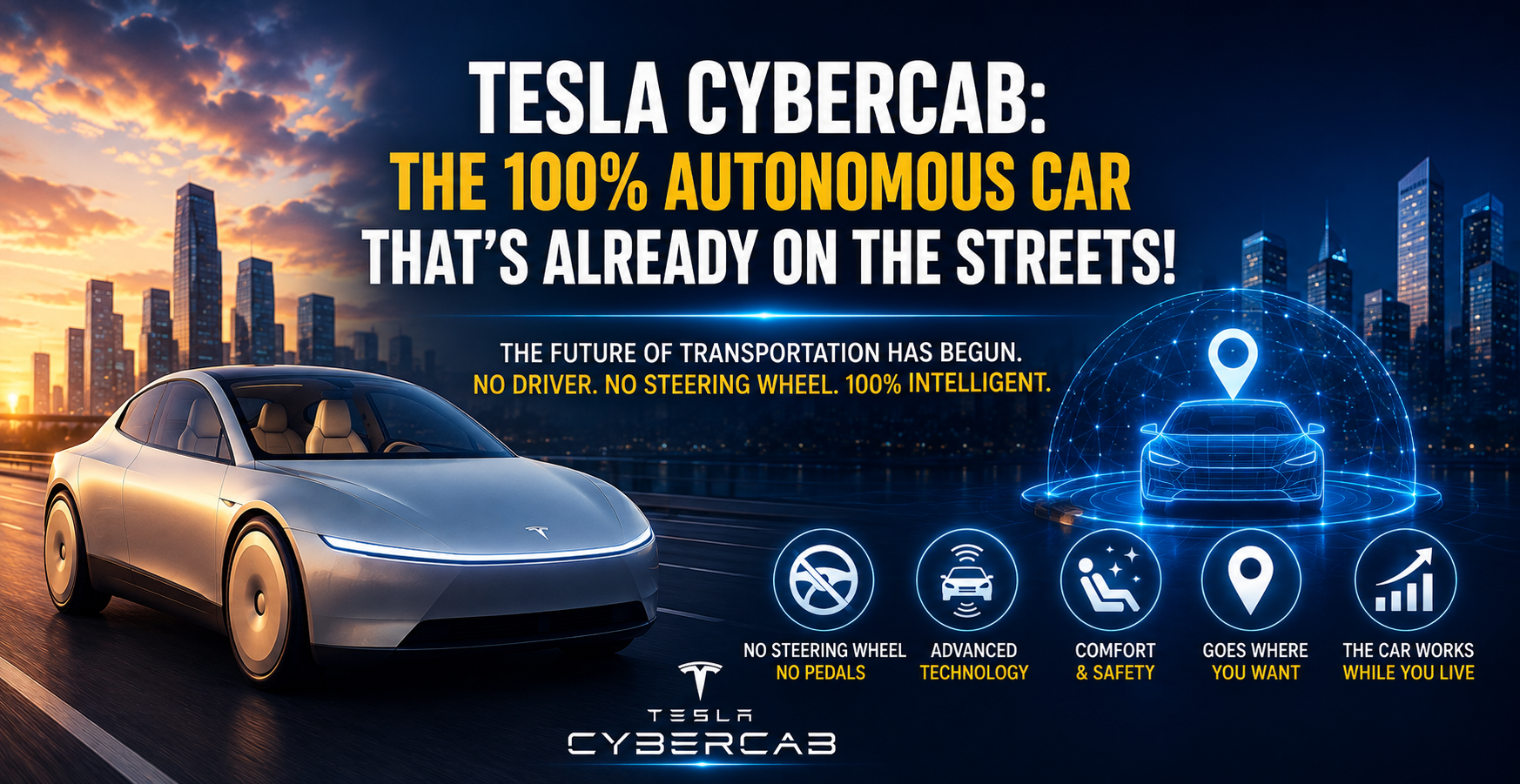
Tesla has begun limited Cybercab operations in Austin, Texas. The vehicle was designed specifically for autonomous operation and does not have a steering wheel or traditional driving pedals.
But are we really witnessing the beginning of a transportation revolution?
Or are there still major obstacles ahead?
Let’s take a closer look.
🚘 Forget Everything You Know About Cars
When we think about a modern car, we usually imagine four things:
a steering wheel, accelerator, brake pedal and driver.
The Cybercab challenges that entire concept.
Tesla says the vehicle has two seats and was designed without a steering wheel, accelerator pedal or brake pedal.
The car is no longer simply something a person buys to drive.
It becomes a kind of intelligent transportation service.
You request it.
The car arrives.
You get in.
It takes you to your destination.
Then it can potentially continue on its own to pick up another passenger.
And that is where things become truly interesting.
🤯 What If Your Car Could Work While You Sleep?
This may be one of the most fascinating ideas behind Tesla’s strategy.
Imagine owning a vehicle that, when you’re not using it, could potentially become part of an autonomous transportation network.
While you’re working, sleeping or traveling, the vehicle could theoretically transport passengers.
That’s one of the major ideas behind Tesla’s robotaxi strategy.
Tesla currently offers autonomous rides in several U.S. cities, including Austin, Dallas, Houston, Miami, Orlando and Tampa.
In this scenario, a car could stop being only an expense and potentially become an income-generating asset.
🧠 How Can a Car Drive Itself?
This is one of the most fascinating parts.
Cybercab uses cameras and computer systems to interpret its surroundings.
The vehicle needs to recognize:
- traffic lights;
- pedestrians;
- other vehicles;
- road lanes;
- traffic signs;
- obstacles;
- parking spaces;
- intersections;
- changing driving conditions.
In other words, the car needs to understand the world around it and make decisions in real time.
Tesla says Cybercab was designed specifically for full autonomy and uses camera vision and sensors to navigate roads.
⚠️ But There Is an Important Difference
This is where many people get confused.
You’ve probably heard about Tesla’s Full Self-Driving, or FSD.
But a conventional Tesla equipped with FSD does not necessarily mean the driver can simply sit back and sleep.
FSD (Supervised) still requires active human supervision in conventional Tesla vehicles.
Cybercab is different.
It was designed from the beginning as an autonomous vehicle without traditional driving controls.
FSD Supervised = advanced driving assistance.
Cybercab = a vehicle designed for autonomous operation.
That distinction is extremely important.
🏙️ Where Are These Cars Already Operating?
Tesla has begun offering Cybercab rides in selected areas of Austin, Texas.
The rollout is still limited, but it represents an important milestone: passengers can already experience a vehicle without a human driver and without conventional driving controls.
Tesla is also operating autonomous vehicles based on models such as the Model Y as part of its robotaxi strategy.
So this is no longer just a prototype shown at an event.
The technology has reached the streets.
😨 But What Happens If Something Goes Wrong?
This is where things become much more complicated.
The more autonomy we give a machine, the greater the responsibility placed on that machine.
A human driver can make a mistake.
But an autonomous system must deal with thousands of different situations without human intervention.
A child suddenly running into the street.
An animal crossing unexpectedly.
A blocked road.
An accident ahead.
An emergency vehicle approaching.
A severe storm.
A situation the system has never encountered before.
That’s why safety, testing and regulation matter so much.
And Cybercab is already facing these challenges.
Shortly after its launch, the U.S. National Highway Traffic Safety Administration began evaluating Tesla’s Cybercab rollout, particularly because the vehicle lacks traditional controls such as a steering wheel and pedals.
⚖️ Is Technology Moving Faster Than the Law?
Perhaps this is one of the biggest challenges.
Technology can evolve extremely quickly.
Regulations have to deal with safety, liability, insurance, certification and enforcement.
Cybercab puts all of these questions at the center of the debate.
Who is responsible if an autonomous vehicle causes an accident?
The manufacturer?
The owner?
The company operating the service?
The software?
These are questions society still needs to answer.
💰 The Biggest Opportunity May Be Economic
Perhaps the most revolutionary aspect of autonomous vehicles isn’t the technology itself.
It is the economic model that could develop around it.
Think about a traditional taxi.
There is a driver.
There is a vehicle.
There are operating costs.
And there is the driver’s time.
Now remove the driver from the equation.
That could fundamentally change the economics of transportation.
And it could transform the entire mobility industry.
🚕 What Could This Mean for Uber, Taxis and Drivers?
This may be one of the most important questions.
If a car can pick up passengers by itself for much of the day, it creates a completely different type of competition.
Tesla isn’t alone.
Waymo and Zoox are also expanding autonomous ride-hailing services across U.S. cities.
The competition may therefore become:
Tesla vs. Waymo vs. Zoox vs. other technology and mobility companies.
And whoever wins this race could capture a huge share of the future transportation market.
🏠 What If You Don’t Need to Own a Car?
This is another fascinating possibility.
Many people own cars because they need transportation.
But imagine simply opening an app and requesting an autonomous vehicle whenever you need one.
Why pay for insurance, maintenance and parking if a robotaxi can arrive at your door?
This could reduce car ownership in some cities.
It could even change urban design.
Fewer parked cars.
Fewer parking lots.
More efficient use of urban space.
And more vehicles operating continuously.
🤖 The Car Is Becoming a Computer on Wheels
Perhaps this is the best way to understand what is happening.
For decades, a car’s value was mainly associated with:
engine + design + comfort + performance.
Now the equation is becoming:
software + artificial intelligence + data + sensors + connectivity + autonomy.
The automobile is becoming much closer to a technology platform.
🔥 But Are People Ready?
This may be the biggest unknown.
A machine can technically be capable of driving itself.
But that doesn’t automatically mean people will trust it.
Imagine getting into a car and realizing:
there is no steering wheel.
You look forward.
Nobody is driving.
The car starts moving.
For some people, that will be exciting.
For others, terrifying.
And perhaps the biggest barrier to autonomous driving won’t be technological.
It may be psychological.
People need to learn to trust the technology.
🚀 So, Has the Future Arrived?
In a way, yes.
But it is only beginning.
Cybercab doesn’t mean that everyone will have a steering-wheel-free car in their garage tomorrow.
It means something perhaps even more important:
the automotive industry has entered a new phase.
The car is no longer simply a machine controlled by a person.
It is becoming a machine capable of perceiving, interpreting, deciding and acting.
And when that happens at scale, our relationship with cars could change completely.
💭 Now Imagine This…
You wake up in the morning.
You don’t need to look for your keys.
You don’t need to drive.
You simply open your phone and request a vehicle.
A few minutes later, it arrives.
You get in.
The car knows where you’re going.
And while it takes you there, you work, read, watch a video or simply look out the window.
The question is no longer whether autonomous cars will exist.
They already do.
The real question is:
How far will this technology go — and how long will it take to change our lives?
Cybercab may be only the first chapter of a much larger transformation.
And perhaps, years from now, looking at a car with a steering wheel and pedals will feel as strange as looking at a wired telephone feels today.