Imagine two companies selling almost exactly the same product.
One publishes:
“We have the best product. Buy now!”
The other says:
“Tired of wasting time trying to solve this problem on your own? Discover a solution designed to make your day easier.”
Both may be selling exactly the same thing.
But which one creates more interest?
Probably the second.
And there is a reason:
it didn’t start by talking about the product. It started by talking about the customer.
That is persuasion.
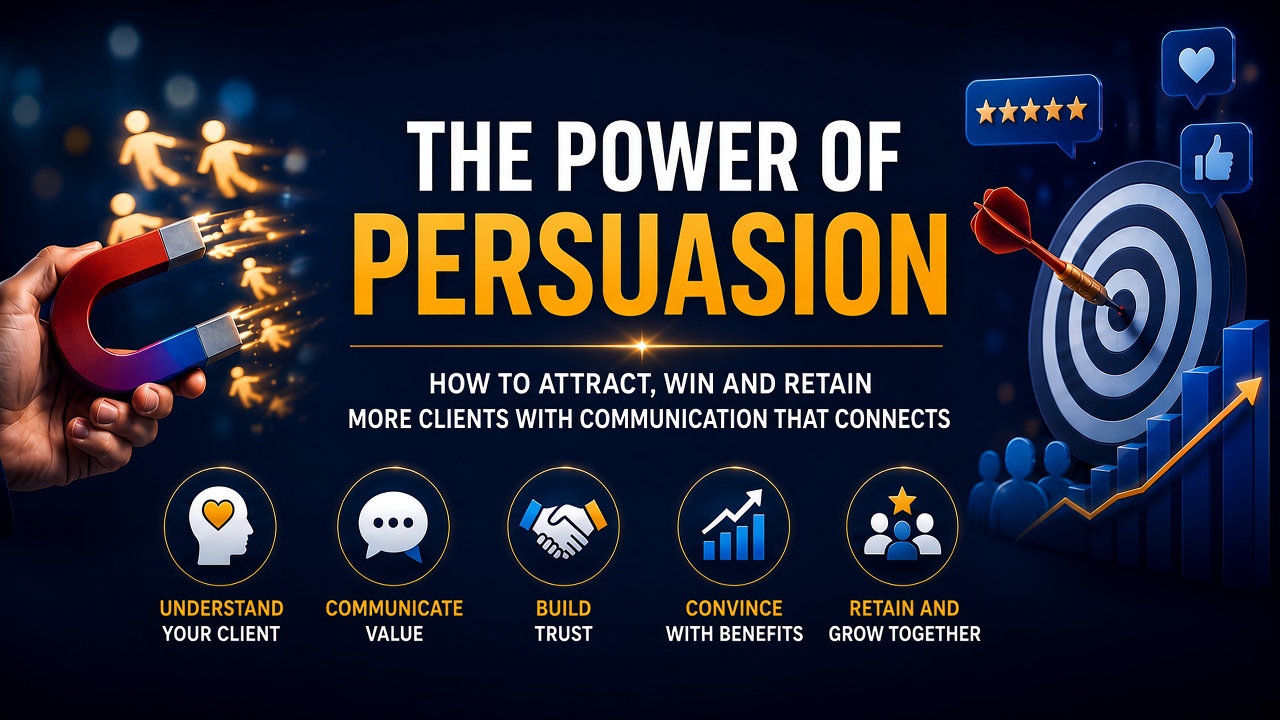
And understanding the power of persuasion can completely change the way a business attracts, wins and retains customers.
🧠 So, What Is Persuasion?
Persuasion is the ability to influence perceptions, decisions and behavior through communication.
But there is an important difference between persuasion and manipulation.
Manipulation attempts to push someone toward a decision by hiding information, exploiting vulnerabilities or creating a false perception.
Ethical persuasion is different.
It means presenting an idea, product or solution clearly and relevantly, showing the potential customer why it may make sense for them.
In other words:
Persuasion is not forcing someone to buy. It is helping someone recognize the value of what you offer.
And that is extremely important for any business owner.
🎯 Customers Don’t Just Buy Products
This is one of the first concepts every entrepreneur should understand.
People rarely buy only what is written on the package.
They buy the result they expect to achieve.
A person doesn’t buy a mattress simply because they need foam and fabric.
They buy a better night’s sleep.
Someone doesn’t buy a car simply to own four wheels and an engine.
They may be buying comfort, safety, convenience or status.
A company doesn’t hire a marketing agency simply to receive advertisements.
It wants more customers, more sales and growth.
See the difference?
The product is what you sell. The benefit is what the customer buys.
❤️ Persuasion Begins With Empathy
Before trying to convince someone, you need to understand that person.
What are their problems?
What do they want?
What worries them?
What is preventing them from making a decision?
What do they want to achieve?
The better a company understands its audience, the easier it becomes to create relevant communication.
Imagine a business owner who needs to increase sales.
You could say:
“We provide professional paid-traffic management.”
That explains the service.
But you could say:
“While you focus on running your business, we can put your offer in front of people who are already interested in what you sell.”
Now the conversation has changed.
You stopped selling a tool.
You started presenting a solution.
🔥 Pain Gets Attention
One of the most powerful elements of persuasion is showing that you understand the problem the customer is facing.
This doesn’t mean frightening or exploiting people.
It means recognizing a real need.
Imagine a security company.
It could say:
“We sell security camera systems.”
Or it could say:
“Is your business protected when you’re not there?”
The second message creates reflection.
It makes the business owner think.
And when a message makes someone stop and think, it has achieved something extremely valuable:
attention.
🌟 But Persuasion Cannot Depend Only on Pain
If you talk only about problems, you may create fear without necessarily creating trust.
After presenting the problem, you need to show that a solution exists.
And this brings us to another fundamental element:
Desire.
People don’t just want to eliminate problems.
They want to get somewhere.
They want to:
- earn more money;
- save time;
- feel safer;
- improve their appearance;
- gain freedom;
- take care of their families;
- grow professionally;
- have more comfort;
- feel valued.
Good persuasive communication connects the product or service to the future the customer wants to achieve.
🗣️ Words Can Completely Change an Offer
Compare these two sentences:
“We create professional websites.”
Now:
“We turn your online presence into a professional storefront that presents your company, builds trust and works for you even when your office is closed.”
The service may be exactly the same.
But the second message explains why it matters.
That is one of the great powers of persuasion.
It isn’t necessarily about changing the product.
It’s about changing how the value of the product is perceived.
👀 People Buy From Businesses They Trust
You may have the best offer in the market.
But if the customer doesn’t trust you, they probably won’t buy.
That’s why trust is one of the pillars of persuasion.
And trust isn’t built simply by saying:
“We are the best.”
It is built by showing evidence.
For example:
- customer reviews;
- testimonials;
- results;
- demonstrations;
- case studies;
- certifications;
- experience;
- transparency;
- guarantees when appropriate;
- professional communication.
There is a huge difference between saying:
“Our service is excellent.”
and showing:
“Here’s how we helped this customer solve this problem.”
Proof is more persuasive than empty promises.
👥 The Power of Social Proof
There is another psychological phenomenon widely used in communication:
social proof.
When we don’t know which decision to make, we often observe what other people are doing.
That is why reviews, comments, testimonials and recommendations carry so much weight.
Imagine two restaurants.
One has dozens of positive reviews.
The other has almost none.
Even without knowing either restaurant, many people will naturally feel more comfortable choosing the first.
That doesn’t mean the second restaurant is worse.
It means the first provides more signals of trust.
For a business, this is extremely important.
Every satisfied customer can become a powerful persuasion tool.
⏳ The Power of Urgency — Without False Pressure
Another well-known persuasion principle is urgency.
When we know an opportunity may disappear, we tend to pay more attention.
For example:
“Registration closes tomorrow.”
or
“Only a few units remain.”
But there is one fundamental rule:
Urgency must be real.
Creating false scarcity may generate short-term sales.
But it destroys trust in the long run.
And companies that want to build strong brands need to think beyond today’s sale.
They need to think about tomorrow’s customer.
💎 Exclusivity Can Also Be Powerful
People like to feel that they are receiving something special.
A personalized offer.
Different treatment.
An exclusive condition.
Early access.
A premium experience.
These can increase perceived value.
But again, there is a difference between creating genuine exclusivity and simply inventing a false sense of privilege.
The most powerful persuasion is the kind that still works after the customer realizes how they were persuaded.
🤝 Persuasion Doesn’t End When the Customer Buys
This may be one of the biggest mistakes businesses make.
Many think:
“We got the sale. It’s over.”
In reality, the sale may only be the beginning.
After the purchase comes the opportunity to turn a customer into:
a repeat customer → a loyal customer → a brand advocate.
How?
Delivering what was promised.
Providing good service.
Solving problems quickly.
Staying in touch.
Personalizing experiences.
Creating benefits for existing customers.
And showing that the company genuinely cares.
❤️ Customer Loyalty Is a Powerful Form of Persuasion
Imagine that you bought something from a company.
After the purchase, nobody contacts you again.
Now imagine another company that:
- asks whether you’re satisfied;
- provides support;
- remembers your preferences;
- recommends genuinely relevant products;
- solves problems quickly;
- rewards loyalty.
Which one are you more likely to choose again?
The second.
Because it didn’t simply sell.
It built a relationship.
And strong relationships make the next purchasing decision much easier.
🤖 Persuasion and Artificial Intelligence
Technology is also transforming the way businesses use persuasion.
With data and Artificial Intelligence, companies can better understand different customer groups and personalize their messages.
One customer may receive a different offer from another because they have different needs.
A visitor who abandoned a purchase can receive a specific message.
An existing customer can receive a recommendation based on previous purchases.
A potential customer can receive educational content before receiving an offer.
This makes communication more relevant.
But there is an important consideration:
Personalization should never become intrusion.
Customers should feel understood — not watched.
📱 Persuasion Is Almost Everywhere in Marketing
Think about a sales page.
The headline needs to capture attention.
The text needs to create interest.
The benefits need to create desire.
Proof needs to build trust.
The offer needs to make the decision easier.
The button needs to clearly indicate the next step.
All of this involves persuasion.
Now think about an advertisement.
You have only a few seconds to capture attention.
That’s why you need to communicate:
problem → solution → benefit → action.
The same happens on social media.
A post must compete with hundreds of other messages.
Those who understand persuasion can turn ordinary communication into communication that makes people stop and pay attention.
⚠️ Unethical Persuasion Can Destroy a Brand
This point needs to be taken seriously.
A company can use psychological techniques to sell almost anything.
But that doesn’t mean it should.
Lies.
False promises.
Fake testimonials.
False scarcity.
Manipulated results.
Hidden information.
These strategies can generate quick results.
But they can also destroy reputation.
And today, a bad reputation can spread extremely quickly.
Make a sale today and lose trust tomorrow: that’s not a good business strategy.
🏆 The Best Persuasion Is When Everyone Wins
Truly powerful communication creates a positive situation for both sides.
The company makes the sale.
The customer solves a problem or achieves a goal.
The customer is satisfied.
The company earns trust.
And there is an opportunity for another purchase.
This is the real cycle:
Attention → Interest → Trust → Decision → Experience → Loyalty
When a company masters this cycle, it becomes less dependent on constant promotions and discounts.
It starts selling value.
💡 The Business Owner Who Learns Persuasion Learns How to Communicate Value
You may have an amazing product.
You may have an extraordinary team.
You may offer an excellent service.
But if you don’t know how to communicate the value of what you do, many people simply won’t recognize it.
And that is a missed opportunity.
Persuasion isn’t about speaking louder.
It isn’t about pressure.
It isn’t about manipulation.
It’s about communicating better.
Understanding the customer.
Showing that you understand the problem.
Presenting a solution.
Demonstrating value.
Building trust.
And, most importantly, delivering what you promised.
🎯 The Question Every Business Owner Should Ask
The next time you create an advertisement, write a post, build a landing page or talk to a customer, don’t think only:
“How can I make this person buy?”
Ask:
“How can I help this person understand why my solution could be important to them?”
That small change in thinking can completely transform your communication.
Because when you stop simply trying to sell and start helping the customer make an informed decision, your message becomes much more human.
And human messages are remembered.
🌟 Conclusion: Persuasion Is About Much More Than Selling
The power of persuasion is present in almost every purchasing decision.
But its true value goes far beyond making a sale.
A business that knows how to persuade can:
capture attention;
create interest;
communicate value;
build trust;
reduce uncertainty;
make decisions easier;
win customers;
and create long-term relationships.
At the end of the day, people don’t just want to buy.
They want to feel confident that they are making a good choice.
And businesses have the opportunity to help them make that decision.
So before asking:
“How can I sell more?”
perhaps the better question is:
“How can I communicate the value I deliver more effectively?”
Because when people understand the value of what you offer, the sale stops feeling like pressure.
It becomes what it should have been from the beginning:
a good decision for both sides.